core
The core module.
Note
The following developments comply with the YAGNI principle without sacrificing any axis of generalization.
Warning
Variables’ notations only serve a distinctive purpose and will be revised.
Todo
Add MyPy-friendly type annotations.
-
class
iamax.core.DSpace(file_path: str = '', sheets_names: dict = None, year: str|int = BASE_YEAR, **kwargs: 'str')¶ Class that aggregates a bunch of attributes and methods related to the dimensionality-agnostic assimilation of the dataspace.
- Parameters
file_path (str) – Full path of the excel file to read, be it absolute or relative. Set to
''by default.year (int or str) – Location of the instance onto the (discrete) temporal line of years. Set to
BASE_YEARby default.sheets_names (dict) – Correspondences between worksheets’ internal names and their external counterpart. Set to
Noneby default.
Note
As just outlined, argument
sheets_namesconsists in a python dictionary whose i) keys relate to data’ internal names and ii) values to the arbitrary ones that users have chosen. A non-exhaustive (tabulated) list follows.sheets_names’s keyMeaning
Consumption prices
Excises values
Excisesexoneration ratesIncome privatecircuitInput costs
Input volumes
Markets drivenrentsContributive taxes
Output volumes
Output values
Average grossproducer priceAverage netproducer priceSales taxestotalsSales taxesexoneration ratesSpecific margins
Unemployedcapacities ratesPer entitymorphismIf you want to provide your
DSpaceinstance with information regarding how each datum evolve over time, you can eitherDirectly long-format your tables or
Provide your tables as wide and then create another sheet displaying (0-centered) rates of growth.
If you decide to go the second way, the instantiation argument is that of the sheet name of interest suffixed with
'_grates'. See the example below.In the exact same fashion, you can also endow your data with (an other type of) 0-centered components, suffixing with
'_drates'instead, standing ‘driving’ rates.Important
The above table is not exhaustive. To get a full list of the sheets names that can be used, you can call
display_legal_sheets_names(), refer to it.- Example
>>> system = DSpace(
...     file_path='examples/.ut(KLEM-BRICS-202006)-fr.xlsx',
...     sheets_names={
...         'input_volumes'        : "volumes intrant",
...         'input_values'         : "valeurs des intrants",
...         'markets_rents'        : "rentes économiques",
...         'producer_gross_prices': "prix bruts de production",
...         'consumer_prices'      : "prix à la consommation",
...         'output_volumes'       : "volumes extrant",
...         'contrib_taxes'        : "taxes contributives",
...         'excises_totals'       : "accises",
...         'excises_exorates'     : "taux d'éxonération d'accises",
...         'sales_taxes_totals'   : "TVA",
...         'sales_taxes_exorates' : "taux d'éxonération de TVA",
...         'specific_margins'     : "marges spécifiques",
...         'unemployment_rates'   : "surcapacités relatives",
...         'mappings'             : "entities",
...     }
... )
Echoing the advices related to growth rates, the following shows the way to go.
>>> system = DSpace(
...     file_path='examples/.ut(KLEM-BRICS-202006)-fr.xlsx',
...     sheets_names={
...         ...
...         'specific_margins': "marges spécifiques",  # Wide
...         'specific_margins_grates': "dynamique des marges",  # Long
...         ...
...     }
... )
-
classmethod
display_legal_sheets_names(cls)¶ Helper defined to display the legal arguments names to be used when getting a
DSpace(orMSystem) instance.- Example
>>> DSpace.display_legal_sheets_names()
added_values
added_values_drates
 ...
utilization_rates_transpose_grates
utilization_rates_transpose_lagged
utilization_rates_transpose_shoptr
-
property
uid(self)¶ Dataquest unique identifier.
Note
This attribute is session-stable and cross-platform.
- Example
>>> DSpace().uid
'm8fRXAF9JOrt'
-
property
_keyed_core_sheets_names(self)¶ Keyed sheets’ names whose content consist in numerical data.
Note
This attribute is not intended for public use.
- Example
>>> s = DSpace(
...     'examples/ut(KLEM-BRICS-202006)@sol.xlsx', {
...         'input_values': 'i-vals',
...         'mappings': 'entities',
...     }
... )
>>> s._keyed_core_sheets_names
{'_ivals': 'i-vals'}
-
property
_keyed_epi_sheets_names(self)¶ Keyed sheets’ names whose content consist in epi-data.
Note
This attribute is not intended for public use.
- Example
>>> s = DSpace(
...     'examples/ut(KLEM-BRICS-202006)@sol.xlsx', {
...         'input_values': 'i-vals',
...         'mappings': 'entities',
...     }
... )
>>> s._keyed_epi_sheets_names
{'mppngs': 'entities'}
-
property
_keyed_sheets_names(self)¶ Merging of
_keyed_core_sheets_namesand_keyed_epi_sheets_namesattributes.Note
This attribute is not intended for public use.
- Example
>>> s = DSpace(
...     'examples/ut(KLEM-BRICS-202006)@sol.xlsx', {
...         'input_values': 'i-vals',
...         'mappings': 'entities',
...     }
... )
>>> s._keyed_sheets_names
{'_ivals': 'i-vals', 'mppngs': 'entities'}
-
property
_named_sheets_keys(self)¶ _keyed_sheets_names’s reciprocal.Note
This attribute is not intended for public use.
- Example
>>> s = DSpace(
...     'examples/ut(KLEM-BRICS-202006)@sol.xlsx', {
...         'input_values': 'i-vals',
...         'mappings': 'entities',
...     }
... )
>>> s._named_sheets_keys
{'i-vals': '_ivals', 'entities': 'mppngs'}
-
_sheet_ids_getter(self, sheet_name_or_key: str, on_error: str = 'raise')¶ Get pairs of (public and private) names associated to a sheet’s (public or private) name.
- Parameters
Note
This method is not intended for public use.
- Example
>>> s = DSpace(
...     'examples/ut(KLEM-BRICS-202006)@sol.xlsx', {
...         'input_values': 'i-vals',
...         'mappings': 'entities',
...     }
... )
>>> s._sheet_ids_getter(
...     sheet_name_or_key='_ivals'
... )
('i-vals', '_ivals')
>>> s._sheet_ids_getter(
...     sheet_name_or_key='i-vals'
... )
('i-vals', '_ivals')
>>> s._sheet_ids_getter(
...     sheet_name_or_key='input sales', on_error='ignore'
... )
(None, None)
-
property
_grates_keys(self)¶ Growth rates variables’ private names.
Note
This attribute is not intended to be used publicly.
-
property
_grates_saturations_keys(self)¶ Growth rates saturations variables’ private names.
Note
This attribute is not intended to be used publicly.
-
property
_drates_keys(self)¶ Driving rates variables’ private names.
Note
This attribute is not intended to be used publicly.
-
property
_lagged_keys(self)¶ Lagged variables’ private names.
Note
This attribute is not intended to be used publicly.
-
property
file_as_xml_obj(self)¶ Instance of
Archiverthat concentrates all metadata that can be gathered from the instantiation input file.- Example
>>> md = DSpace(
...     'examples/ut(KLEM-BRICS-202006)@sol.xlsx',
...     sheets_names={'input_values': 'i-vals'}
... ).file_as_xml_obj['i-vals']
>>> md.keys()
dict_keys(['styles', 'comments', 'hyperlinks'])
See also
-
property
file_as_pd_obj(self)¶ Caching wrapper of
xl_file_getter()configured with a'pandas'engine.- Example
>>> DSpace(
...     'examples/ut(KLEM-BRICS-202006)@sol.xlsx',
... ).file_as_pd_obj
{
   ...
  "language": "en-US",
   ...
}
-
property
file_as_op_obj(self)¶ Caching wrapper of
xl_file_getter()configured with a'openpyxl'engine.- Example
>>> DSpace(
...     'examples/ut(KLEM-BRICS-202006)@sol.xlsx',
... ).file_as_op_obj
{
   ...
  "language": "en-US",
   ...
}
-
_close(self)¶ Close all file’s working accesses.
- Example
>>> ds = DSpace(
...     'examples/ut(KLEM-BRICS-202006)@sol.xlsx'
... )
>>> ds._close()
-
table_reader(self, sheet_name: str, **kwargs: type)¶ Augmented wrapper of
xl_ndtables_pd_reader().- Parameters
sheet_name (str) – Name of the sheet that contains data.
**kwargs (type) –
xl_ndtables_pd_reader()remaining arguments.
- Example
>>> s = DSpace(
...     'examples/ut(KLEM-BRICS-202006)@sol.xlsx',
... )
>>> df = s.table_reader(
...     sheet_name='sp-mgs', frame_addrs=True, dropna=True
... )
>>> df
               n
               z                     d                    x
           o_kle      e_kle          c    g    i          e
n a e  826457.27 -731385.37 -202822.61  0.0  0.0  107750.71
>>> df.attrs['addresses']
          n
          z         d           x
      o_kle e_kle   c   g   i   e
n a e    D4    E4  F4  G4  H4  I4
-
property
_localization(self)¶ Position of the
DSpaceinstance in hand within_localizations.- Example
>>> DSpace()._localization
MultiIndex([(2010,)],
           names=['year'])
>>> DSpace(year=1010)._localization
MultiIndex([(1010,)],
           names=['year'])
-
property
_localization_delta(self)¶ Position of the
DSpaceinstance in hand within_localizations_deltas.- Example
>>> DSpace()._localization_delta
MultiIndex([(1000.0,)],
           names=['year'])
>>> DSpace(year=1010)._localization_delta
MultiIndex([(1000.0,)],
           names=['year'])
-
property
_ilocalization(self)¶ Integer-based version of
_localization,- Example
>>> DSpace()._ilocalization
0
>>> DSpace(year=1010)._ilocalization
0
>>> s = DSpace(
...     'examples/ut(KLEM-BRICS-202006)@sol.xlsx', year=2020,
...     sheets_names={'input_volumes': 'i-vols'}
... )
>>> s._localizations
MultiIndex([(2010,),
            (2015,),
            (2020,),
            (2025,),
            (2030,),
            (2035,),
            (2040,),
            (2045,),
            (2050,)],
           names=['year'])
>>> s._localization
MultiIndex([(2020,)],
           names=['year'])
>>> s._ilocalization
2
>>> s.year = 2045
>>> s._localization
MultiIndex([(2045,)],
           names=['year'])
>>> s._ilocalization
7
-
property
_χ(self)¶ _ilocalization’s alias.
-
property
_к(self)¶ Discretized
_ilocalization’s version that qualifies the current modeling phase, betweenCalibration andRecursion.- Example
>>> DSpace()._к
'C'
-
property
t(self)¶ Yet another
_ilocalization’s alias, vanishing the generality by restricting the evolution domain of data to that of time.See also
_χ.
-
property
year(self)¶ Getter/setter specifying the position of the instance in hand onto one of the
_localizations’s dimension, i.e. that related to year.- Example
>>> DSpace().year
2010
Why
2010? RememberBASE_YEAR.>>> s = DSpace(year=1990) >>> s.year 1990 >>> s.year = 2100 >>> s._year 2100
-
property
_dlocalizations(self)¶ Differentiated version of
_localizations.See also
_dγs,delta_yearsanddyears.- Example
>>> DSpace()._dlocalizations
Array([1000.], dtype=float64)
>>> DSpace(year=1010)._dlocalizations
Array([1000.], dtype=float64)
>>> s = DSpace(
...     'examples/ut(KLEM-BRICS-202006)@sol.xlsx', year=2020,
...     sheets_names={'input_volumes': 'i-vols'}
... )
>>> s._ilocalizations
(0, 1, 2, 3, 4, 5, 6, 7, 8)
>>> s._localizations
MultiIndex([(2010,),
            (2015,),
            (2020,),
            (2025,),
            (2030,),
            (2035,),
            (2040,),
            (2045,),
            (2050,)],
           names=['year'])
>>> s._dlocalizations
Array([1000.,    5.,    5.,    5.,    5.,    5.,    5.,    5.,
          5.], dtype=float64)
-
property
_dγs(self)¶ _dlocalizations’s alias.
-
property
delta_years(self)¶ Yet another
_dlocalizations’s alias, vanishing the generality by expliciting the evolution domain of data to that of time.See also
_dγsand_dlocalizations.
-
property
dyears(self)¶ Yet another
_dlocalizations’s alias.See also
-
property
_dlocalization(self)¶ Difference between two consecutive
_localizations.See also
_dγ,delta_yearanddyear.- Example
>>> DSpace()._dlocalization
Array(1000., dtype=float64)
>>> DSpace(year=1010)._dlocalization
Array(1000., dtype=float64)
>>> s = DSpace(
...     'examples/ut(KLEM-BRICS-202006)@sol.xlsx', year=2020,
...     sheets_names={'input_volumes': 'i-vols'}
... )
>>> s._ilocalization
2
>>> s._localization
MultiIndex([(2020,)],
           names=['year'])
>>> s._dlocalization
Array(5., dtype=float64)
-
property
_dγ(self)¶ _dlocalization’s alias.
-
property
delta_year(self)¶ Yet another
_dlocalization’s alias, vanishing the generality by expliciting the evolution domain of data to that of time.See also
_dγand_dlocalization.
-
property
dyear(self)¶ Yet another
_dlocalization’s alias.See also
-
property
_raw_nodes(self)¶ Dictionary of nodes read from the tab related to entities’ technology/preference/behavior/dynamic.
- Example
>>> DSpace()._raw_nodes
[]
>>> DSpace(
...     'examples/ut(KLEM-BRICS-202006)@sol.xlsx',
...     dict(mappings='entities'),
... )._raw_nodes
[((('n', 'd', 'k'),), Node...)]
-
property
_blueprint(self, _usym: str = UNIV_SYM)¶ Largest possible data space – built over provided sheets – and rendered as
_localizations-indexed square matrices.- Parameters
_usym (str) – Unaccessible argument defined at the class level. Set to
UNIV_SYM.- Example
>>> DSpace()._blueprint
Empty DataFrame
Columns: []
Index: [(2010,)]
>>> DSpace(
...     'examples/ut(KLEM-BRICS-202006)@sol.xlsx',
...     sheets_names={'sales_taxes_totals': 's-txs-tot'}
... )._blueprint
              *    n
              *    a
              *    e    o
year
2010 * * *  0.0  0.0  0.0
     n a e  0.0  0.0  0.0
         o  0.0  0.0  0.0
>>> DSpace(
...     'examples/ut(KLEM-BRICS-202006)@sol.xlsx',
...     sheets_names={'input_volumes': 'i-vols'}
... )._blueprint.iloc[:10, :5]
              *    n
              *    a    d
              *    e    c    g    i
year
2010 * * *  0.0  0.0  0.0  0.0  0.0
     n a e  0.0  0.0  0.0  0.0  0.0
       d c  0.0  0.0  0.0  0.0  0.0
         g  0.0  0.0  0.0  0.0  0.0
         i  0.0  0.0  0.0  0.0  0.0
       m e  0.0  0.0  0.0  0.0  0.0
       x e  0.0  0.0  0.0  0.0  0.0
2015 * * *  0.0  0.0  0.0  0.0  0.0
     n a e  0.0  0.0  0.0  0.0  0.0
       d c  0.0  0.0  0.0  0.0  0.0
-
property
_loc_blueprint(self)¶ Localized version of
_blueprint.- Example
>>> DSpace()._loc_blueprint
Empty DataFrame
Columns: []
Index: []
>>> DSpace(
...     'examples/ut(KLEM-BRICS-202006)@sol.xlsx',
...     sheets_names={'sales_taxes_totals': 's-txs-tot'}
... )._loc_blueprint
         *    n
         *    a
         *    e    o
* * *  0.0  0.0  0.0
n a e  0.0  0.0  0.0
    o  0.0  0.0  0.0
-
property
_identifiers(self)¶ Label space the good-and-service’s index set \(\mcI\) (cf. Eq.1) derives from.
- Example
The identifiers space has to be representative of something, which is why we instantiate
DSpacebelow with at least one sheet, whatever it is as long as it relates to rectangular data.>>> DSpace( ... 'examples/ut(KLEM-BRICS-202006)@sol.xlsx', sheets_names={ ... 'sales_taxes_exorates': '¬%(s-txs)' ... } ... )._identifiers MultiIndex([('*', '*', '*'), ('n', 'a', 'e'), ('n', 'a', 'o'), ('n', 'x', 'e'), ('n', 'x', 'o')], )
-
property
_identifiers_space(self)¶ _identifiers’s alias.
-
property
_identifiers_exp(self)¶ Explicitly active entities’ identifiers.
- Example
>>> DSpace(
...     'examples/ut(KLEM-BRICS-202006)@sol.xlsx', sheets_names={
...         'sales_taxes_exorates': '¬%(s-txs)'
...     }
... )._identifiers_exp
MultiIndex([('n', 'a', 'e'),
            ('n', 'a', 'o'),
            ('n', 'x', 'e'),
            ('n', 'x', 'o')],
           )
-
property
_identifiers_imp(self)¶ Implicitly active entities’ identifiers.
- Example
>>> DSpace(
...     'examples/ut(KLEM-BRICS-202006)@sol.xlsx', sheets_names={
...         'mappings': 'entities',
...         'input_values': 'i-vals'
...     }
... )._identifiers_imp
MultiIndex([('n', 'b',   'b'),
            ('n', 'd',  'cg'),
            ('n', 'd', 'cgi'),
            ('n', 'd',  'ib'),
            ('n', 'd',   'l'),
            ('n', 'm',   '*'),
            ('n', 'n',   'n'),
            ('n', 'x',   '*')],
           )
-
property
_iidentifiers(self)¶ _identifiers’s index set, denoted as(1)¶\[\mcI = \{ n \mid n \in \mathbb{N} \}\]- Example
>>> DSpace(
...     'examples/ut(KLEM-BRICS-202006)@sol.xlsx', sheets_names={
...         'sales_taxes_exorates': '¬%(s-txs)'
...     }
... )._iidentifiers
(0, 1, 2, 3, 4)
-
property
_identifiers_card(self)¶ Cardinality of the label space, \(|\mcI|\).
- Example
>>> DSpace(
...     'examples/ut(KLEM-BRICS-202006)@sol.xlsx', sheets_names={
...         'sales_taxes_exorates': '¬%(s-txs)'
...     }
... )._identifiers_card
5
-
property
_identifiers_ndim(self)¶ Dimensionality of the label space.
- Example
>>> DSpace(
...     'examples/ut(KLEM-BRICS-202006)@sol.xlsx', sheets_names={
...         'sales_taxes_exorates': '¬%(s-txs)'
...     }
... )._identifiers_ndim
3
-
property
_identifiers_right_levels_range(self)¶ Identifying right levels’ integer positions.
- Example
>>> DSpace(
...     'examples/ut(KLEM-BRICS-202006)@sol.xlsx', sheets_names={
...         'sales_taxes_exorates': '¬%(s-txs)'
...     }
... )._identifiers_right_levels_range
[-3, -2, -1]
-
property
_identifiers_left_levels_range(self)¶ Identifying left levels’ integer positions.
- Example
>>> DSpace(
...     'examples/ut(KLEM-BRICS-202006)@sol.xlsx', sheets_names={
...         'sales_taxes_exorates': '¬%(s-txs)'
...     }
... )._identifiers_left_levels_range
[1, 2, 3]
-
property
_identifiers_left_loc_levels_range(self)¶ Identifying left levels’ localized integer positions.
- Example
>>> DSpace(
...     'examples/ut(KLEM-BRICS-202006)@sol.xlsx', sheets_names={
...         'sales_taxes_exorates': '¬%(s-txs)'
...     }
... )._identifiers_left_loc_levels_range
[0, 1, 2]
-
property
_identifiers_hyperplanes(self)¶ Label space’s hyperplanes.
- Example
The identifiers space has to be representative of something, which is why we instantiate
DSpacebelow with at least one sheet, whatever it is as long as it relates to rectangular data.>>> s = DSpace( ... 'examples/ut(KLEM-BRICS-202006)@sol.xlsx', sheets_names={ ... 'sales_taxes_exorates': '¬%(s-txs)' ... } ... ) >>> s._identifiers_hyperplanes[0] MultiIndex([('*',), ('n',), ('n',), ('n',), ('n',)], ) >>> s._identifiers_hyperplanes[1] MultiIndex([('*', '*'), ('n', 'a'), ('n', 'a'), ('n', 'x'), ('n', 'x')], )
Cf.
_identifiersif you haven’t already.
-
property
_univ_identifiers(self, _usym: str = UNIV_SYM)¶ Archetype of the (CSS inspired) universal index, ordered by level from
0to_identifiers_ndim.- Parameters
_usym (str) – Unaccessible argument defined at the class level. Set to
UNIV_SYM.- Example
>>> DSpace()._univ_identifiers
[Index([], dtype='object')]
>>> s = DSpace(
...     'examples/ut(KLEM-BRICS-202006)@sol.xlsx',
...     sheets_names={'sales_taxes_totals': 's-txs-tot'}
... )
>>> s._univ_identifiers[0]
MultiIndex([('*',)],
           )
>>> s._univ_identifiers[1]
MultiIndex([('*', '*')],
           )
>>> s._univ_identifiers[-1]
MultiIndex([('*', '*', '*')],
           )
-
property
_loc_univ_identifiers(self, _usym: str = UNIV_SYM)¶ Localized version of
_univ_identifiers.- Parameters
_usym (str) – Unaccessible argument defined at the class level. Set to
UNIV_SYM.- Example
>>> DSpace()._loc_univ_identifiers[0]
MultiIndex([(2010,)],
           names=['year'])
>>> s = DSpace(
...     'examples/ut(KLEM-BRICS-202006)@sol.xlsx',
...     sheets_names={'sales_taxes_totals': 's-txs-tot'}
... )
>>> s._loc_univ_identifiers[0]
MultiIndex([(2010, '*')],
           names=['year', None])
>>> s._loc_univ_identifiers[1]
MultiIndex([(2010, '*', '*')],
           names=['year', None, None])
>>> s._loc_univ_identifiers[-1]
MultiIndex([(2010, '*', '*', '*')],
           names=['year', None, None, None])
-
property
_unloc_univ_identifiers(self, _usym: str = UNIV_SYM)¶ Unlocalized version of
_univ_identifiers(not aspandas.Indexthough) defined to easily perform multi-index slicing.- Parameters
_usym (str) – Unaccessible argument defined at the class level. Set to
UNIV_SYM.- Example
>>> DSpace()._unloc_univ_identifiers[0]
(slice(None, None, None),)
>>> s = DSpace(
...     'examples/ut(KLEM-BRICS-202006)@sol.xlsx',
...     sheets_names={'sales_taxes_totals': 's-txs-tot'}
... )
>>> s._unloc_univ_identifiers[0]
(slice(None, None, None), '*')
>>> s._unloc_univ_identifiers[1]
(slice(None, None, None), '*', '*')
>>> s._unloc_univ_identifiers[-1]
(slice(None, None, None), '*', '*', '*')
-
property
_loc_univ_identifiers_inuse(self)¶ Operating localized
_univ_identifiers.- Example
>>> DSpace()._loc_univ_identifiers_inuse[0]
MultiIndex([(2010,)],
           names=['year'])
>>> s = DSpace(
...     'examples/ut(KLEM-BRICS-202006)@sol.xlsx',
...     sheets_names={'input_volumes': 'i-vols'}
... )
>>> s._loc_univ_identifiers_inuse[0]
MultiIndex([(2010, '*'),
            (2015, '*'),
            ...
            (2045, '*'),
            (2050, '*')],
           names=['year', None])
>>> s._loc_univ_identifiers_inuse[1]
MultiIndex([(2010, '*', '*'),
            (2015, '*', '*'),
            ...
            (2045, '*', '*'),
            (2050, '*', '*')],
           names=['year', None, None])
>>> s._loc_univ_identifiers_inuse[-1]
MultiIndex([(2010, '*', '*', '*'),
            (2015, '*', '*', '*'),
            ...
            (2045, '*', '*', '*'),
            (2050, '*', '*', '*')],
           names=['year', None, None, None])
-
property
_localizations(self)¶ Localization space of the modeling exercise.
- Example
>>> DSpace(year=1010)._localizations
MultiIndex([(1010,)],
           names=['year'])
>>> DSpace(
...     'examples/ut(KLEM-BRICS-202006)@sol.xlsx',
...     sheets_names={'input_volumes': 'i-vols'}
... )._localizations
MultiIndex([(2010,),
            (2015,),
            (2020,),
            (2025,),
            (2030,),
            (2035,),
            (2040,),
            (2045,),
            (2050,)],
           names=['year'])
-
property
_localizations_space(self)¶ _localizations’s alias.
-
property
_ilocalizations(self)¶ _localizations’s index set, denoted as(2)¶\[\mcL = \{ n \mid n \in \mathbb{N} \}\]- Example
>>> DSpace(
...     'examples/ut(KLEM-BRICS-202006)@sol.xlsx',
...     sheets_names={'input_volumes': 'i-vols'}
... )._ilocalizations
(0, 1, 2, 3, 4, 5, 6, 7, 8)
-
property
_localizations_card(self)¶ Cardinality of the localization space.
- Example
>>> DSpace()._localizations_card
1
>>> DSpace(
...     'examples/ut(KLEM-BRICS-202006)@sol.xlsx',
...     sheets_names={'input_volumes': 'i-vols'}
... )._localizations_card
9
-
property
_localizations_ndim(self)¶ Dimensionality of the localization space.
- Example
>>> DSpace()._localizations_ndim
1
>>> DSpace(
...     'examples/ut(KLEM-BRICS-202006)@sol.xlsx',
...     sheets_names={'input_volumes': 'i-vols'}
... )._localizations_ndim
1
-
property
_localizations_deltas(self)¶ Localization space’s coordinates’ deltas, if any, i.e. for numeric coordinates.
- Example
>>> DSpace(year=1010)._localizations_deltas
MultiIndex([(1000.0,)],
           names=['year'])
>>> DSpace(
...     'examples/ut(KLEM-BRICS-202006)@sol.xlsx',
...     sheets_names={'input_volumes': 'i-vols'}
... )._localizations_deltas
MultiIndex([(1000.0,),
            (   5.0,),
            (   5.0,),
            (   5.0,),
            (   5.0,),
            (   5.0,),
            (   5.0,),
            (   5.0,),
            (   5.0,)],
           names=['year'])
-
_register_tables(self, **kwargs: 'str|Callable')¶ Vectorized version of
_register_table().- Parameters
**kwargs (str or Callable) – Arguments to be passed to
_register_table().
Note
This method is not intended to be used publicly.
-
_register_table(self, sheet_key: str, _xuign: str = XUNK_IG_CNAME, _xusfn: str = XUNK_SF_CNAME)¶ In place gather, analyze and register all meta information associated to a given table.
- Parameters
sheet_key (str) – Internal key of the worksheet to be processed.
_xuign (str) – Private argument assigned at the class level. Set to
XUNK_IG_CNAME._xusfn (str) – Idem. Set to
XUNK_SF_CNAME.
Note
This method is not intended to be used publicly.
-
_iid_flattening_identifier(self, iid: tuple[int])¶ Map frame’s integer position to labels.
- Parameters
iid (tuple) – Sequence of integers to be processed.
- Example
>>> s = DSpace(
...     'examples/ut(KLEM-BRICS-202006)@sol.xlsx', sheets_names={
...         'sales_taxes_exorates': '¬%(s-txs)',
...     }
... )
>>> s._iid_flattening_identifier(iid=(1, 0))
('n', 'a', 'e', '*', '*', '*')
>>> s._iid_flattening_identifier(iid=(3, 3))
('n', 'x', 'e', 'n', 'x', 'e')
>>> s._iid_flattening_identifier(iid=(0, -1))
('*', '*', '*', 'n', 'x', 'o')
-
_ndarray_labeller(self, a: np.ndarray, *, dtype: type = None, localized: bool = False, undensified: bool = False, **_kws: type)¶ Label arrays into
pandas.DataFrameinstance.- Parameters
a (numpy.ndarray) – Array to be processed.
dtype (type) – Data type specifying how
acomponents should be interpreted. Set toNoneby default, which boils down to that ofa.localized (bool) – Whether data are to be rendered localized at the current position of the
DSpaceinstance (within_localizations. Set toFalseby default.undensified (bool) – Whether the labeling process involves sparsification. Set to
Falseby default.**_kws (type) – Arguments to be passed to
_ndarray_undensifier()asundensifiedisTrue.
Note
localizedbecomes inoperative asa.ndimequals 2.- Example
As explained in
_identifiers’s example section, we need at least one sheet to get something meaningful.>>> s = DSpace( ... 'examples/ut(KLEM-BRICS-202006)@sol.xlsx', sheets_names={ ... 'sales_taxes_exorates': '¬%(s-txs)', ... } ... ) >>> c = s._identifiers_card >>> mat = np.arange(c*c).reshape((1, c, c)) >>> cvec = (vec := np.arange(c)).reshape((1, c, 1)) >>> rvec = vec.reshape((1, 1, c))
>>> s._ndarray_labeller(a=mat)
             *   n
             *   a       x
             *   e   o   e   o
year
2010 * * *   0   1   2   3   4
     n a e   5   6   7   8   9
         o  10  11  12  13  14
       x e  15  16  17  18  19
         o  20  21  22  23  24
>>> s._ndarray_labeller(a=cvec)
            *
            *
            *
year
2010 * * *  0
     n a e  1
         o  2
       x e  3
         o  4
>>> s._ndarray_labeller(a=rvec)
            *  n
            *  a     x
            *  e  o  e  o
year
2010 * * *  0  1  2  3  4
>>> s._ndarray_labeller(a=rvec, localized=True)
       *  n
       *  a     x
       *  e  o  e  o
* * *  0  1  2  3  4
-
_frame_unlabeller(self, df: pd.DataFrame|None, is_v: bool = True, is_h: bool = True, dkind: str = 'f', densified: bool = False, as_jarray: bool = False)¶ _ndarray_labeller’s reciprocal.- Parameters
df (pandas.DataFrame or None) – Frame to be processed. Process
_blueprintwhenever set toNone.is_v (bool) – Whether the unlabelling process has to keep the vertical axis. Set to
Trueby default.is_h (bool) – Whether the unlabelling process has to keep the horizontal axis. Set to
Trueby default.dkind (str) – A character code identifying the general kind of data. Set to
'f'by default.densified (bool) – Whether the returned array should be dense. Set to
Falseby default.as_jarray (bool) – Whether the returned array is to be an instance of
jax.numpy.array. Set toFalseby default.
- Example
>>> s = DSpace(
...     'examples/ut(KLEM-BRICS-202006)@sol.xlsx', sheets_names={
...         'sales_taxes_exorates': '¬%(s-txs)',
...     }
... )
>>> c   = s._identifiers_card
>>> mat = np.arange(c*c).reshape((1, c, c))
>>> df  = s._ndarray_labeller(a=mat)
>>> df
             *   n
             *   a       x
             *   e   o   e   o
year
2010 * * *   0   1   2   3   4
     n a e   5   6   7   8   9
         o  10  11  12  13  14
       x e  15  16  17  18  19
         o  20  21  22  23  24
>>> s._frame_unlabeller(df)
array([[[ 0.,  1.,  2.,  3.,  4.],
        [ 5.,  6.,  7.,  8.,  9.],
        [10., 11., 12., 13., 14.],
        [15., 16., 17., 18., 19.],
        [20., 21., 22., 23., 24.]]])
>>> s._frame_unlabeller(df, is_v=False)
array([[[0., 1., 2., 3., 4.]]])
>>> s._frame_unlabeller(df, is_h=False)
array([[[ 0.],
        [ 5.],
        [10.],
        [15.],
        [20.]]])
>>> s._frame_unlabeller(df, is_v=False, is_h=False)
array([[[0.]]])
-
_ndarray_scratcher(self, copy: bool = True, unlabelled: bool = True, localized: bool = False, **kws: 'str|bool')¶ Produce
_blueprint-derived arrays.- Parameters
copy (bool) – Whether the newly created array is prohibited from referencing any previously array that would have been created with the same
kws-specific properties. Set toTrueby default.unlabelled (bool) – Whether the created array is to be returned unlabelled. Set to
Trueby default.localized (bool) – Whether data are to be rendered localized at the current position of the
DSpaceinstance (within_localizations. Inoperative whenunlabelledisTrue. Set toFalseby default.**kws (str or bool) – Arguments to be passed to
_frame_unlabeller().
- Example
>>> s = DSpace()
>>> s._ndarray_scratcher()
array([], shape=(1, 0, 0), dtype=float64)
>>> s._ndarray_scratcher(is_v=False)
array([], shape=(1, 0, 0), dtype=float64)
>>> s._ndarray_scratcher(is_h=False)
array([], shape=(1, 0, 0), dtype=float64)
>>> s._ndarray_scratcher(is_v=False, is_h=False)
array([], shape=(1, 0, 0), dtype=float64)
-
ndarray_reader(self, sheet_id: str, **kws: 'str|bool')¶ Process data read from a given worksheet as
numpy.ndarray.- Parameters
sheet_id (str) – Public or internal/private name of the worksheet to be processed.
**kws (str or bool) – Arguments to be passed to
_frame_unlabeller().
Note
This method i) may do some meta jobs such as e.g. converting the label-based locations of traced values into their integer position-based analogues and ii) is not intended to be used publicly.
- Example
>>> a = DSpace(
...     'examples/ut(KLEM-BRICS-202006)@sol.xlsx', sheets_names={
...         'producer_gross_prices': 'av-p-prices',
...         'excises_totals'       : 'exs-tot',
...     }
... ).ndarray_reader(
...     sheet_id='av-p-prices'
... )
>>> a
array([[[    0.  ,  1631.53,  1000.  ,  1543.37,   101.92,
           102.48,   103.55,  1000.  ,  2447.99,  1000.  ,
         16335.99, 18012.41, 21576.92, 24968.98,  2447.99,
          1000.  ]]])
>>> a.shape
(1, 1, 16)
-
_ndarray_reader(self, sheet_key: str, sheet_name: str = None, unlabelled: bool = True, **kws: 'str|bool')¶ Private caching underlier of
ndarray_reader().- Parameters
sheet_key (str) – Internal key of the worksheet to be processed.
sheet_name (str) – Public name of the worksheet to be processed. Set to
Noneby default.unlabelled (bool) – Whether the read array is to be returned unlabelled. Set to
Trueby default.**kws (str or bool) – Arguments to be passed to
_frame_unlabeller().
Note
This method is not intended to be used publicly.
-
property
identity_matrix(self)¶ Identity matrix of size \(|\mcI|\), denoted as
(3)¶\[\btxtI_{|\mcI|} = \left[ i \overset{?}{=} j \right], \ \forall \ \{i, j\} \in \mcI^2\]where \(\mcI\) is as defined in Eq.1.
- Example
As explained in
_identifiers’s example section, we need at least one sheet to get something meaningful.>>> s = DSpace( ... 'examples/ut(KLEM-BRICS-202006)@sol.xlsx', sheets_names={ ... 'sales_taxes_exorates': '¬%(s-txs)', ... } ... )
>>> s.identity_matrix * n * a x * e o e o * * * 1.0 0.0 0.0 0.0 0.0 n a e 0.0 1.0 0.0 0.0 0.0 o 0.0 0.0 1.0 0.0 0.0 x e 0.0 0.0 0.0 1.0 0.0 o 0.0 0.0 0.0 0.0 1.0
-
property
ones_vector(self)¶ \(|\mcI| \times 1\) vector of 1s, denoted as
(4)¶\[\mathbf{1}_{|\mcI|} = \left(1, \ldots, 1 \right)' \ \ \ \ \in \mathbb{R}^{|\mcI|}\]- Example
As explained in
_identifiers’s example section, we need at least one sheet for the sake of the illustration.>>> s = DSpace( ... 'examples/ut(KLEM-BRICS-202006)@sol.xlsx', sheets_names={ ... 'sales_taxes_exorates': '¬%(s-txs)', ... } ... )
>>> s.ones_vector * * * * * * 1.0 n a e 1.0 o 1.0 x e 1.0 o 1.0
-
property
ones_matrix(self)¶ \(|\mcI| \times |\mcI|\) matrix of 1s, denoted as
(5)¶\[\mathbf{1}_{|\mcI|^2} = \mathbf{1}_{|\mcI|} \mathbf{1}_{|\mcI|}'\]with \(\mathbf{1}_{|\mcI|}\) as in Eq.4.
- Example
As explained in
_identifiers’s example section, we need at least one sheet for the sake of the illustration.>>> s = DSpace( ... 'examples/ut(KLEM-BRICS-202006)@sol.xlsx', sheets_names={ ... 'sales_taxes_exorates': '¬%(s-txs)', ... } ... )
>>> s.ones_matrix * n * a x * e o e o * * * 1.0 1.0 1.0 1.0 1.0 n a e 1.0 1.0 1.0 1.0 1.0 o 1.0 1.0 1.0 1.0 1.0 x e 1.0 1.0 1.0 1.0 1.0 o 1.0 1.0 1.0 1.0 1.0
-
property
valued_econsumptions(self)¶ Boolean mask specifying the non-zero explicit consumptions.
Note
The inference that supports such attribute is based on
input_values.Attention
The above note boils down to saying that if no
input_valuesrelated sheet is provided, the inference won’t be performed, silently.- Example
>>> DSpace().valued_econsumptions Empty DataFrame Columns: [] Index: [] >>> d = DSpace( ... 'examples/ut(KLEM-BRICS-202006)@sol.xlsx', sheets_names={ ... 'mappings': 'entities', ... 'input_values': 'i-vals', ... }, ... ) >>> d.valued_econsumptions.loc[ ... pd.IndexSlice['n', 'a', :], ... pd.IndexSlice['n', 'd', ['c', 'g', 'i', 'cg', 'cgi']] ... ] n d c g i cg cgi n a e True False False False False o True True True False False
-
property
valued_iconsumptions(self)¶ Implicit-entities-focused version of
valued_econsumptions.Note
The inference that supports such attribute is based on
mappings_trees.Attention
The above note boils down to saying that if no
mappings_treesrelated sheet is provided, the inference won’t be performed, silently.- Example
>>> DSpace().valued_iconsumptions Empty DataFrame Columns: [] Index: [] >>> d = DSpace( ... 'examples/ut(KLEM-BRICS-202006)@sol.xlsx', sheets_names={ ... 'mappings': 'entities', ... 'input_values': 'i-vals', ... }, ... ) >>> d.valued_iconsumptions.loc[ ... pd.IndexSlice['n', 'a', :], ... pd.IndexSlice['n', 'd', ['c', 'g', 'i', 'cg', 'cgi']] ... ] n d c g i cg cgi n a e False False False True True o False False False True True
-
property
valued_consumptions(self)¶ Boolean mask specifying the non-zero explicit consumptions.
- Example
>>> DSpace().valued_consumptions Empty DataFrame Columns: [] Index: [] >>> d = DSpace( ... 'examples/ut(KLEM-BRICS-202006)@sol.xlsx', sheets_names={ ... 'mappings': 'entities', ... 'input_values': 'i-vals', ... }, ... ) >>> d.valued_consumptions.loc[ ... pd.IndexSlice['n', 'a', :], ... pd.IndexSlice['n', 'd', ['c', 'g', 'i', 'cg', 'cgi']] ... ] n d c g i cg cgi n a e True False False True True o True True True True True
-
property
consumptions_types(self)¶ Column vector of consumption qualifiers, among
Pfor primary,Ifor intermediary andFfor final.Note
The inference that supports such attribute is based on
input_values.Attention
The above note boils down to saying that if no
input_valuesrelated sheet is provided, the inference won’t be performed.- Example
>>> DSpace( ... 'examples/ut(KLEM-BRICS-202006)@sol.xlsx', ... sheets_names={'input_values': 'i-vals'}, ... ).consumptions_types * * * * * * [] n a e [F, I] o [F, I] d c [F] e [I] g [F] i [F] k [P] l1 [P] l2 [P] o [I] m e [I] o [I] x e [F] o [F] z e_kl [I] e_kle [I] o_kl [I] o_kle [I] w x e [P] o [P]
Finally, echoing the above admonitions,
>>> DSpace( ... 'examples/ut(KLEM-BRICS-202006)@sol.xlsx', ... sheets_names={'specific_margins': 'sp-mgs'}, ... ).consumptions_types * * * * * * [] n a e [] d c [] g [] i [] x e [] z e_kle [] o_kle []
Putting aside the fact that the dataspace is not the same as what it was in the previous (and non-corrupted) example, one can read above that no consumption has been qualified.
Important
Following such inference, some entities may abusively be qualified as “primary”, e.g. importations. Be that as it may, depending on how explained your productions are, some become “primary” from the system’s point of view.
-
property
are_autogenerated(self)¶ \(|\mcI| \times 1\) vector of booleans specifying whether the outputs put at stake are autogenerated. This qualification does not necessarily coincides with that of primary consumption.
(6)¶\[\btxta_{|\mcI|} = \left( q_{i} \ \text{is autogenerated}, \ldots \right)', \ \ \ \ \text{for} \ i=1, \ldots, |\mcI|\]where \(q_i\) is the produced quantity of output \(i\).
Note
The inference that supports such attribute is based on
consumptions_types.- Example
>>> s = DSpace( ... 'examples/ut(KLEM-BRICS-202006)@sol.xlsx', ... sheets_names={'input_values': 'i-vals'}, ... ) >>> s.are_autogenerated * * * * * * False n a e False o False d c False e False g False i False k True l1 True l2 True o False m e False o False x e False o False z e_kl False e_kle False o_kl False o_kle False w x e True o True
-
property
are_intermediary(self)¶ \(|\mcI| \times 1\) vector of booleans specifying whether the outputs put at stake are subject to intermediary consumption.
(7)¶\[\btxti_{|\mcI|} = \left( q_{i} \ \text{is intermediary}, \ldots \right)', \ \ \ \ \text{for} \ i=1, \ldots, |\mcI|\]where \(q_i\) is the produced quantity of output \(i\).
Note
The inference that supports such attribute is based on
consumptions_types.- Example
>>> DSpace( ... 'examples/ut(KLEM-BRICS-202006)@sol.xlsx', ... sheets_names={'input_values': 'i-vals'}, ... ).are_intermediary * * * * * * False n a e True o True d c False e True g False i False k False l1 False l2 False o True m e True o True x e False o False z e_kl True e_kle True o_kl True o_kle True w x e False o False
-
property
are_only_final(self)¶ \(|\mcI| \times 1\) vector of booleans specifying whether the outputs put at stake are only subject to final consumption.
(8)¶\[\textbf{f}_{|\mcI|} = \left( q_{i} \ \text{is final only}, \ldots \right)', \ \ \ \ \text{for} \ i=1, \ldots, |\mcI|\]where \(q_i\) is the produced quantity of output \(i\).
Note
The inference that supports such attribute is based on
consumptions_types.- Example
>>> s = DSpace( ... 'examples/ut(KLEM-BRICS-202006)@sol.xlsx', ... sheets_names={'input_values': 'i-vals'}, ... ) >>> s.are_only_final * * * * * * False n a e False o False d c True e False g True i True k False l1 False l2 False o False m e False o False x e True o True z e_kl False e_kle False o_kl False o_kle False w x e False o False
-
property
arent_only_final(self)¶ \(|\mcI| \times 1\) negated (aware) version of
are_only_final.
-
property
are_final(self)¶ \(|\mcI| \times 1\) vector of booleans specifying whether the outputs put at stake are also subject to final consumption.
Note
The inference that supports such attribute is based on
consumptions_types.- Example
>>> s = DSpace( ... 'examples/ut(KLEM-BRICS-202006)@sol.xlsx', ... sheets_names={'input_values': 'i-vals'}, ... ) >>> s.are_final * * * * * * False n a e True o True d c True e False g True i True k False l1 False l2 False o False m e False o False x e True o True z e_kl False e_kle False o_kl False o_kle False w x e False o False
-
property
are_income_private_nodes(self, _usyms: tuple[str] = {'0'}.symmetric_difference(USER_SYMS))¶ \(|\mcI| \times 1\) vector of booleans specifying whether modeled entities are active on the private income circuit.
(9)¶\[\btxtn_{|\mcI|} = \left( \obTheta + \obTheta^{'} \right) \mathbf{1}_{|\mcI|} > 0\]where \(\mathbf{1}_{|\mcI|}\) and \(\obTheta\) are as in Eq.4 and Eq.63 respectively.
Note
The inference that supports such attribute is based on
income_private_circuit.- Example
>>> s = DSpace( ... 'examples/ut(KLEM-BRICS-202006)@sol.xlsx', ... sheets_names={'income_private_circuit': 'inc-circuit'}, ... ) >>> s.are_income_private_nodes * * * * * * False n d c False g False i False m e True o True x e False o False w x e True o True
-
property
are_externally_sourced(self, _ix: int = 0)¶ \(|\mcI| \times |\mcI|\) matrix of booleans specifying whether the entities at stake are sourced outside their spatial perimeter.
(10)¶\[\btxtM_{|\mcI|} = \left( q_{i} \ \text{is sourced outside}, \ldots \right)', \ \ \ \ \text{for} \ i=1, \ldots, |\mcI|\]Note
_identifiers_ndimhas to be at least 2 for this attribute to be differentiated.Important
Spatial index is assumed to occupy the first axis of the data’s multiindex.
- Example
>>> DSpace( ... 'examples/ut(KLEM-BRICS-202006)@sol.xlsx', ... sheets_names={'input_values': 'i-vals'}, ... ).are_externally_sourced * n ... w * a ... z x * e o ... o_kle e o * * * False True True ... True True True n a e True False False ... False True True o True False False ... False True True d c True False False ... False True True e True False False ... False True True g True False False ... False True True i True False False ... False True True k True False False ... False True True l1 True False False ... False True True l2 True False False ... False True True o True False False ... False True True m e True False False ... False True True o True False False ... False True True x e True False False ... False True True o True False False ... False True True z e_kl True False False ... False True True e_kle True False False ... False True True o_kl True False False ... False True True o_kle True False False ... False True True w x e True True True ... True False False o True True True ... True False False [21 rows x 21 columns]
-
property
_loc_sparsity_map(self, _usyms: tuple[str] = USER_SYMS)¶ Label-space positioned non-zero values.
- Example
>>> DSpace()._loc_sparsity_map Empty DataFrame Columns: [] Index: []
>>> DSpace( ... 'examples/ut(KLEM-BRICS-202006).xlsx', dict( ... input_volumes = 'i-vols', ... input_values = 'i-vals', ... producer_gross_prices = 'av-p-prices', ... consumer_prices = 'c-prices', ... output_volumes = 'o-vols', ... ordinal_volumes = 'w-vols', ... contrib_taxes = 'c-txs', ... markets_rents = 'nos', ... sales_taxes_totals = 's-txs-tot', ... sales_taxes_exorates = '¬%(s-txs)', ... specific_margins = 'sp-mgs', ... available_volumes_grates = 'δ(caps)', ... available_volumes_drates = 'θ(caps)', ... income_private_circuit = 'inc-circuit', ... mappings = 'entities', ... ) ... )._loc_sparsity_map.loc[ ... pd.IndexSlice[:, 'd', :], ... pd.IndexSlice[:, 'd', :] ... ] n ... d ... c cg cgi ... l1 l2 o n d c 120 121 122 ... -1 -1 -1 cg -1 150 151 ... -1 -1 -1 cgi -1 -1 180 ... -1 -1 -1 e -1 -1 -1 ... -1 -1 -1 g 236 237 238 ... -1 -1 -1 i 265 266 267 ... -1 -1 -1 ib -1 -1 -1 ... -1 -1 -1 k -1 -1 -1 ... -1 -1 -1 l -1 -1 -1 ... -1 -1 -1 l1 -1 -1 -1 ... 390 -1 -1 l2 -1 -1 -1 ... -1 420 -1 o -1 -1 -1 ... -1 -1 450 [12 rows x 12 columns]
-
property
_loc_sparsity_map_flatten(self, _usym: str = UNIV_SYM)¶ Flatten densified version of
_loc_sparsity_map.- Example
>>> DSpace()._loc_sparsity_map_flatten Empty DataFrame Columns: [] Index: []
>>> DSpace( ... 'examples/ut(KLEM-BRICS-202006).xlsx', dict( ... input_volumes = 'i-vols', ... input_values = 'i-vals', ... producer_gross_prices = 'av-p-prices', ... consumer_prices = 'c-prices', ... output_volumes = 'o-vols', ... ordinal_volumes = 'w-vols', ... contrib_taxes = 'c-txs', ... markets_rents = 'nos', ... sales_taxes_totals = 's-txs-tot', ... sales_taxes_exorates = '¬%(s-txs)', ... specific_margins = 'sp-mgs', ... available_volumes_grates = 'δ(caps)', ... available_volumes_drates = 'θ(caps)', ... income_private_circuit = 'inc-circuit', ... mappings = 'entities', ... ) ... )._loc_sparsity_map_flatten.loc[ ... pd.IndexSlice[:, 'd', :, :, 'd', :], : ... ] * n d c n d c 120 cg 121 cgi 122 g 124 i 125 ... ... l1 n d l 389 l1 390 l2 n d l 418 l2 420 o n d o 450 [31 rows x 1 columns]
-
property
_densification_gain(self)¶ Indicate whether and how array densification is beneficial in terms of time complexity.
- Example
>>> DSpace()._densification_gain (None, 0.0)
>>> DSpace( ... 'examples/ut(KLEM-BRICS-202006).xlsx', dict( ... input_volumes = 'i-vols', ... input_values = 'i-vals', ... producer_gross_prices = 'av-p-prices', ... consumer_prices = 'c-prices', ... output_volumes = 'o-vols', ... ordinal_volumes = 'w-vols', ... contrib_taxes = 'c-txs', ... markets_rents = 'nos', ... sales_taxes_totals = 's-txs-tot', ... sales_taxes_exorates = '¬%(s-txs)', ... specific_margins = 'sp-mgs', ... available_volumes_grates = 'δ(caps)', ... available_volumes_drates = 'θ(caps)', ... income_private_circuit = 'inc-circuit', ... mappings = 'entities', ... ) ... )._densification_gain (True, 0.7871581450653984)
-
property
_ispaces_specs(self)¶ Dictionary that establishes the mapping between sparse and dense dataspaces’ properties.
- Example
>>> DSpace()._ispaces_specs {} >>> s = DSpace( ... 'examples/ut(KLEM-BRICS-202006)@sol.xlsx', sheets_names={ ... 'sales_taxes_exorates': '¬%(s-txs)', ... } ... ) >>> sorted(d := s._ispaces_specs) ['coords', 'shapes'] >>> d['shapes']['2dto3d'] {(1, 9): (1, 5, 5)} >>> d['coords']['2dto1d'] {(0, 0): (0,), ..., (3, 3): (7,), (4, 4): (8,)}
-
_ispaces_specs_getter_umpire(self, *, sheet_key: str, on_error: str = 'raise')¶ Check whether the interspace conversion has vocation to be performed for a given variable.
- Parameters
Note
This method is not intended to be used publicly.
- Example
>>> s = DSpace(
...     'examples/ut(KLEM-BRICS-202006)@sol.xlsx', sheets_names={
...         'sales_taxes_exorates': '¬%(s-txs)',
...     }
... )
>>> s._ispaces_specs_getter_umpire( ... sheet_key = 'does-not-exist', ... ) Traceback (most recent call last): ... KeyError: 'does-not-exist' >>> s._ispaces_specs_getter_umpire( ... sheet_key = 'does-not-exist', ... on_error = 'ignore', ... ) False
-
_d2s_shapes_converter(self, shape: tuple[Ellipsis|tuple[int]], **kws: str)¶ Convert dense data shapes into their sparse counterparts.
- Parameters
shape (tuple) – Shape to be converted.
**kws (str) – Keyword arguments to be passed to
_ispaces_specs_getter_umpire().
Note
This method is not intended to be used publicly.
-
_s2d_coords_converter(self, ilocs: tuple[Ellipsis|tuple[int]], expand_all: bool = False, keepdims: bool = True, amasks: tuple[int] = None, restore_all: bool = False, forced: bool = False, **kws: str)¶ Convert sparse data coordinates into their dense counterparts.
- Parameters
ilocs (tuple) – Index to be converted.
expand_all (bool) – Whether exotic slicers such as, e.g.
Ellipsisshould be resolved,ilocsbeing converted or not. Set toFalseby default.keepdims (bool) – Whether the returned coordinates should convey axes dimensionality. Set to
Trueby default.amasks (tuple) – Sequence of axis-positioning integers resolved exotic slicers must intersect with. Set to
Noneby default.restore_all (bool) – Whether exotic slicers’ (implied but) missing coordinates should be pointing to zeros. The set of missing coordinates derives from
amasksor_iidentifiers. Set toFalseby default.forced (bool) – Whether missing coordinates are to be converted as pointing to zero. This argument is inoperative as
restore_allisTrueand everted. Set toFalseby default.**kws (str) – Keyword arguments to be passed to
_ispaces_specs_getter_umpire().
Note
This method is not intended to be used publicly.
- Example
>>> DSpace(
...     'examples/ut(KLEM-BRICS-202006)@sol.xlsx', sheets_names={
...         'sales_taxes_exorates': '¬%(s-txs)',
...     }
... )._s2d_coords_converter(
...     ilocs     = (0, (1, 2), (4, 4)),
...     sheet_key = 'does-not-exist',
...     on_error  = 'ignore',
... )
(0, (3, 6))
-
_d2s_coords_converter(self, ilocs: tuple[Ellipsis|tuple[int]], **kws: str)¶ _s2d_coords_converter()’s reciprocal.- Parameters
ilocs (tuple) – Index to be converted.
**kws (str) – Keyword arguments to be passed to
_ispaces_specs_getter_umpire().
Note
YAGNI-driven, this method only deal with 1-dimensional coordinates.
-
_ndarray_densifier(self, a: np.ndarray)¶ Densify array according to
_loc_sparsity_map.- Parameters
a (numpy.ndarray) – Array to be processed.
- Example
>>> s = DSpace(
...     'examples/ut(KLEM-BRICS-202006)@sol.xlsx', dict(
...         consumer_prices = 'c-prices',
...     )
... )
>>> a = (
...     s._loc_sparsity_map
...     .to_numpy(dtype=np.int8, copy=True)[None, ...]
... )
>>> a[a<0] = 0
>>> a
array([[[ 0,  0,  0,  0,  0,  0,  0,  0,  0],
        [ 0, 10,  0, 12,  0,  0, 15, 16, 17],
        [ 0,  0, 20,  0,  0,  0,  0,  0,  0],
        [ 0,  0,  0, 30,  0,  0,  0,  0,  0],
        [ 0, 37,  0,  0, 40,  0,  0,  0,  0],
        [ 0,  0, 47,  0,  0, 50,  0,  0,  0],
        [ 0,  0,  0,  0,  0,  0, 60,  0,  0],
        [ 0,  0,  0,  0,  0,  0,  0, 70,  0],
        [ 0,  0,  0,  0,  0,  0,  0,  0, 80]]], dtype=int8)
>>> s._ndarray_densifier(a)
array([[ 0, 10, 12, 15, 16, 17, 20, 30, 37, 40, 47, 50, 60, 70,
        80]], dtype=int8)
>>> s._ndarray_densifier(np.vstack((a, -a)))
Array([[  0,  10,  12,  15,  16,  17,  20,  30,  37,  40,  47,
         50,  60,  70,  80],
       [  0, -10, -12, -15, -16, -17, -20, -30, -37, -40, -47,
        -50, -60, -70, -80]], dtype=int8)
-
_ndarray_undensifier(self, a: np.ndarray, fill_value: float|int|bool = None)¶ _ndarray_densifier()’s reciprocal.- Parameters
a (numpy.ndarray) – Array to be processed.
fill_value (float or int or bool) – Fill value. Set to
Noneby default, which boils down to filling missing positions with falsy values that have the same data type asa.
- Example
>>> s = DSpace(
...     'examples/ut(KLEM-BRICS-202006)@sol.xlsx', dict(
...         consumer_prices = 'c-prices',
...     )
... )
>>> a = -np.arange(1, 16, dtype=np.int8)[None, :]
>>> s._ndarray_undensifier(a)[:, :5, :5]
Array([[[ -1,   0,   0,   0,   0],
        [  0,  -2,   0,  -3,   0],
        [  0,   0,  -7,   0,   0],
        [  0,   0,   0,  -8,   0],
        [  0,  -9,   0,   0, -10]]], dtype=int8)
-
classmethod
copy_example(cls, dirname: str, _src: str = EXAMPLE_FDIR)¶ Make a copy of the example folder within the mentioned directory.
- Parameters
Note
The method will refuse to overwrite an existing folder.
- Example
>>> DSpace.copy_example('mrun')
Folder copied to 'mrun'
-
class
iamax.core.MSystem(*args, **kwargs)¶ 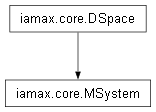
JAX-friendly class that aggregates a bunch of helpers related to the dynamic articulation of
jax.numpy.ndarrayinstances.-
property
mappings_trees(self, _usym: str = UNIV_SYM, _lbd: dict = lb.__dict__)¶ Dictionary whose first component, keyed by
'trees', consists of acollections.namedtupleinstance that provides users with autocompletion-friendly possibilities whenever wishing (in interactive mode) to browse the trees of dynamics/technologies at work within theMSysteminstance in hand.- Example
>>> s = MSystem(
...     'examples/ut(KLEM-BRICS-202006)@sol.xlsx', dict(
...         producer_gross_prices = 'av-p-prices',
...         contrib_taxes         = 'c-txs',
...         sales_taxes_exorates  = '¬%(s-txs)',
...         specific_margins      = 'sp-mgs',
...         consumer_prices       = 'c-prices',
...         output_volumes        = 'o-vols',
...         input_volumes         = 'i-vols',
...         sales_taxes_totals    = 's-txs-tot',
...         mappings              = 'entities',
...         input_values          = 'i-vals',
...     )
... )
>>> forest = s.mappings_trees['trees']
Internally handled as coordinate-like tuples, our sectors names henceforth consists of
__concatenations. Why use two underscores to perform the concatenation ? To imitate Django’s ORM’s paradigm about field lookup.For example, the domestic energy sector, keyed by
('n', 'd', 'e')is now accessible via thendeattribute name, as follows>>> (nde := forest.n__d__e).describe() (n, d, e) ← (n, a, e) (n, d, e) ← (n, z, e_kle) & (n, a, o)
>>> nde.tuid
'trHrRHT'
>>> (nde1 := nde.nodes[1]).agg_pcpt()
EDProducer[(n,d,e)←(n,z,e_kle)&(n,a,o)]
>>> nde1.agg_rule
('EDProducer', {'sigma': 0.1})
>>> nde1.exogenands
[('n', 'z', 'e_kle'), ('n', 'a', 'o')]
>>> nde1.llocs
([('n', 'z', 'e_kle'), ('n', 'a', 'o')], [('n', 'd', 'e')])
>>> s.input_values.loc[nde1.llocs]
                  n
                  d
                  e
n z e_kle  5.40e+06
  a o      1.48e+06
>>> # s._ndarray_getter('ivals')[(s.t, *nde1.lilocs)]
>>> s._ndarray_undensifier(
...     s._ndarray_getter('ivals')
... )[(s.t, *nde1.lilocs)]
Array([5403724.36, 1479126.95], dtype=float64)
See also
-
_libobj_conformity_ensurer(self, classname: str, instkws: dict[str: type], warn: bool = False, _noi: tuple[str] = ('self', 'cls', _n0i := '_'), _lbdcs=dict(ip.getmembers(sys.modules[lb.__name__], ip.isclass)), _crλ: Callable = __crλ, _ζrλ: Callable = __ζrλ, _αrλ: Callable = __αrλ, _ȥrλ: Callable = __ȥrλ, _kwf: Callable = ut.Cache._defargs_collecter, _ipf: Callable = ft.partial(ip.getmembers, predicate=ip.isfunction), _ipm: Callable = ft.partial(ip.getmembers, predicate=ip.ismethod), _ips: Callable = ip.signature, _cod: Callable = co.defaultdict, _hasχ: Callable = {*_pri2pub_para_eligible_names['χ']}.isdisjoint, _ufλ: Callable = _chked_fλ, _vfλ: Callable = _ijctd_fλ, _wfλ: Callable = _sfted_fλ, _gtr: Callable = ut.IMMixin.attrsgetter, _str: Callable = ut.IMMixin.attrssetter, _mqls: dict[tuple[int], str] = __mqls)¶ Assert the conformity of
library’s members by analyzing their signature, and return an almost-ready-to-unpack dictionary of (keyword) arguments.- Parameters
classname (str) – Name of the member to be processed.
instkws (dict) – Illustrative arguments of instantiation.
warn (bool) – Whether warnings related to methods that work in place are to be displayed. Set to
Falseby default._lbdcs (dict) – Private argument assigned at the class level. Set to
library’s class members._noi (tuple) – Idem. Set to
('self', 'cls', '_')._crλ (Callable) – To
__crλ(undocumented)._ζrλ (Callable) – To
__ζrλ(undocumented)._αrλ (Callable) – To
__αrλ(undocumented)._ȥrλ (Callable) – To
__ȥrλ(undocumented)._kwf (Callable) – To
_defargs_collecter()._ipf (Callable) – To
ft.partial(ip.getmembers, predicate=ip.isfunction)._ipm (Callable) – To
ft.partial(ip.getmembers, predicate=ip.ismethod)._ips (Callable) – To
inspect.signature()._cod (Callable) – To
collections.defaultdict._gtr (Callable) – To
attrsgetter()._str (Callable) – To
attrssetter()._mqls (dict) – To
__mqls(undocumented).
Note
This method is not intended to be used publicly.
- Example
>>> classobj, signature = MSystem()._libobj_conformity_ensurer(
...     classname='HicksianCES', instkws={'sigma': 1}
... )
>>> classobj
<class '__main__.MSystem._HicksianCES_Tekx9lrw'>
>>> MSystem._utils.otbprint(
...     o=signature, evaluable=True, on_error='ignore'
... )
{
  "allege_input_shares": {
    "args_len": 4,
    "inj_array": "",
    "is_absltd": False,
    "is_autoco": False,
    "is_clbrnd": False,
    "is_inonly": False,
    "is_magicm": False,
    "is_rooter": False,
    "is_setter": False,
    "is_wcircu": False,
    "is_χaware": False,
    "meth_kind": "λ",
    "meth_kws": {
      "input_prices": "coprcs",
      "input_prices_lagged": "coprcs_lg",
      "ioq_intensities_lagged": "_ioqins1_lg"
    },
    "meth_qual": "ŷ",
    "meth_step": "R",
    "meth_type": "I",
    "w_inplace": True
  },
  "compute_calibrand_0": {
    "args_len": 4,
    "inj_array": "",
    "is_absltd": False,
    "is_autoco": False,
    "is_clbrnd": True,
    "is_inonly": True,
    "is_magicm": False,
    "is_rooter": False,
    "is_setter": False,
    "is_wcircu": False,
    "is_χaware": False,
    "meth_kind": "λ",
    "meth_kws": {
      "input_values": "_ivals",
      "input_volumes": "ivols",
      "output_volume": "_ovols"
    },
    "meth_qual": "_",
    "meth_step": "C",
    "meth_type": "I",
    "w_inplace": True
  },
  "compute_calibrand_0_star": {
    "args_len": 5,
    "inj_array": "",
    "is_absltd": False,
    "is_autoco": False,
    "is_clbrnd": False,
    "is_inonly": False,
    "is_magicm": False,
    "is_rooter": False,
    "is_setter": False,
    "is_wcircu": False,
    "is_χaware": False,
    "meth_kind": "λ",
    "meth_kws": {
      "ioq_productivities_drates": "ioqprs1_dr",
      "ioq_productivities_drates2": "ioqprs1_dr2",
      "ioq_shares_drates": "ioqshs1_dr",
      "ioq_shares_drates2": "ioqshs1_dr2"
    },
    "meth_qual": "ŷ",
    "meth_step": "R",
    "meth_type": "I",
    "w_inplace": True
  },
  "compute_input_volumes_shocks": {
    "args_len": 2,
    "inj_array": "",
    "is_absltd": False,
    "is_autoco": False,
    "is_clbrnd": False,
    "is_inonly": False,
    "is_magicm": False,
    "is_rooter": False,
    "is_setter": False,
    "is_wcircu": False,
    "is_χaware": False,
    "meth_kind": "λ",
    "meth_kws": {
      "input_volumes_drates": "ivols_dr"
    },
    "meth_qual": "ŷ",
    "meth_step": "R",
    "meth_type": "I",
    "w_inplace": True
  },
  "compute_output_price_driver": {
    "args_len": 2,
    "inj_array": "",
    "is_absltd": False,
    "is_autoco": False,
    "is_clbrnd": False,
    "is_inonly": False,
    "is_magicm": False,
    "is_rooter": False,
    "is_setter": False,
    "is_wcircu": False,
    "is_χaware": False,
    "meth_kind": "λ",
    "meth_kws": {
      "output_price_drate": "ontprcs_dr"
    },
    "meth_qual": "ŷ",
    "meth_step": "R",
    "meth_type": "I",
    "w_inplace": True
  },
  "input_volumes_computer": {
    "args_len": 3,
    "inj_array": "",
    "is_absltd": False,
    "is_autoco": False,
    "is_clbrnd": False,
    "is_inonly": False,
    "is_magicm": False,
    "is_rooter": False,
    "is_setter": False,
    "is_wcircu": False,
    "is_χaware": False,
    "meth_kind": "λ",
    "meth_kws": {
      "input_prices": "coprcs",
      "output_volume": "_ovols"
    },
    "meth_qual": "ŷ",
    "meth_step": "R",
    "meth_type": "O",
    "tgt_array": "ivols",
    "w_inplace": False
  },
  "output_price_computer": {
    "args_len": 3,
    "inj_array": "",
    "is_absltd": False,
    "is_autoco": False,
    "is_clbrnd": False,
    "is_inonly": False,
    "is_magicm": False,
    "is_rooter": False,
    "is_setter": False,
    "is_wcircu": False,
    "is_χaware": False,
    "meth_kind": "λ",
    "meth_kws": {
      "input_prices": "coprcs",
      "output_volume": "_ovols"
    },
    "meth_qual": "ŷ",
    "meth_step": "R",
    "meth_type": "O",
    "tgt_array": "ontprcs",
    "w_inplace": False
  }
}
Conform,
HicksianCESis simply returned accompanied with a dictionary that exhibits the instructions implied by methods’ signatures. Let’s manually augmentHicksianCESwith corrupted methods,meth0andmeth1, whose names are not controlled, by opposition to those of their arguments.>>> lb.HicksianCES.meth0 = lambda unexisting0: None >>> lb.HicksianCES.meth1 = lambda unexisting0, unexisting1: None
… and see what happens.
>>> MSystem()._libobj_conformity_ensurer(
...     classname='HicksianCES', instkws={'sigma': 1}
... )
Traceback (most recent call last):
 ...
NameError: The following methods have unrecognized arguments:
--- HicksianCES.meth0: unexisting0
--- HicksianCES.meth1: unexisting0, unexisting1
>>> del lb.HicksianCES.meth0
>>> del lb.HicksianCES.meth1
-
classmethod
_libobj_paths_flattener(cls, inst: type, of_interest: tuple[type] = (), to_be_slotted: tuple[str] = (), path: str = '', _afltr: Callable = __argsfilterer, _level: int = 0)¶ Inspect a (toy) instance with the intention of using its
__class__underlier as dynamically-augmented inheritance base.- Parameters
inst (type) – Instance to be inspected.
of_interest (tuple) – Sequence of
inst’s attributes’ types to be inspected recursively. Set to()by default.to_be_slotted (tuple) – Attributes to be additionally considered as
__slots__’s member. To()by default._afltr (Callable) – Private argument assigned at the class level. To
_MSystem__argsfilterer()(undocumented).
Note
This method is not intended to be used publicly.
- Example
>>> A = type(
...     'A', (), {
...         '__init__': lambda s: (
...             setattr(s, 'attr0', 'val0')
...         )
...     }
... )
>>> B = type(
...     'B', (), {
...         '__init__': lambda s: (
...             setattr(s, 'attr0', 'val0')
...             or setattr(s, 'b_a', A())
...         )
...     }
... )
>>> C = type(
...     'C', (), {
...         '__init__': lambda s: (
...             setattr(s, 'attr0', 'val0')
...             or setattr(s, 'c_a', A())
...             or setattr(s, 'c_b', B())
...         )
...     }
... )
>>> MSystem._libobj_paths_flattener(
...     inst=C(), of_interest=['A', 'B']
... )
[({'c_a': 'A', ...}, ...), ..., (..., ['c_b.b_a.attr0'])]
-
_libobj_preparator(self, classobj: type, signatures: dict[str, dict[str, str]], lilocs: tuple[tuple[int]], kws_inst: type, node: at.Node = None, _lbdcs=dict(ip.getmembers(sys.modules[lb.__name__], ip.isclass)), _grp: Callable = ft.partial(ut.IMMixin._items_grouper, i=0), _ftp: Callable = ft.partial)¶ Instantiate a fully partialized version of the mobilized
library’s members.- Parameters
classobj (str) – Member to be processed.
signatures (dict) – Dictionary that concentrates methods’ signatures related elements of
classobj.lilocs (tuple) – Integer-based location of the scalar(s) of interest.
lilocsreads as ‘leaf integer-based location’.kws_inst (type) – Instantiation arguments to be passed to
classobj.node (anytree.Node) – Node to be passed as
classnameinstance attribute, if any. Set toNoneby default._lbdcs (dict) – Private argument assigned at the class level. Set to
library’s class members._grp (Callable) – Item. Partializes from
_items_grouper()._ftp (Callable) – Idem. To
functools.partial().
Note
This method augments
classobjwith__slots__attribute, add description-friendly attributes, etc. Moreover, it is not intended to be used publicly.See also
Cf. section A Canonical Use Case.
-
classmethod
_fancy_connecter(cls, shape: tuple[int], ilocs: tuple[tuple[int]], is_vctrzd: bool, is_dyna: bool, is_wcircu: bool, is_multiv: bool, on_lhs: bool, _infos: dict = None, _mupped: bool = False, _λgt1: Callable = (1).__lt__)¶ Change integer-based locations to make them fit the matrix-like object to be fancy-indexed.
- Parameters
shape (tuple) – Shape of the array to be fancy-indexed.
ilocs (tuple) – Integer-based location of the scalar(s) of interest.
ilocsreads as ‘integer-based locations’.is_vctrzd (int) – Whether the interrelation to be defined is vectorized.
is_dyna (bool) – Whether the interrelation to be defined is dynamic.
is_wcircu (bool) – Whether the broadcasting is actually self-dependent due to a circularly defined operand. Inoperative as soon as
shapeexhibits strict rectangularity.is_multiv (bool) – Whether the interrelation to be defined is multivariate.
on_lhs (bool) – Whether the broadcasting is performed left-hand-side. Inoperative as soon as
is_wcircu=False._infos (dict) – Private argument to be provided for debugging purpose. To
Noneby default._mupped (bool) – Private argument specifying whether advance indexes that relate to self-definitions are to be relocated as first arrays’ components. To
Falseby default._λgt1 (Callable) – Private argument assigned at the class level. Set to
(1).__lt__.
Note
This method is not intended to be used publicly. Moreover, while
shapecan relate to arrays of arbitrary dimensionality,ilocswill always be 2-dimensional.- Example
>>> kws11 = {
...     'is_vctrzd': False,
...     'is_dyna'  : True,
...     'is_wcircu': True,
...     'is_multiv': False,
...     'on_lhs'   : False,
... }
>>> MSystem._fancy_connecter(
...     shape=(4, 2, 2), ilocs=((0, 1), (0, 0)), **kws11
... )
(Ellipsis, (0, 1), (0, 0))
-
classmethod
_fancy_moveupper(cls, iloc: int, ilocs: tuple[Ellipsis|tuple[int]], drop_duplicates: bool = True, **_kws: int)¶ Recursively move up advanced indexes of interest until it acts as identity.
- Parameters
- Example
>>> MSystem._fancy_moveupper(
...     iloc=6, ilocs=((1, 1), (1, 6))
... )
((1, 1), (6, 1))
>>> MSystem._fancy_moveupper(
...     iloc=6, ilocs=((1, 6), (1, 1))
... )
((6, 1), (1, 1))
>>> MSystem._fancy_moveupper(
...     iloc=6, ilocs=((1, 6), (1, 6))
... )
((6, 1), (6, 1))
>>> MSystem._fancy_moveupper(
...     iloc=6, ilocs=((1, 1), (1, 1))
... )
((1,), (1,))
>>> MSystem._fancy_moveupper(
...     iloc=6, ilocs=(..., (1, 6))
... )
(Ellipsis, (6, 1))
>>> MSystem._fancy_moveupper(
...     iloc=6, ilocs=((1, 6), ...)
... )
((6, 1), Ellipsis)
>>> MSystem._fancy_moveupper(
...     iloc=6, ilocs=((3, 2, 1), (1, 6, 6))
... )
((1, 2, 3), (6, 6, 1))
>>> MSystem._fancy_moveupper(
...     iloc=6, ilocs=((1, 3, 2, 1), (6, 1, 6, 6))
... )
((1, 2, 3), (6, 6, 1))
>>> MSystem._fancy_moveupper(
...     iloc=6, ilocs=((1, 3, 2, 1), (6, 1, 6, 6)),
...     drop_duplicates=False
... )
((1, 2, 1, 3), (6, 6, 6, 1))
>>> MSystem._fancy_moveupper(
...     iloc=6, ilocs=(..., (6, 1, 6, 6)),
...     drop_duplicates=False
... )
(Ellipsis, (6, 6, 6, 1))
>>> MSystem._fancy_moveupper(
...     iloc=6, ilocs=(..., (6, 1, 6, 6))
... )
(Ellipsis, (6, 1))
>>> MSystem._fancy_moveupper(
...     iloc=6, ilocs=((6, 1, 6, 6), ...)
... )
((6, 1), Ellipsis)
-
classmethod
_fancy_reshaper(cls, ilocs: tuple[tuple[int]], vcard: int, ycard: int, xcard: int, incdim: bool = False, vellrep: tuple[tuple[int]] = (), transpose: bool = False, _infos: dict = None)¶ Restructure flat index tuples within a space of up to 4 dimensions.
- Parameters
ilocs (tuple[tuple[int]]) – Integer-based location to be restructured.
vcard (int) – Cardinality of the vectorization set.
xcard (int) – Cardinality of the exogenands set.
ycard (int) – Cardinality of the endogenands set.
incdim (bool) – Whether indexers’ dimensionality is to be increased by one. Set to
Falseby default.vellrep (tuple) –
Ellipsis’s vertical fancy-index explicited version. Set to()by default, in which case the method returnsilocsunprocessed.transpose (bool) – Whether the two last axes must be swaped. Set to
Falseby default.
-
classmethod
_status_inferrer(cls, arrays_mdata: dict[str, dict[str, str|bool|tuple[str]]], nosrc_teller: Callable)¶ Infer the perimeter status of array-contained data among i) endogenous
(1, 1), ii) exogenous(0, 0), iii) constrained(0, 1)and iv) disconnected(1, 0).Note
This method is not intended to be used publicly.
- Parameters
- Example
>>> MSystem._status_inferrer(
...     arrays_mdata = {'_ivals': {'f': False}},
...     nosrc_teller   = lambda k, _f=MSystem(
...         'examples/ut(KLEM-BRICS-202006)@sol.xlsx',
...         {'input_values': 'i-vals'}
...     )._ndarray_reader: _f(k) is None
... )
{(0, 0): ['_ivals']}
-
property
inferred_cstatus(self)¶ Gather the user-provided calibration data and infer their status among i) endogenous
(1, 1), ii) exogenous(0, 0), iii) constrained(0, 1)and iv) undefined/disconnected(1, 0).See also
- Example
>>> s = MSystem(
...     'examples/ut(KLEM-BRICS-202006)@sol.xlsx', {
...         'input_volumes'        : 'i-vols',
...         'input_values'         : 'i-vals',
...         'contrib_taxes'        : 'c-txs',
...         'producer_gross_prices': 'av-p-prices',
...         'consumer_prices'      : 'c-prices',
...         'output_volumes'       : 'o-vols',
...         'excises_totals'       : 'exs-tot',
...         'sales_taxes_totals'   : 's-txs-tot',
...         'sales_taxes_exorates' : '¬%(s-txs)',
...         'specific_margins'     : 'sp-mgs',
...         'mappings'             : 'entities',
...     }
... )
>>> [*s.inferred_cstatus]
[(0, 0), (0, 1), (1, (1+1j)), (1, 0), (1, 1)]
>>> s.inferred_cstatus[(0, 1)]
['_ovols', 'coprcs', 'ivols']
-
classmethod
_loss_computer(cls, z: np.ndarray, θ: np.float_, k: np.float_, s: np.float_)¶ JAX’s Autograd-friendly loss function, computed as
\[\begin{split}\begin{cases} s z^k \ \text{if} \ k > 1 \\ s |z|^k \ \text{otherwise} \end{cases}\end{split}\]where \(k\), \(s\) and \(z\) echo their argument counterpart below.
- Parameters
z (numpy.ndarray) – Array (of residuals) to be processed.
θ (float) – Scale factor.
k (float) – Order of the loss calculation, e.g. Least Absolute Deviations for
k=1..s (float) – Scale factor of the loss calculation.
Note
Distances are forced to be positive prior to exponentiation.
- Example
>>> c = MSystem
>>> z = np.array([-4], dtype=np.float_)
>>> c._loss_computer(z, k=1/3, s=3., θ=1.)
Array([4.76], dtype=float64)
>>> c._loss_computer(z, k=1/2, s=2., θ=1.)
Array([4.], dtype=float64)
>>> c._loss_computer(z, k=1., s=1., θ=1.)
Array([4.], dtype=float64)
>>> c._loss_computer(z, k=2., s=.5, θ=1.)
Array([8.], dtype=float64)
>>> c._loss_computer(z, k=3., s=1/3, θ=1.)
Array([21.33], dtype=float64)
-
classmethod
_rsaturations_computer(cls, f: np.ndarray, c: np.ndarray, θ: np.ndarray|np.float_ = 1.0)¶ JAX-friendly relative differences vector-valued computer.
(11)¶\[\mathscr{L}(\boldsymbol{f},\boldsymbol{c}) = a\,\boldsymbol{\theta}\,\left[ \left( \frac{ \boldsymbol{c}-\boldsymbol{f} }{ \sqrt{ \varepsilon^{2} + \boldsymbol{c}^{2} + \boldsymbol{f}^{2} } } \right) \odot \sqrt{ 1 + \upsilon \left| \frac{ \boldsymbol{c}-\boldsymbol{f} }{ \sqrt{ \varepsilon^{2} + \boldsymbol{c}^{2} + \boldsymbol{f}^{2} } } \right|^{2} \log\left( 1+ \boldsymbol{c}^{2} + \boldsymbol{f}^{2} \right) } \right]^k\]where \(\varepsilon\) is a regularizing offset, \(\upsilon\) is a plateau-breaking parameter and \(\theta\) an heterogeneous scale factor.
\(k\) and \(a\) are set according to
LOSSES_EXPONENTandLOSSES_FACTORrespectively.- Parameters
f (numpy.ndarray) – Array to be processed.
c (numpy.ndarray) – Constraining array.
θ (numpy.ndarray or float) – Scale factor. To
1.by default.
Important
fandcmust have the exact same shape.Note
Resort to
_loss_computer()withkandarespectively set toLOSSES_EXPONENTandLOSSES_FACTOR.- Example
>>> MSystem._rsaturations_computer(
...     f=np.array([-1., 2., -3.], dtype=np.float_),
...     c=np.array([1e9, 2., np.nan], dtype=np.float_),
... )
Array([ 1.,  0., nan], dtype=float64)
-
classmethod
_mrsaturations_computer(cls, f: np.ndarray, c: np.ndarray, m: np.ndarray, θ: np.float_ = 1.0, d: np.ndarray = None, n: np.ndarray = None, e: np.ndarray = None, o: np.ndarray = None)¶ JAX-friendly masking version of
_rsaturations_computer().- Parameters
f (numpy.ndarray) – Array to be processed.
c (numpy.ndarray) – First-level constraining array.
m (numpy.ndarray) – First-level boolean (mask) array.
θ (float) – Scale factor. To
1.by default.d (numpy.ndarray) – Second-level constraining array. Set to
Noneby default.(INOPERATIVE)n (numpy.ndarray) – Second-level boolean (mask) array. Set to
Noneby default.(INOPERATIVE)e (numpy.ndarray) – Third-level constraining array. Set to
Noneby default.(INOPERATIVE)o (numpy.ndarray) – Third-level boolean (mask) array. Set to
Noneby default.(INOPERATIVE)
Important
All provided arrays must have the exact same shape.
- Example
>>> MSystem._mrsaturations_computer(
...     f=np.array([-1., 2., -3.]),
...     c=np.array([1e9, 0., 1.]),
...     m=np.array([True, True, False]),
...     d=np.array([0., 2., 0.]),
...     n=np.array([False, True, True]),
... )
Array([1., 1., 1.], dtype=float64)
-
classmethod
_asaturations_computer(cls, f: np.ndarray, c: np.ndarray, θ: np.float_ = 1.0)¶ JAX-friendly absolute differences computer.
- Parameters
f (numpy.ndarray) – Array to be processed.
c (numpy.ndarray) – Constraining array.
θ (float) – Scale factor. To
1.by default.
Important
fandcmust have the exact same shape.Note
Resort to
_loss_computer()withk=2.- Example
>>> MSystem._asaturations_computer(
...     f=np.array([-1., 2., -3.]),
...     c=np.array([0., 2., np.nan]),
... )
Array([ 1.,  0., nan], dtype=float64)
-
classmethod
_masaturations_computer(cls, f: np.ndarray, c: np.ndarray, m: np.ndarray, θ: np.float_ = 1.0, d: np.ndarray = None, n: np.ndarray = None, e: np.ndarray = None, o: np.ndarray = None)¶ JAX-friendly absolute differences masking computer.
- Parameters
f (numpy.ndarray) – Array to be processed.
c (numpy.ndarray) – First-level constraining array.
m (numpy.ndarray) – First-level boolean (mask) array.
θ (float) – Scale factor. To
1.by default.d (numpy.ndarray) – Second-level constraining array. Set to
Noneby default.(INOPERATIVE)n (numpy.ndarray) – Second-level boolean (mask) array. Set to
Noneby default.(INOPERATIVE)e (numpy.ndarray) – Third-level constraining array. Set to
Noneby default.(INOPERATIVE)o (numpy.ndarray) – Third-level boolean (mask) array. Set to
Noneby default.(INOPERATIVE)
Important
All provided arrays must have the exact same shape.
Note
Resort to
_loss_computer()withk=2.- Example
>>> MSystem._masaturations_computer(
...     f=np.array([-1., 2., -3.]),
...     c=np.array([0., 0., 0.]),
...     m=np.array([True, True, False]),
...     d=np.array([0., 2., 0.]),
...     n=np.array([False, True, True]),
... )
Array([1., 4., 0.], dtype=float64)
-
classmethod
_aroots_computer(cls, f: np.ndarray, θ: np.float_ = 1.0)¶ JAX-friendly absolute residuals computer.
- Parameters
f (numpy.ndarray) – Array to be processed.
θ (float) – Scale factor. To
1.by default.
Note
Resort to
_loss_computer()withk=2.- Example
>>> MSystem._aroots_computer(
...     f=np.array([-1., 0., -3.], dtype=np.float_),
... )
Array([1., 0., 9.], dtype=float64)
-
classmethod
_maroots_computer(cls, f: np.ndarray, m: np.ndarray, θ: np.float_ = 1.0)¶ JAX-friendly absolute residuals masking computer.
- Parameters
f (numpy.ndarray) – Array to be processed.
m (numpy.ndarray) – Boolean mask array.
θ (float) – Scale factor. To
1.by default.
Note
Resort to
_loss_computer()withk=2.Important
fandmmust have the same shape, not asserted though.- Example
>>> MSystem._maroots_computer(
...     f=np.array([-1., 2., -3.], dtype=np.float_),
...     m=np.array([True, False, True], dtype=np.bool_),
... )
Array([ 1., nan,  9.], dtype=float64)
-
classmethod
_mabounds_computer(cls, f: np.ndarray, m: np.ndarray, θ: np.float_ = 1.0, c: float|np.ndarray = 0.0)¶ Positivity constraint formalizer.
- Parameters
f (numpy.ndarray) – Array to be processed.
m (numpy.ndarray) –
f’s mask.θ (float) – Scale factor. To
1.by default.c (float or numpy.ndarray) – Constraining value(s). Set to
.0by default.
Note
Resort to
_loss_computer()withk=2.- Example
>>> MSystem._mabounds_computer(
...     f=np.array([-1., 1., -3.], dtype=np.float_),
...     m=np.array([True, True, False])
... )
Array([10.], dtype=float64)
-
static
_ndarray_dtyping_negbooler(a: np.ndarray, _0a: np.ndarray = _0e1, _1a: np.ndarray = _1e0)¶ Convert arrays into negated binary ones, not preserving the original data type in favor of
floats.- Parameters
a (numpy.ndarray) – Array to be processed.
- Example
>>> a = ((_a := np.arange(-4, 4)) % 2 * _a).astype(np.int16)
>>> a
Array([ 0, -3,  0, -1,  0,  1,  0,  3], dtype=int16)
>>> MSystem._ndarray_dtyping_negbooler(a)
Array([1., 0., 1., 0., 1., 0., 1., 0.], dtype=float64)
-
static
_ndarray_dtyping_booler(a: np.ndarray, _0a: np.ndarray = _0e1, _1a: np.ndarray = _1e0)¶ Convert arrays into binary ones, not preserving the original data type in favor of
floats.- Parameters
a (numpy.ndarray) – Array to be processed.
- Example
>>> a = ((_a := np.arange(-4, 4)) % 2 * _a).astype(np.int16)
>>> a
Array([ 0, -3,  0, -1,  0,  1,  0,  3], dtype=int16)
>>> MSystem._ndarray_dtyping_booler(a)
Array([0., 1., 0., 1., 0., 1., 0., 1.], dtype=float64)
-
static
_ndarray_masker(a: np.ndarray, zeros_as_nans: bool = True)¶ Apply mask, dealing with argument-provided conditions.
- Parameters
a (numpy.ndarray) – Array the mask is to be applied on.
zeros_as_nans (bool) – Whether zeros must be treated as well. Set to
Trueby default.
- Example
>>> a = np.array([np.nan, 0, 1])
>>> MSystem._ndarray_masker(a, zeros_as_nans=False)
Array([False,  True,  True], dtype=bool)
>>> MSystem._ndarray_masker(a, zeros_as_nans=True)
Array([False, False,  True], dtype=bool)
-
classmethod
_ndarray_zeros_canceller(cls, a: np.ndarray, m: np.ndarray = None)¶ Replace zeros by their smallest left or right representable deviation.
- Parameters
a (numpy.ndarray) – Array to be processed.
m (numpy.ndarray) – Boolean (mask) array, shaped as
a, if any. ToNoneby default.
- Example
>>> apos = np.array([[1., 0.], [1., 1.]])
>>> MSystem._ndarray_zeros_canceller(a=apos).tolist()
[[1.0, 2.220446049250313e-16], [1.0, 1.0]]
>>> aneg = -apos
>>> MSystem._ndarray_zeros_canceller(a=aneg).tolist()
[[-1.0, -1.1102230246251565e-16], [-1.0, -1.0]]
>>> m = np.array([[1, 0], [1, 1]], dtype=np.bool_)
>>> MSystem._ndarray_zeros_canceller(a=apos, m=m).tolist()
[[1.0, 0.0], [1.0, 1.0]]
-
static
_ndarray_taker(index: int, a: np.ndarray)¶ Partialized version of
numpy.takewithmode='clip'to prevent negative indexing and/orIndexError.- Parameters
index (int) – Index of interest along axis
0.a (numpy.ndarray) – Array to be sliced. At least 2-dimensional.
- Example
>>> MSystem._ndarray_taker(
...     a=np.array([[1010]]), index=0
... )
Array([1010], dtype=int64)
>>> MSystem._ndarray_taker(
...     a=np.array([[1010]]), index=-1
... )
Array([1010], dtype=int64)
>>> MSystem._ndarray_taker(
...     a=np.array([[1010]]), index=2
... )
Array([1010], dtype=int64)
-
classmethod
_ndarrays_taker(cls, indices: (list|tuple)[int], a: np.ndarray)¶ Vectorized version of
_ndarray_taker()- Parameters
indices (list) – Sequence of indices of interest along axis
0.a (numpy.ndarray) – Array to be sliced. At least 2-dimensional.
-
classmethod
_ndarray_slicing_vals_replacer(cls, index: int, a: np.ndarray, from_: float|int, to: float|int)¶ Contingented version of
_ndarray_taker()that ultimately does the job of replacing some values of interest.- Parameters
- Example
>>> MSystem._ndarray_slicing_vals_replacer(
...     index=0, a=np.array([[[0], [1]], [[2], [3]]]),
...     from_=0, to=1
... )
Array([[1],
       [1]], dtype=int64)
-
classmethod
_ndarrays_divider(cls, n: np.ndarray, d: np.ndarray, v: float|np.ndarray = 0.0)¶ -
- Parameters
n (numpy.ndarray) – Numerator operand.
d (numpy.ndarray) – Denominator operand.
v (float or numpy.ndarray) – Value to be used to fill
float('nan')values. Set to0.by default.
- Example
>>> MSystem._ndarrays_divider(
...     n=(n := np.ones(3)),
...     d=np.zeros_like(n),
... )
Array([0., 0., 0.], dtype=float64)
Note
The method checks that operands have the same shape and throws a
ValueErrorotherwise.
-
_ndarray_getter(self, sheet_key: str, on_error: str = 'raise')¶ Pick arrays from their JAX-fed cache attribute.
- Parameters
Note
This method is not intended to be used publicly.
- Example
>>> MSystem(
...     'examples/ut(KLEM-BRICS-202006)@sol.xlsx', sheets_names={
...         'producer_gross_prices': 'av-p-prices',
...     }
... )._ndarray_getter('ogrprcs').__class__
<class 'jaxlib._jax.ArrayImpl'>
-
_xdarray_labeller(self, sheet_key: str = None, force_full_frames: bool = False, force_section_frames: bool = False, **kws: type)¶ Partialized version of
_ndarray_labeller().- Parameters
sheet_key (str) – Private name of the worksheet to be identified. Set to
Noneby default, in which caseinspect.stack()is mobilized.force_full_frames (bool) – Whether the so-identified frames are to be returned full, even if it means contradicting
frames_as_denseapandframes_as_pleated. ToFalseby default.force_section_frames (bool) – Whether the so-identified frames are to be returned as cross sections, even if it means contradicting
frames_as_tseries. ToFalseby default.**kws (type) – Arguments to be passed to
_ndarray_labeller().
-
property
are_rights_reflected(self)¶ Scalar boolean telling whether
income_private_circuitandincome_public_circuitare explicitly reflecting the property and disposal rights at work in the economy, denoted as(12)¶\[\theta^{\checkmark} := \text{false}\]See also
Note
This value is immutably set to
Falseat the class level. The possibility of negating it at the instance level is under development.- Example
>>> s = MSystem()
>>> s.are_rights_reflected
False
>>> s.are_rights_reflected = True
Traceback (most recent call last):
 ...
AttributeError: property 'are_rights_reflected' ... has no setter
-
property
added_values(self)¶ Inferred value added, \(|\mcI| \times |\mcI|\), denoted as
(13)¶\[\bV_{\Gamma} = \left( \btxta_{|\mcI|} \odot \bmcV \right) + \left( \neg\btxta_{|\mcI|} \odot \btxtI_{|\mcI|} \odot \bv_{\outau} \right)\]with \(\btxtI_{|\mcI|}\) as in Eq.3, \(\btxta_{|\mcI|}\) as in Eq.6, \(\bv_{\outau}\) as in Eq.73, \(\bmcV\) as in Eq.79.
- Example
>>> (a := MSystem(
...     'examples/ut(KLEM-BRICS-202006)@sol.xlsx', sheets_names={
...         'input_values'      : 'i-vals',
...         'contrib_taxes'     : 'c-txs',
...         'markets_rents'     : 'nos',
...         'sales_taxes_totals': 's-txs-tot',
...     }
... ).added_values).astype(int)
             n
             d                 m                 z
             e        o        e        o     e_kl      o_kl
n d e   714150        0        0        0        0         0
    k        0        0        0        0  1400597  13830565
    l1       0        0        0        0        0  18534817
    l2       0        0        0        0  1049801         0
    o        0  4269047        0        0        0         0
w x e        0        0  1301080        0        0         0
    o        0        0        0  8927231        0         0
>>> a.to_numpy().sum().item()
50027292.11496461
-
property
added_values_grates(self)¶ added_values’s rates of growth.
-
property
added_values_drates(self)¶ added_values’s driving rates.
-
property
additive_output_volumes(self)¶ Naively performed column sum of
input_volumes, \(1 \times |\mcI|\), denoted as(14)¶\[\bq = \mathbf{1}_{|\mcI|}' \bQ\]with \(\mathbf{1}_{|\mcI|}\) and \(\bQ\) as in Eq.4 and Eq.84 respectively.
Note
The expression “additive output” echoes the illegality of such an operation without the hypothesis of perfect inputs substitutability, here assumed for the sake of dimensional homogeneity.
Important
The calculations underlying this attribute do not take
consumptions_typesinto account in any way.- Example
>>> s = MSystem(
...     'examples/ut(KLEM-BRICS-202006)@sol.xlsx', sheets_names={
...         'input_values'         : 'i-vals',
...         'contrib_taxes'        : 'c-txs',
...         'producer_gross_prices': 'av-p-prices',
...         'sales_taxes_totals'   : 's-txs-tot',
...         'sales_taxes_exorates' : '¬%(s-txs)',
...     }
... )
>>> s.additive_output_volumes.T
                   *
                   *
                   *
n a e        5453.82
    o      124377.95
  d c       14173.55
    e        1760.49
    g        5131.71
    i       20133.35
    o       74299.04
  m e         531.49
    o        8927.23
  x e         142.44
    o       11081.45
  z e_kl    23879.86
    e_kle    1953.18
    o_kl   316569.90
    o_kle    4606.58
Which shows the transpose of \(\bq\).
-
property
additive_output_volumes_grates(self)¶ additive_output_volumes’s rates of growth.
-
property
additive_output_volumes_drates(self)¶ additive_output_volumes’s driving rates.
Naively computed shares of
input_volumes, \(|\mcI| \times |\mcI|\), denoted aswith \(\mathbf{1}_{|\mcI|^2}\), \(\bQ\) and \(\bq\) respectively as in Eq.5, Eq.84 and Eq.14.
See also
Attribute
additive_output_volumes.- Example
>>> MSystem(
...     'examples/ut(KLEM-BRICS-202006)@sol.xlsx', sheets_names={
...         'input_values'         : 'i-vals',
...         'contrib_taxes'        : 'c-txs',
...         'producer_gross_prices': 'av-p-prices',
...         'sales_taxes_totals'   : 's-txs-tot',
...         'sales_taxes_exorates' : '¬%(s-txs)',
...     }
... ).additive_input_volumes_shares
             n              ...
             a           d  ...     z
             e     o     c  ... e_kle  o_kl o_kle
n a e      0.0  0.00  0.03  ...  0.92  0.00  0.67
    o      0.0  0.00  0.97  ...  0.00  0.00  0.00
  d e      0.9  0.00  0.00  ...  0.00  0.00  0.00
    k      0.0  0.00  0.00  ...  0.00  0.43  0.00
    l1     0.0  0.00  0.00  ...  0.00  0.57  0.00
    l2     0.0  0.00  0.00  ...  0.00  0.00  0.00
    o      0.0  0.93  0.00  ...  0.00  0.00  0.00
  m e      0.1  0.00  0.00  ...  0.00  0.00  0.00
    o      0.0  0.07  0.00  ...  0.00  0.00  0.00
  z e_kl   0.0  0.00  0.00  ...  0.08  0.00  0.00
    e_kle  0.0  0.00  0.00  ...  0.00  0.00  0.00
    o_kl   0.0  0.00  0.00  ...  0.00  0.00  0.33
    o_kle  0.0  0.00  0.00  ...  0.00  0.00  0.00
w x e      0.0  0.00  0.00  ...  0.00  0.00  0.00
    o      0.0  0.00  0.00  ...  0.00  0.00  0.00

[15 rows x 15 columns]
additive_input_volumes_shares’s rates of growth.
additive_input_volumes_shares’s driving rates.
-
property
aggregated_input_volumes(self)¶ Input total volumes, \(|\mcI| \times 1\), denoted as
(16)¶\[\bq^{T} = \bq^{'}\]with \(\bq\) as in Eq.129.
- Example
>>> s = MSystem(
...     'examples/ut(KLEM-BRICS-202006)@sol.xlsx', sheets_names={
...         'input_values'         : 'i-vals',
...         'contrib_taxes'        : 'c-txs',
...         'producer_gross_prices': 'av-p-prices',
...         'sales_taxes_totals'   : 's-txs-tot',
...         'sales_taxes_exorates' : '¬%(s-txs)',
...     }
... )
>>> s.aggregated_input_volumes
                   *
                   *
                   *
n a e        5453.82
    o      124377.95
  d e        4922.33
    k      149440.83
    l1     180871.06
    l2      10137.87
    o      115450.72
  m e         531.49
    o        8927.23
  z e_kl      150.00
    e_kle     300.00
    o_kl     1500.00
    o_kle    1500.00
w x e         531.49
    o        8927.23
-
property
aggregated_input_volumes_grates(self)¶ aggregated_input_volumes’s rates of growth.
-
property
aggregated_input_volumes_drates(self)¶ aggregated_input_volumes’s driving rates.
-
property
available_values(self)¶ Available values, \(1 \times |\mcI|\), denoted as
(17)¶\[\hbv = \hbq \odot \ubp\]with \(\hbq\) and \(\ubp\) respectively as in Eq.18 and Eq.133.
-
property
available_values_grates(self)¶ available_values’s rates of growth.
-
property
available_values_drates(self)¶ available_values’s driving rates.
-
property
available_volumes(self)¶ Available volumes, be them market-internalized or not, \(1 \times |\mcI|\), denoted as
(18)¶\[\hbq = \frac{\bq}{1 - \btau_{\neg\hq}}\]with \(\bq\) and \(\btau_{\neg\hq}\) respectively as in Eq.129 and Eq.171.
Note
In the case of market-internalized quantities, this attribute consists of their supply.
- Example
>>> s = MSystem(
...     'examples/ut(KLEM-BRICS-202006)@sol.xlsx', {
...         'mappings'                 : 'entities',
...         'input_values'             : 'i-vals',
...         'output_volumes'           : 'o-vols',
...         'unemployment_rates'       : 'u-rates',
...         'unemployment_rates_shoptr': 'η(u-rates)',
...         'producer_gross_prices'    : 'av-p-prices',
...         'available_volumes_grates' : 'δ(caps)',
...         'available_volumes_drates' : 'θ(caps)',
...     }
... )
>>> s.employed_volumes.xs('l1', axis=1, level=2)
               n
               d
* * *  180871.06
>>> s.available_volumes.xs('l1', axis=1, level=2)
               n
               d
* * *  189390.59
Which value is the active population, i.e. pop1 if we had to name it consistently.
-
property
supplies(self)¶ Yet another
available_volumes’s alias.
-
property
available_volumes_grates(self)¶ available_volumes’s rates of growth.
-
property
available_volumes_drates(self)¶ available_volumes’s driving rates.
-
property
available_volumes_underliers(self)¶ Available volumes underliers, e.g. primitive of any sort, such as stocks, or else, be them market-internalized or not, \(1 \times |\mcI|\), denoted as
(19)¶\[\hubq = \left(\huq_1, \ldots, \huq_{|\mcI|}\right)\]where \(\huq_{i=1, \ldots, |\mcI|}\) is the underlier of available volume \(i\).
See also
Attribute
available_volumes.
-
property
supplies_underliers(self)¶ Yet another
available_volumes_underliers’s alias.
-
property
available_volumes_underliers_grates(self)¶ available_volumes_underliers’s rates of growth.
-
property
available_volumes_underliers_drates(self)¶ available_volumes_underliers’s driving rates.
-
property
consumed_volumes(self)¶ Input volumes, \(|\mcI| \times |\mcI|\), denoted as
(20)¶\[\bQ^{T} = \bQ^{'}\]with \(\bQ\) as in Eq.84.
- Example
>>> s = MSystem(
...     'examples/ut(KLEM-BRICS-202006)@sol.xlsx', sheets_names={
...         'input_values'         : 'i-vals',
...         'contrib_taxes'        : 'c-txs',
...         'producer_gross_prices': 'av-p-prices',
...         'sales_taxes_totals'   : 's-txs-tot',
...         'sales_taxes_exorates' : '¬%(s-txs)',
...         'specific_margins'     : 'sp-mgs',
...     }
... )
>>> s.consumed_volumes.loc[:, pd.IndexSlice['n', 'a', :]]
                 n
                 a
                 e         o
n a e         0.00      0.00
    o         0.00      0.00
  d c       525.94  13771.93
    e         0.00   1460.49
    g         0.00   5131.71
    i         0.00  20133.35
    o         0.00  72799.04
  m e         0.00      0.00
    o         0.00      0.00
  x e        76.40      0.00
    o         0.00  11081.45
  z e_kl      0.00      0.00
    e_kle  2251.46      0.00
    o_kl      0.00      0.00
    o_kle  2600.03      0.00
-
property
consumed_volumes_grates(self)¶ consumed_volumes’s rates of growth.
-
property
consumed_volumes_drates(self)¶ consumed_volumes’s driving rates.
-
property
consumed_volumes_iparts(self)¶ consumed_volumes’s imaginary part.
-
property
consumer_prices(self)¶ Consumer prices, \(|\mcI| \times |\mcI|\), denoted as
(21)¶\[\tbP = \cbP \odot \left(1 + ... + ... \right) \odot (1 + \ubtau + \jbtau + \cbtau) \odot (1 + \hbtau)\]where \(\cbP\), \(\ubtau\), \(\jbtau\), \(\cbtau\) and \(\hbtau\) are respectively as in Eq.134, Eq.153, Eq.166, Eq.51 and Eq.144 respectively.
- Example
>>> s = MSystem(
...     'examples/ut(KLEM-BRICS-202006)@sol.xlsx', sheets_names={
...         'producer_gross_prices': 'av-p-prices',
...     }
... )
>>> s.consumer_prices  # .loc[:, pd.IndexSlice['n', 'a', :]]
Empty DataFrame
Columns: []
Index: []
The above frame is empty because of no input values being considered.
-
property
input_prices(self)¶ consumer_prices’s alias.
-
property
consumer_prices_grates(self)¶ consumer_prices’s rates of growth.
-
property
consumer_prices_drates(self)¶ consumer_prices’s driving rates.
-
property
consumer_prices_iparts(self)¶ consumer_prices’s imaginary part.
-
property
consumer_real_prices(self)¶ Consumer real prices, \(|\mcI| \times |\mcI|\), denoted as
(22)¶\[\tbmfP = \frac{\tbP}{ \mathbf{1}_{|\mcI|^2} \odot \bmfp_{\text{F}}^{'} }\]with \(\tbP\), \(\mathbf{1}_{|\mcI|^2}\) and \(\bmfp_{\text{F}}\) as in Eq.21, Eq.5 and Eq.31 respectively.
-
property
input_real_prices(self)¶ consumer_real_prices’s alias.
-
property
consumer_real_prices_grates(self)¶ consumer_real_prices’s rates of growth.
-
property
consumer_real_prices_drates(self)¶ consumer_real_prices’s driving rates.
-
property
consumer_real_prices_iparts(self)¶ consumer_real_prices’s imaginary part.
-
property
contrib_taxes(self)¶ Contributive taxes totals, \(1 \times |\mcI|\), denoted as
(23)¶\[\bv_{\otau} = \left( v_{\otau, 1}, \ldots, v_{\otau, |\mcI|} \right)\]- Example
>>> s = MSystem(
...     'examples/ut(KLEM-BRICS-202006)@sol.xlsx',
...     sheets_names={'contrib_taxes': 'c-txs'}
... )
>>> s.contrib_taxes
               n
               d
               e         l1        l2         o
* * *  698745.92  447712.07  36014.71  4.24e+06
-
property
contrib_taxes_grates(self)¶ contrib_taxes’s rates of growth.
-
property
contrib_taxes_drates(self)¶ contrib_taxes’s driving rates.
-
property
contrib_taxes_bdown(self)¶ Allocated contributive taxes, \(|\mcI| \times |\mcI|\), denoted as
(24)¶\[\bV_{\otau} = \left( \bbeta \odot \bv_{\otau} \right)^{'}\]where \(\bv_{\otau}\) and \(\bbeta\) respectively as in Eq.23 and Eq.95.
- Example
>>> s = MSystem(
...     'examples/ut(KLEM-BRICS-202006)@sol.xlsx', sheets_names={
...         'mappings'             : 'entities',
...         'input_values'         : 'i-vals',
...         'contrib_taxes'        : 'c-txs',
...         'producer_gross_prices': 'av-p-prices',
...         'sales_taxes_totals'   : 's-txs-tot',
...         'sales_taxes_exorates' : '¬%(s-txs)',
...         'specific_margins'     : 'sp-mgs',
...     }
... )
>>> s.contrib_taxes_bdown
                n
                a                   z
                e         o      e_kl       o_kl
n d e   698745.92  0.00e+00      0.00       0.00
    l1       0.00  0.00e+00      0.00  447712.07
    l2       0.00  0.00e+00  36014.71       0.00
    o        0.00  4.24e+06      0.00       0.00
-
property
contrib_taxes_bdown_grates(self)¶ contrib_taxes_bdown’s rates of growth.
-
property
contrib_taxes_bdown_drates(self)¶ contrib_taxes_bdown’s driving rates.
-
property
contrib_taxes_rates(self)¶ Contributive taxes (margin) rates, \(1 \times |\mcI|\), denoted as
(25)¶\[\obtau = \frac{\bv_{\otau}}{\cbv_{q}}\]where \(\bv_{\otau}\) and \(\cbv_{q}\) are as described in Eq.23 and Eq.56 respectively.
- Example
>>> s = MSystem(
...     'examples/ut(KLEM-BRICS-202006)@sol.xlsx', sheets_names={
...         'input_values'      : 'i-vals',
...         'contrib_taxes'     : 'c-txs',
...         'sales_taxes_totals': 's-txs-tot',
...     }
... )
>>> s.contrib_taxes_rates.map("{:.2%}".format)
           n
           d
           e     l1     l2      o
* * *  9.20%  2.42%  3.43%  3.67%
-
property
contrib_taxes_rates_grates(self)¶ contrib_taxes_rates’s rates of growth.
-
property
contrib_taxes_rates_drates(self)¶ contrib_taxes_rates’s driving rates.
-
property
corpo_income_taxes(self)¶ Corporate income taxes, \(1 \times |\mcI|\), denoted as
(26)¶\[\gbv^{\mfc} = \gbtau^{\mfc} \odot \bv_{\oupi}\]with \(\gbtau^{\mfc}\) as in Eq.27 and \(\bv_{\oupi}\) as in Eq.116.
-
property
corpo_income_taxes_grates(self)¶ corpo_income_taxes’s rates of growth.
-
property
corpo_income_taxes_drates(self)¶ corpo_income_taxes’s driving rates.
-
property
corpo_income_taxes_rates(self)¶ Corporate income taxes rates, \(1 \times |\mcI|\), denoted as
(27)¶\[\gbtau^{\mfc} = \left( \gtau^{\mfc}_1, \ldots, \gtau^{\mfc}_{|\mcI|} \right)\]where \(\gtau^{\mfc}_{i=1, \ldots, |\mcI|}\) is the tax rate at work on entity \(i\)’s net operating surplus.
-
property
corpo_income_taxes_rates_grates(self)¶ corpo_income_taxes_rates’s rates of growth.
-
property
corpo_income_taxes_rates_drates(self)¶ corpo_income_taxes_rates’s driving rates.
-
property
custom_qois(self)¶ User-defined quantities of interests, \(1 \times |\mcI|\), denoted as
(28)¶\[\obxi = \left(\oxi_1, \ldots, \oxi_{|\mcI|}\right)\]where \(\oxi_{i=1, \ldots, |\mcI|}\) is the custom quantity associated to entity \(i\).
-
property
transitories(self)¶ custom_qois’s alias.
-
property
user_statistics(self)¶ Yet another
custom_qois’s alias.
-
property
custom_qois_grates(self)¶ custom_qois’s rates of growth.
-
property
custom_qois_drates(self)¶ custom_qois’s driving rates.
-
property
custom_sois(self)¶ Yet another user-defined vector of statistics of interests, \(1 \times |\mcI|\), denoted as
(29)¶\[\obxi^{\text{ii}} = \left( \oxi^{\text{ii}}_1, \ldots, \oxi^{\text{ii}}_{|\mcI|} \right)\]where \(\oxi^{\text{ii}}_{i=1, \ldots, |\mcI|}\) is the custom statistic associated to entity \(i\).
-
property
custom_sois_grates(self)¶ custom_sois’s rates of growth.
-
property
custom_sois_drates(self)¶ custom_sois’s driving rates.
-
property
custom_vois(self)¶ Yet another user-defined vector of values of interests, \(1 \times |\mcI|\), denoted as
(30)¶\[\obxi^{\text{iii}} = \left( \oxi^{\text{iii}}_1, \ldots, \oxi^{\text{iii}}_{|\mcI|} \right)\]where \(\oxi^{\text{iii}}_{i=1, \ldots, |\mcI|}\) is the custom value associated to entity \(i\).
-
property
custom_vois_grates(self)¶ custom_vois’s rates of growth.
-
property
custom_vois_drates(self)¶ custom_vois’s driving rates.
-
property
deflators_fisher(self)¶ Base-year starting Fisher deflators, \(|\mcI| \times 1\), denoted as
(31)¶\[\bmfp_{\text{F},t} = \prod_{t'=0}^t \bmfp_{\text{F}_\ell, t'}\]with \(\bmfp_{\text{F}_\ell}\) as in Eq.33.
-
property
deflators_fisher_grates(self)¶ deflators_fisher’s rates of growth.
-
property
deflators_fisher_drates(self)¶ deflators_fisher’s driving rates.
-
property
deflators_laspeyres(self)¶ Base-year starting Laspeyres deflators, \(|\mcI| \times 1\), denoted as
(32)¶\[\bmfp_{\text{L},t} = \prod_{t'=0}^t \bmfp_{\text{L}_\ell, t'}\]with \(\bmfp_{\text{L}_\ell}\) as in Eq.34.
-
property
deflators_laspeyres_grates(self)¶ deflators_laspeyres’s rates of growth.
-
property
deflators_laspeyres_drates(self)¶ deflators_laspeyres’s driving rates.
-
property
deflators_lfisher(self)¶ dyear-lagged Fisher deflators, \(|\mcI| \times 1\), denoted as(33)¶\[\bmfp_{\text{F}_\ell} = \sqrt{\bmfp_{\text{F}_\ell^2}}\]with \(\bmfp_{\text{F}_\ell^2}\) as in Eq.37.
-
property
deflators_lfisher_grates(self)¶ deflators_lfisher’s rates of growth.
-
property
deflators_lfisher_drates(self)¶ deflators_lfisher’s driving rates.
-
property
deflators_llaspeyres(self)¶ dyear-lagged Laspeyres deflators, \(|\mcI| \times 1\), denoted as(34)¶\[\bmfp_{\text{L}_\ell,t}^{'} = \frac{\bmcv_{\text{CW}_\ell,t}}{\bmcv_{t-1}}\]with \(\bmcv_{\text{CW}_\ell}\) and \(\bmcv\) as in Eq.158 and Eq.155 respectively.
-
property
deflators_llaspeyres_grates(self)¶ deflators_llaspeyres’s rates of growth.
-
property
deflators_llaspeyres_drates(self)¶ deflators_llaspeyres’s driving rates.
-
property
deflators_lpaasche(self)¶ dyear-lagged Paasche deflators, \(|\mcI| \times 1\), denoted as(35)¶\[\bmfp_{\text{P}_\ell}^{'} = \frac{\bmcv}{\bmcv_{\text{BW}_\ell}}\]with \(\bmcv\) and \(\bmcv_{\text{BW}_\ell}\) as in Eq.155 and Eq.157 respectively.
-
property
deflators_lpaasche_grates(self)¶ deflators_lpaasche’s rates of growth.
-
property
deflators_lpaasche_drates(self)¶ deflators_lpaasche’s driving rates.
-
property
deflators_paasche(self)¶ Base-year starting Paasche deflators, \(|\mcI| \times 1\), denoted as
(36)¶\[\bmfp_{\text{P},t} = \prod_{t'=0}^t \bmfp_{\text{P}_\ell, t'}\]with \(\bmfp_{\text{P}_\ell}\) as in Eq.35.
-
property
deflators_paasche_grates(self)¶ deflators_paasche’s rates of growth.
-
property
deflators_paasche_drates(self)¶ deflators_paasche’s driving rates.
-
property
deflators_sq_lfisher(self)¶ dyear-lagged squared Fisher deflators, \(|\mcI| \times 1\), denoted as(37)¶\[\bmfp_{\text{F}_\ell^2} = \bmfp_{\text{P}_\ell} \bmfp_{\text{L}_\ell}\]with \(\bmfp_{\text{P}_\ell}\) as in Eq.35 and \(\bmfp_{\text{L}_\ell}\) as in Eq.34.
-
property
deflators_sq_lfisher_grates(self)¶ deflators_sq_lfisher’s rates of growth.
-
property
deflators_sq_lfisher_drates(self)¶ deflators_sq_lfisher’s driving rates.
-
property
direct_taxes(self)¶ Direct taxes, \(1 \times |\mcI|\), denoted as
(38)¶\[\gbv = \gbv^{\mfi} + \gbv^{\mfc}\]with \(\gbv^{\mfi}\) as in Eq.77 and \(\gbv^{\mfc}\) as in Eq.26.
-
property
direct_taxes_grates(self)¶ direct_taxes’s rates of growth.
-
property
direct_taxes_drates(self)¶ direct_taxes’s driving rates.
-
property
disposable_incomes(self)¶ Disposable incomes, \(1 \times |\mcI|\), denoted as
(39)¶\[\bmcr = \obmcr - \gbv^{\mfi}\]with \(\obmcr\) as in Eq.55 and \(\gbv^{\mfi}\) as in Eq.77.
-
property
budget_constraints(self)¶ disposable_incomes’s alias.
-
property
disposable_incomes_grates(self)¶ disposable_incomes’s rates of growth.
-
property
disposable_incomes_drates(self)¶ disposable_incomes’s driving rates.
-
property
disposable_incomes_transpose(self)¶ Transposed version of disposable incomes, \(|\mcI| \times 1\), denoted as
(40)¶\[\bmcr^{T} = \bmcr^{'}\]with \(\bmcr\) as in Eq.39.
-
property
budget_constraints_transpose(self)¶ disposable_incomes_transpose’s alias.
-
property
disposable_incomes_transpose_grates(self)¶ disposable_incomes_transpose’s rates of growth.
-
property
disposable_incomes_transpose_drates(self)¶ disposable_incomes_transpose’s driving rates.
-
property
disposable_real_incomes(self)¶ Disposable incomes, \(1 \times |\mcI|\), denoted as
(41)¶\[\bmfr = \frac{\bmcr}{\bmfp_{\text{F},t}^{'}}\]with \(\bmcr\) as in Eq.39 and \(\bmfp_{\text{F},t}\) as in Eq.31.
-
property
disposable_real_incomes_grates(self)¶ disposable_real_incomes’s rates of growth.
-
property
disposable_real_incomes_drates(self)¶ disposable_real_incomes’s driving rates.
-
property
employment_rates(self)¶ Employed capacities rates, \(1 \times |\mcI|\), denoted as
(42)¶\[\btau_{\hq} = \mathbf{1}_{|\mcI|}^{'} - \btau_{\neg\hq}\]with \(\mathbf{1}_{|\mcI|}\) and \(\btau_{\neg\hq}\) as in Eq.4 and Eq.171 respectively.
- Example
>>> MSystem(
...     'examples/ut(KLEM-BRICS-202006)@sol.xlsx', {
...         'unemployment_rates'       : 'u-rates',
...         'unemployment_rates_shoptr': 'η(u-rates)',
...     }
... ).employment_rates.loc[
...     :, pd.IndexSlice[:, :, ['l1', 'l2']]
... ].map("{:.1%}".format)
           n
           d
          l1     l2
* * *  95.5%  95.5%
-
property
employment_rates_grates(self)¶ employment_rates’s rates of growth.
-
property
employment_rates_drates(self)¶ employment_rates’s driving rates.
-
property
excisables(self)¶ Excisable volumes, \(|\mcI| \times |\mcI|\), denoted as
(43)¶\[\cbQ_{\ctau} = \left(\mathbf{1}_{|\mcI|^2} - \bR_{\neg \ctau}\right) \odot \frac{\ubV_{\htau} - \bV_{\utau} - \bV_{\jtau}}{\cbP}\]with \(\mathbf{1}_{|\mcI|^2}\) as in Eq.5, \(\bR_{\neg \ctau}\) as in Eq.49, \(\ubV_{\htau}\) as in Eq.142, \(\bV_{\utau}\) as in Eq.150, \(\bV_{\jtau}\) as in Eq.163 and \(\cbP\) as in Eq.134.
-
property
excisables_grates(self)¶ excisables’s rates of growth.
-
property
excisables_drates(self)¶ excisables’s driving rates.
Excisable shares, \(|\mcI| \times |\mcI|\), denoted as
with \(\cbQ_{\ctau}\) as in Eq.43, \(\cbq_{\ctau,\Sigma}\) as in Eq.45 and \(\mathbf{1}_{|\mcI|^2}\) as in Eq.5.
excisables_shares’s rates of growth.
excisables_shares’s driving rates.
-
property
excisables_totals(self)¶ Excisable volumes totals, \(|\mcI| \times 1\), denoted as
(45)¶\[\cbq_{\ctau,\Sigma} = \cbQ_{\ctau} \mathbf{1}_{|\mcI|}\]with \(\cbQ_{\ctau}\) and \(\mathbf{1}_{|\mcI|}\) as in Eq.43 and Eq.4.
-
property
excisables_totals_grates(self)¶ excisables_totals’s rates of growth.
-
property
excisables_totals_drates(self)¶ excisables_totals’s driving rates.
-
property
excises(self)¶ Excises values, \(|\mcI| \times |\mcI|\), denoted as
(46)¶\[\bV_{\ctau} = \bv_{\ctau} \odot \cbQ_{\ctau,\%}\]with \(\bv_{\ctau}\) as in Eq.52 and \(\cbQ_{\ctau,\%}\) as in Eq.44.
-
property
excises_average_premia(self)¶ Excises average premia, \(|\mcI| \times 1\), denoted as
(47)¶\[\cbdelta_{\Sigma} = \frac{\bv_{\ctau}}{ \left[ \bQ \odot \left( \mathbf{1}_{|\mcI|^2} - \bR_{\neg \ctau} \right) \right] \mathbf{1}_{|\mcI|} }\]with \(\bv_{\ctau}\) as in Eq.52, \(\mathbf{1}_{|\mcI|^2}\) as in Eq.5, \(\bR_{\neg \ctau}\) as in Eq.49, \(\mathbf{1}_{|\mcI|}\) as in Eq.4, and \(\bQ\) Eq.84 respectively.
-
property
excises_average_premia_grates(self)¶ excises_average_premia’s rates of growth.
-
property
excises_average_premia_drates(self)¶ excises_average_premia’s driving rates.
-
property
excises_bases(self)¶ Excises bases, \(|\mcI| \times |\mcI|\), denoted as
(48)¶\[\ubV_{\ctau} = \ubV_{\htau} - \bV_{\ctau} - \bV_{\jtau} - \bV_{\utau}\]with \(\ubV_{\htau}\), \(\bV_{\ctau}\), \(\bV_{\jtau}\) and \(\bV_{\utau}\) as in Eq.142, Eq.46, Eq.163 and Eq.150 respectively.
-
property
excises_bases_grates(self)¶ excises_bases’s rates of growth.
-
property
excises_bases_drates(self)¶ excises_bases’s driving rates.
-
property
excises_exorates(self)¶ Excises exoneration rates, \(|\mcI| \times |\mcI|\), denoted as
(49)¶\[\bR_{\neg \ctau} = \left[r^{\neg \ctau}_{ij}\right], \ \forall \ \{i, j\} \in \mcI^2\]where \(r^{\neg \ctau}_{ij}\) is the excise exoneration rate applied to entity \(j\) when consuming product \(i\).
See also
Attribute
excises_totals.- Example
>>> s = MSystem(
...     'examples/ut(KLEM-BRICS-202006)@sol.xlsx', sheets_names={
...         'input_values': 'i-vals',
...     }
... )
File
examples/ut(KLEM-BRICS-202006)@sol.xlsxhas no sheet that relates to excise exonerations.>>> s.excises_exorates Empty DataFrame Columns: [] Index: []
-
property
excises_exorates_grates(self)¶ excises_exorates’s rates of growth.
-
property
excises_exorates_drates(self)¶ excises_exorates’s driving rates.
-
property
excises_premia(self)¶ Excises premia, \(|\mcI| \times |\mcI|\), denoted as
(50)¶\[\cbdelta = \frac{\bV_{\ctau}}{\bQ}\]with \(\bV_{\ctau}\) and \(\bQ\) as in Eq.46 and Eq.84 respectively.
-
property
excises_premia_grates(self)¶ excises_premia’s rates of growth.
-
property
excises_premia_drates(self)¶ excises_premia’s driving rates.
-
property
excises_rates(self)¶ Excises (markup) rates, \(|\mcI| \times |\mcI|\), denoted as
(51)¶\[\cbtau = \frac{\bV_{\ctau}}{\ubV_{\ctau}}\]with \(\bV_{\ctau}\) and \(\ubV_{\ctau}\) as in Eq.46 and Eq.48 respectively.
-
property
excises_rates_grates(self)¶ excises_rates’s rates of growth.
-
property
excises_rates_drates(self)¶ excises_rates’s driving rates.
-
property
excises_totals(self)¶ Excises totals, \(|\mcI| \times 1\), denoted as
(52)¶\[\bv_{\ctau} = \left( v_{\ctau,1}, \ldots, v_{\ctau,|\mcI|} \right)'\]- Example
>>> s = MSystem(
...     'examples/ut(KLEM-BRICS-202006)@sol.xlsx', sheets_names={
...         'excises_totals': 'exs-tot',
...     }
... )
>>> s.frames_as_denseap = False
>>> s.excises_totals
         *
         *
         *
* * *  0.0
n a e  0.0
    o  0.0
-
property
excises_totals_grates(self)¶ excises_totals’s rates of growth.
-
property
excises_totals_drates(self)¶ excises_totals’s driving rates.
-
property
excises_totals_bases(self)¶ Excises bases totals, \(|\mcI| \times 1\), denoted as
(53)¶\[\ubv_{\ctau} = \cbq_{\ctau,\Sigma} \odot \obp^{'} - \bv_{\ctau}\]with \(\cbq_{\ctau,\Sigma}\) as in Eq.45, \(\obp\) as in Eq.132 and \(\bv_{\ctau}\) as in Eq.52.
-
property
excises_totals_bases_grates(self)¶ excises_totals_bases’s rates of growth.
-
property
excises_totals_bases_drates(self)¶ excises_totals_bases’s driving rates.
-
property
excises_totals_rates(self)¶ Excises totals (markup) rates, \(|\mcI| \times 1\), denoted as
(54)¶\[\cbtau_{\Sigma} = \frac{\bv_{\ctau}}{\ubv_{\ctau}}\]with \(\bv_{\ctau}\) and \(\ubv_{\ctau}\) as in Eq.52 and Eq.53 respectively.
-
property
excises_totals_rates_grates(self)¶ excises_totals_rates’s rates of growth.
-
property
excises_totals_rates_drates(self)¶ excises_totals_rates’s driving rates.
-
property
gross_incomes(self)¶ Gross (of income taxes) incomes, \(1 \times |\mcI|\), denoted as
(55)¶\[\begin{split}\obmcr^{'} = \ubmcr^{'} + \begin{cases} \obmcr^{'}_{\text{cum}} \odot \left( \mathbf{1}_{|\mcI|} - \obTheta\mathbf{1}_{|\mcI|} \right) \odot \btxtn_{|\mcI|} \ \text{if} \ \theta^{\checkmark} \\ \obTheta_{\infty}^{'} \left( \btxta_{|\mcI|} \odot \left(\bV_{\Delta} \mathbf{1}_{|\mcI|}\right) + \textbf{f}_{|\mcI|} \odot \bmcv^{'} \right) \ \text{if} \ \neg\theta^{\checkmark} \end{cases}\end{split}\]with \(\mathbf{1}_{|\mcI|}\) as in Eq.4, \(\btxta_{|\mcI|}\) as in Eq.6, \(\textbf{f}_{|\mcI|}\) as in Eq.8, \(\btxtn_{|\mcI|}\) as in Eq.9, \(\theta^{\checkmark}\) as in Eq.12, \(\obmcr_{\text{cum}}\) as in Eq.136, \(\bV_{\Delta}\) as in Eq.62, \(\obTheta\) as Eq.63, \(\obTheta_{\infty}\) as in Eq.64, \(\bv_{\oupi}\) as in Eq.116, \(\bv_{q}\) as in Eq.119, \(\bmcv\) as in Eq.155 and \(\ubmcr\) as in Eq.170.
-
property
gross_incomes_grates(self)¶ gross_incomes’s rates of growth.
-
property
gross_incomes_drates(self)¶ gross_incomes’s driving rates.
-
property
gross_operating_costs(self)¶ Gross operating costs totals, \(1 \times |\mcI|\), denoted as
(56)¶\[\cbv_{q}^{'} = \tbv_{q} - \bv_{\ttau}\]with \(\tbv_{q}\) as in Eq.60 and \(\bv_{\ttau}\) as in Eq.70.
- Example
>>> s = MSystem(
...     'examples/ut(KLEM-BRICS-202006)@sol.xlsx', sheets_names={
...         'input_values'        : 'i-vals',
...         'contrib_taxes'       : 'c-txs',
...         'sales_taxes_totals'  : 's-txs-tot',
...         'sales_taxes_exorates': '¬%(s-txs)',
...     }
... )
>>> s.gross_operating_costs.T
                  *
                  *
                  *
n a e      8.90e+06
    o      1.24e+08
  d e      7.60e+06
    k      1.52e+07
    l1     1.85e+07
    l2     1.05e+06
    o      1.15e+08
  m e      1.30e+06
    o      8.93e+06
  z e_kl   2.45e+06
    e_kle  5.40e+06
    o_kl   3.24e+07
    o_kle  3.75e+07
w x e      1.30e+06
    o      8.93e+06
-
property
gross_operating_costs_grates(self)¶ gross_operating_costs’s rates of growth.
-
property
gross_operating_costs_drates(self)¶ gross_operating_costs’s driving rates.
-
property
gross_operating_costs_bdown(self)¶ Allocated gross operating costs totals, \(|\mcI| \times |\mcI|\), denoted as
(57)¶\[\cbV_{q} = \bmcV - \bV_{\tau}\]
-
property
gross_operating_costs_bdown_grates(self)¶ gross_operating_costs_bdown’s rates of growth.
-
property
gross_operating_costs_bdown_drates(self)¶ gross_operating_costs_bdown’s driving rates.
-
property
gross_operating_surplus(self)¶ Producers’ gross operating surplus, \(1 \times |\mcI|\), denoted as
(58)¶\[\bv_{\outau^{\pi}} = \bv_{\oupi} + \mathbf{1}_{|\mcI|}^{'} \left( \btau_{\bv_{\outau^{\pi}}} \odot \bmcV \right)\]with \(\bv_{\oupi}\) as in Eq.116, \(\btau_{\bv_{\outau^{\pi}}}\) as in Eq.59 and \(\bmcV\) as in Eq.79.
- Example
>>> s = MSystem(
...     'examples/ut(KLEM-BRICS-202006)@sol.xlsx', sheets_names={
...         'mappings'             : 'entities',
...         'input_values'         : 'i-vals',
...         'contrib_taxes'        : 'c-txs',
...         'markets_rents'        : 'nos',
...         'producer_gross_prices': 'av-p-prices',
...         'sales_taxes_totals'   : 's-txs-tot',
...         'sales_taxes_exorates' : '¬%(s-txs)',
...         'specific_margins'     : 'sp-mgs',
...     }
... )
>>> s.gross_operating_surplus.T
              *
              *
              *
n a e  1.16e-10
  d e  1.54e+04
    o  2.64e+04
Which shows the transpose of \(\bv_{\outau^{\pi}}\).
-
property
gos(self)¶ gross_operating_surplus’s alias.
-
property
gross_operating_surplus_grates(self)¶ gross_operating_surplus’s rates of growth.
-
property
gross_operating_surplus_drates(self)¶ gross_operating_surplus’s driving rates.
-
property
gos_addback_rates(self)¶ Gross operating surplus reintegration rates, \(|\mcI| \times |\mcI|\), denoted as
(59)¶\[\btau_{\bv_{\outau^{\pi}}} = \left[ \tau_{v_{\outau^{\pi}}, ij} \right] \ \forall \ \{i, j\} \in \mcI^2\]where \(\tau_{v_{\outau^{\pi}}, ij}\) is the gos addback rate of the value of input \(i\) implied when producing output \(j\) and \(\mcI\) is as defined in Eq.1.
-
property
gos_addback_rates_grates(self)¶ gos_addback_rates’s rates of growth.
-
property
gos_addback_rates_drates(self)¶ gos_addback_rates’s driving rates.
-
property
gross_revenues(self)¶ Gross sales revenues totals, \(1 \times |\mcI|\), denoted as
(60)¶\[\tbv_{q}^{'} = \bmcV \mathbf{1}_{|\mcI|}\]with \(\mathbf{1}_{|\mcI|}\) as in Eq.4 and \(\bmcV\) as in Eq.79.
- Example
>>> s = MSystem(
...     'examples/ut(KLEM-BRICS-202006)@sol.xlsx', sheets_names={
...         'input_values'        : 'i-vals',
...         'contrib_taxes'       : 'c-txs',
...         'sales_taxes_totals'  : 's-txs-tot',
...         'sales_taxes_exorates': '¬%(s-txs)',
...     }
... )
>>> s.gross_revenues.T
                  *
                  *
                  *
n a e      8.93e+06
    o      1.26e+08
  d e      7.60e+06
    k      1.52e+07
    l1     1.85e+07
    l2     1.05e+06
    o      1.15e+08
  m e      1.30e+06
    o      8.93e+06
  z e_kl   2.45e+06
    e_kle  5.40e+06
    o_kl   3.24e+07
    o_kle  3.75e+07
w x e      1.30e+06
    o      8.93e+06
Which shows the transpose of \(\tbv_{q}\).
-
property
gross_revenues_grates(self)¶ gross_revenues’s rates of growth.
-
property
gross_revenues_drates(self)¶ gross_revenues’s driving rates.
-
property
idle_rates(self)¶ Productive capacity idle rates, \(1 \times |\mcI|\), denoted as
(61)¶\[\btau_{\neg q} = \left( \tau_{\neg q, 1}, \ldots, \tau_{\neg q, |\mcI|} \right)\]where \(\tau_{\neg q, i=1, \ldots, |\mcI|}\) is the \(i\)th capacity idle rate.
-
property
idle_rates_grates(self)¶ idle_rates’s rates of growth.
-
property
idle_rates_drates(self)¶ idle_rates’s driving rates.
-
property
income_gross_products(self)¶ Income based gross products, \(|\mcI| \times |\mcI|\), denoted as
(62)¶\[\bV_{\Delta} = \bV_{\Gamma} + \bV_{\ttau}\]with \(\bV_{\Gamma}\) and \(\bV_{\ttau}\) respectively as in Eq.13 and Eq.69.
- Example
>>> #
-
property
income_gross_products_grates(self)¶ income_gross_products’s rates of growth.
-
property
income_gross_products_drates(self)¶ income_gross_products’s driving rates.
-
property
income_private_circuit(self)¶ Income private circuit, \(|\mcI| \times |\mcI|\), denoted as
(63)¶\[\obTheta = \left[\otheta_{ij}\right], \ \forall \ \{i, j\} \in \mcI^2\]where \(\otheta_{ij}\) is the share of sector \(i\)’s flows of revenue passing through entity \(j\).
Warning
The diagonal of the underlying user-provided matrix is zeroed out.
- Example
>>> ic = MSystem(
...     'examples/ut(KLEM-BRICS-202006)@sol.xlsx',
...     {'income_private_circuit': 'LEG(inc-circuit)'}
... ).income_private_circuit
Let’s see how the return on capital is distributed among first-order entities.
>>> ic.loc[:, pd.IndexSlice[:, :, 'k']]
         n
         d
         k
n b b  0.0
  d c  0.0
    g  0.0
    i  0.0
  n n  0.0
  x e  0.0
    o  0.0
w w w  1.0
-
property
income_private_circuit_order1(self)¶ income_private_circuit’s alias, expliciting the idea that the underlying square matrix can be seen as a \(1^{\text{st}}\)-order shift operator.
-
property
private_income_circuit(self)¶ Another
income_private_circuit’s alias.
-
property
income_private_circuit_grates(self)¶ income_private_circuit’s rates of growth.
-
property
income_private_circuit_drates(self)¶ income_private_circuit’s driving rates.
-
property
income_private_circuit_eigens(self)¶ income_private_circuit’s eigenvalues.Attention
_identifiersis still attached to the eigenvalue vector, but this association has no interpretative meaning and is to be removed in the future.
-
property
income_private_circuit_leoninv(self)¶ Income private circuit’s Leontief inverse, \(|\mcI| \times |\mcI|\), denoted as
(64)¶\[\begin{split}\obTheta_{\infty} &= \left(\btxtI_{|\mcI|} - \obTheta\right)^{-1} \\ &= \sum_{k=0}^\infty \obTheta^k,\end{split}\]with \(\btxtI_{|\mcI|}\) and \(\obTheta\) as in Eq.3 and Eq.63 respectively.
Note
Keeping in mind that \(\left(\btxtI_{|\mcI|} - \obTheta\right)^{-1} = \sum_{k=0}^\infty \obTheta^k\) is true only if all of \(\obTheta\)’s eigenvalues have absolute value smaller than \(1\), which is currently not asserted but checkable via
income_private_circuit_eigens.Attention
The issue discussed in np.linalg.inv support #44 is henceforth resolved and \(k\) above consequently really goes up to \(\infty\).
See also
- Example
>>> icl = MSystem(
...     'examples/ut(KLEM-BRICS-202006)@sol.xlsx',
...     {'income_private_circuit': 'LEG(inc-circuit)'}
... ).income_private_circuit_leoninv
Let’s see how the return on capital is distributed among any-order entities.
>>> icl.loc[:, pd.IndexSlice[:, :, 'k']]
               n
               d
               k
* * *   0.00e+00
n a e   0.00e+00
    o   0.00e+00
  b b   2.20e-01
  d c   2.84e-01
    e   0.00e+00
    g   1.01e-01
    i   3.96e-01
    k   1.00e+00
    l1  0.00e+00
    l2  0.00e+00
    o   0.00e+00
  m e   0.00e+00
    o   0.00e+00
  n n   1.00e+00
  x e   4.51e-03
    o   2.15e-01
w w w   1.00e+00
-
property
income_private_circuit_leoninv_grates(self)¶ income_private_circuit_leoninv’s rates of growth.
-
property
income_private_circuit_leoninv_drates(self)¶ income_private_circuit_leoninv’s driving rates.
-
property
income_private_circuit_rsto(self)¶ Income private circuit’s right stochasticity, be it effective or not, \(|\mcI| \times 1\), denoted as
(65)¶\[\obtheta = \obTheta \mathbf{1}_{|\mcI|}\]with \(\obTheta\) and \(\mathbf{1}_{|\mcI|}\) as in Eq.63 and Eq.4.
- Example
>>> s = MSystem(
...     'examples/ut(KLEM-BRICS-202006)@sol.xlsx', sheets_names={
...         'input_values'         : 'i-vals',
...         'contrib_taxes'        : 'c-txs',
...         'producer_gross_prices': 'av-p-prices',
...         'sales_taxes_totals'   : 's-txs-tot',
...         'sales_taxes_exorates' : '¬%(s-txs)',
...     }
... )
>>> s.income_private_circuit_rsto
Empty DataFrame
Columns: []
Index: []
-
property
income_private_circuit_rsto_grates(self)¶ income_private_circuit_rsto’s rates of growth.
-
property
income_private_circuit_rsto_drates(self)¶ income_private_circuit_rsto’s driving rates.
-
property
income_public_circuit(self)¶ Income public circuit, \(|\mcI| \times |\mcI|\), denoted as
(66)¶\[\ubTheta = \left[\utheta_{ij}\right], \ \forall \ \{i, j\} \in \mcI^2\]where \(\utheta_{ij}\) is the share of sector \(i\)’s flows of revenue passing through entity \(j\).
Warning
The diagonal of the underlying user-provided matrix is zeroed out.
-
property
income_public_circuit_order1(self)¶ income_public_circuit’s alias, expliciting the idea that the underlying square matrix can be seen as a \(1^{\text{st}}\)-order shift operator.
-
property
public_income_circuit(self)¶ Another
income_public_circuit’s alias.
-
property
income_public_circuit_grates(self)¶ income_public_circuit’s rates of growth.
-
property
income_public_circuit_drates(self)¶ income_public_circuit’s driving rates.
-
property
income_public_circuit_eigens(self)¶ income_public_circuit’s eigenvalues.Attention
_identifiersis still attached to the eigenvalue vector, but this association has no interpretative meaning and is to be removed in the future.
-
property
income_public_circuit_leoninv(self)¶ Income public circuit’s Leontief inverse, \(|\mcI| \times |\mcI|\), denoted as
(67)¶\[\begin{split}\ubTheta_{\infty} &= \left(\btxtI_{|\mcI|} - \ubTheta\right)^{-1} \\ &= \sum_{k=0}^\infty \ubTheta^k,\end{split}\]with \(\btxtI_{|\mcI|}\) and \(\ubTheta\) as in Eq.3 and Eq.66 respectively.
Note
Keeping in mind that \(\left(\btxtI_{|\mcI|} - \ubTheta\right)^{-1} = \sum_{k=0}^\infty \ubTheta^k\) is true only if all of \(\ubTheta\)’s eigenvalues have absolute value smaller than \(1\), which is currently not asserted but checkable via
income_public_circuit_eigens.Attention
Same (solved) issue as described here.
See also
-
property
income_public_circuit_leoninv_grates(self)¶ income_public_circuit_leoninv’s rates of growth.
-
property
income_public_circuit_leoninv_drates(self)¶ income_public_circuit_leoninv’s driving rates.
-
property
income_public_circuit_rsto(self)¶ Income public circuit’s right stochasticity, be it effective or not, \(|\mcI| \times 1\), denoted as
(68)¶\[\ubtheta = \ubTheta \mathbf{1}_{|\mcI|}\]with \(\ubTheta\) and \(\mathbf{1}_{|\mcI|}\) as in Eq.66 and Eq.4.
-
property
income_public_circuit_rsto_grates(self)¶ income_public_circuit_rsto’s rates of growth.
-
property
income_public_circuit_rsto_drates(self)¶ income_public_circuit_rsto’s driving rates.
-
property
indirect_business_taxes(self)¶ Taxes collected by producers, \(|\mcI| \times |\mcI|\), denoted as
(69)¶\[\bV_{\ttau} = \bV_{\htau} + \bV_{\ctau}\]with \(\bV_{\htau}\) and \(\bV_{\ctau}\) respectively as in Eq.141 and Eq.46.
- Example
>>> s = MSystem(
...     'examples/ut(KLEM-BRICS-202006)@sol.xlsx', sheets_names={
...         'input_values'        : 'i-vals',
...         'contrib_taxes'       : 'c-txs',
...         'sales_taxes_totals'  : 's-txs-tot',
...         'sales_taxes_exorates': '¬%(s-txs)',
...     }
... )
>>> s.indirect_business_taxes.T
                  n
                  a
                  e          o
n d c       2535.48  175775.64
    e          0.00   18640.67
    g          0.00   65497.68
    i          0.00  256968.53
    o          0.00  929158.10
  z e_kle  11383.58       0.00
    o_kle  19612.04       0.00
Which shows the transpose of \(\bV_{\ttau}\).
-
property
indirect_business_taxes_grates(self)¶ indirect_business_taxes’s rates of growth.
-
property
indirect_business_taxes_drates(self)¶ indirect_business_taxes’s driving rates.
-
property
indirect_business_taxes_totals(self)¶ Taxes totals collected by producers, \(|\mcI| \times 1\), denoted as
(70)¶\[\bv_{\ttau} = \bv_{\htau} + \bv_{\ctau}\]with \(\bv_{\htau}\) and \(\bv_{\ctau}\) respectively as in Eq.145 and Eq.52.
- Example
>>> s = MSystem(
...     'examples/ut(KLEM-BRICS-202006)@sol.xlsx', sheets_names={
...         'input_values'        : 'i-vals',
...         'contrib_taxes'       : 'c-txs',
...         'sales_taxes_totals'  : 's-txs-tot',
...         'sales_taxes_exorates': '¬%(s-txs)',
...     }
... )
>>> s.indirect_business_taxes_totals
              *
              *
              *
n a e  3.35e+04
    o  1.45e+06
-
property
indirect_business_taxes_totals_grates(self)¶ indirect_business_taxes_totals’s rates of growth.
-
property
indirect_business_taxes_totals_drates(self)¶ indirect_business_taxes_totals’s driving rates.
-
property
indirect_costs(self)¶ Producers’ indirect costs totals, \(1 \times |\mcI|\), denoted as
(71)¶\[\bv_{\tutau} = \bv_{\outau} + \bv_{\ttau}^{'}\]with \(\bv_{\outau}\) as in Eq.73, \(\bv_{\ttau}\) as in Eq.70.
- Example
>>> s = MSystem(
...     'examples/ut(KLEM-BRICS-202006)@sol.xlsx', sheets_names={
...         'input_values'        : 'i-vals',
...         'contrib_taxes'       : 'c-txs',
...         'markets_rents'       : 'nos',
...         'sales_taxes_totals'  : 's-txs-tot',
...         'sales_taxes_exorates': '¬%(s-txs)',
...     }
... )
>>> s.indirect_costs.T
               *
               *
               *
n a e   3.35e+04
    o   1.45e+06
  d e   7.14e+05
    l1  4.48e+05
    l2  3.60e+04
    o   4.27e+06
Which shows the transpose of \(\bv_{\tutau}\).
-
property
indirect_costs_grates(self)¶ indirect_costs’s rates of growth.
-
property
indirect_costs_drates(self)¶ indirect_costs’s driving rates.
-
property
indirect_costs_bdown(self)¶ Allocated producers’ indirect costs, \(|\mcI| \times |\mcI|\), denoted as
(72)¶\[\bV_{\tutau} = \bV_{\outau} + \bV_{\ttau}\]with \(\bV_{\outau}\) as in Eq.74 and \(\bV_{\ttau}\) as in Eq.69.
- Example
>>> s = MSystem(
...     'examples/ut(KLEM-BRICS-202006)@sol.xlsx', sheets_names={
...         'input_values'        : 'i-vals',
...         'contrib_taxes'       : 'c-txs',
...         'sales_taxes_totals'  : 's-txs-tot',
...         'sales_taxes_exorates': '¬%(s-txs)',
...     }
... )
>>> s.indirect_costs_bdown.T
                  n
                  a
                  e          o
n d c       2535.48  175775.64
    e          0.00   18640.67
    g          0.00   65497.68
    i          0.00  256968.53
    o          0.00  929158.10
  z e_kle  11383.58       0.00
    o_kle  19612.04       0.00
Which shows the transpose of \(\bV_{\tutau}\).
-
property
indirect_costs_bdown_grates(self)¶ indirect_costs_bdown’s rates of growth.
-
property
indirect_costs_bdown_drates(self)¶ indirect_costs_bdown’s driving rates.
-
property
indirect_operating_costs(self)¶ Producers’ indirect operating costs totals, \(1 \times |\mcI|\), denoted as
(73)¶\[\bv_{\outau} = \bv_{\otau} + \bv_{\ootau} + \bv_{\oupi}\]where \(\bv_{\otau}\), \(\bv_{\ootau}\) and \(\bv_{\oupi}\) are as in Eq.23, Eq.126 and Eq.116 respectively.
- Example
>>> s = MSystem(
...     'examples/ut(KLEM-BRICS-202006)@sol.xlsx', sheets_names={
...         'input_values'      : 'i-vals',
...         'contrib_taxes'     : 'c-txs',
...         'markets_rents'     : 'nos',
...         'sales_taxes_totals': 's-txs-tot',
...     }
... )
>>> s.markets_rents
              n
              d
              e         o
* * *  15404.71  26352.29
>>> s.indirect_operating_costs
               n
               d
               e         l1        l2         o
* * *  714150.64  447712.07  36014.71  4.27e+06
-
property
indirect_operating_costs_grates(self)¶ indirect_operating_costs’s rates of growth.
-
property
indirect_operating_costs_drates(self)¶ indirect_operating_costs’s driving rates.
-
property
indirect_operating_costs_bdown(self)¶ Allocated producers’ indirect operating costs, \(|\mcI| \times |\mcI|\), denoted as
(74)¶\[\bV_{\outau} = \bV_{\otau} + \bV_{\ootau} + \bV_{\oupi}\]with \(\bV_{\otau}\), \(\bV_{\ootau}\) and \(\bV_{\oupi}\) as in Eq.24, Eq.127 and Eq.117 respectively.
- Example
>>> s = MSystem(
...     'examples/ut(KLEM-BRICS-202006)@sol.xlsx', sheets_names={
...         'mappings'             : 'entities',
...         'input_values'         : 'i-vals',
...         'contrib_taxes'        : 'c-txs',
...         'markets_rents'        : 'nos',
...         'producer_gross_prices': 'av-p-prices',
...         'sales_taxes_totals'   : 's-txs-tot',
...         'sales_taxes_exorates' : '¬%(s-txs)',
...         'specific_margins'     : 'sp-mgs',
...     }
... )
>>> s.markets_rents_bdown
              n
              a
              e         o
n d e  15404.71      0.00
    o      0.00  26352.29
>>> s.contrib_taxes_bdown
                n
                a                   z
                e         o      e_kl       o_kl
n d e   698745.92  0.00e+00      0.00       0.00
    l1       0.00  0.00e+00      0.00  447712.07
    l2       0.00  0.00e+00  36014.71       0.00
    o        0.00  4.24e+06      0.00       0.00
>>> s.specific_margins.T
                   n
                   a
                   e
n b b      107750.71
  d c     -202822.61
    cg    -202822.61
    cgi   -202822.61
    ib     107750.71
  n n      -95071.90
  x *      107750.71
    e      107750.71
  z e_kle -731385.37
    o_kle  826457.27
>>> s.indirect_operating_costs_bdown.loc[
...     (__eo := pd.IndexSlice[:, :, ['e', 'o']]), __eo
... ]
               n
               a                    x
               e         o          e
n a e       0.00  0.00e+00  107750.71
  d e  714150.64  0.00e+00       0.00
    o       0.00  4.27e+06       0.00
-
property
indirect_operating_costs_bdown_grates(self)¶ indirect_operating_costs_bdown’s rates of growth.
-
property
indirect_operating_costs_bdown_drates(self)¶ indirect_operating_costs_bdown’s driving rates.
-
property
indirect_taxes(self)¶ Indirect taxes totals, \(1 \times |\mcI|\), denoted as
(75)¶\[\bv_{\tau} = \bv_{\otau} + \mathbf{1}_{|\mcI|}^{'} \bV_{\ttau}\]with \(\mathbf{1}_{|\mcI|}\) as in Eq.4, \(\bv_{\otau}\) as in Eq.23 and \(\bV_{\ttau}\) as in Eq.69.
- Example
>>> s = MSystem(
...     'examples/ut(KLEM-BRICS-202006)@sol.xlsx', dict(
...         input_values          = 'i-vals',
...         contrib_taxes         = 'c-txs',
...         sales_taxes_totals    = 's-txs-tot',
...         sales_taxes_exorates  = '¬%(s-txs)',
...         producer_gross_prices = 'av-p-prices',
...         specific_margins      = 'sp-mgs',
...     )
... )
>>> s.frames_as_pleated = True
>>> s.indirect_taxes.to_numpy().sum().item()
6904739.369459611
-
property
indirect_taxes_grates(self)¶ indirect_taxes’s rates of growth.
-
property
indirect_taxes_drates(self)¶ indirect_taxes’s driving rates.
-
property
indirect_taxes_bdown(self)¶ Allocated indirect taxes, \(|\mcI| \times |\mcI|\), denoted as
(76)¶\[\bV_{\tau} = \bV_{\otau} + \bV_{\ttau}\]with \(\bV_{\otau}\) as in Eq.24 and \(\bV_{\ttau}\) as in Eq.69.
- Example
>>> MSystem(
...     'examples/ut(KLEM-BRICS-202006)@sol.xlsx', dict(
...         input_values          = 'i-vals',
...         contrib_taxes         = 'c-txs',
...         sales_taxes_totals    = 's-txs-tot',
...         sales_taxes_exorates  = '¬%(s-txs)',
...         producer_gross_prices = 'av-p-prices',
...         specific_margins      = 'sp-mgs',
...     )
... ).indirect_taxes_bdown.to_numpy().sum().item()
6904739.36945961
-
property
indirect_taxes_bdown_grates(self)¶ indirect_taxes_bdown’s rates of growth.
-
property
indirect_taxes_bdown_drates(self)¶ indirect_taxes_bdown’s driving rates.
-
property
indiv_income_taxes(self)¶ Individual income taxes, \(1 \times |\mcI|\), denoted as
(77)¶\[\gbv^{\mfi} = \gbtau^{\mfi} \odot \obmcr\]with \(\gbtau^{\mfi}\) as in Eq.78 and \(\obmcr\) as in Eq.55.
-
property
indiv_income_taxes_grates(self)¶ indiv_income_taxes’s rates of growth.
-
property
indiv_income_taxes_drates(self)¶ indiv_income_taxes’s driving rates.
-
property
indiv_income_taxes_rates(self)¶ Personal income taxes rates, \(1 \times |\mcI|\), denoted as
(78)¶\[\gbtau^{\mfi} = \left( \gtau^{\mfi}_1, \ldots, \gtau^{\mfi}_{|\mcI|} \right)\]where \(\gtau^{\mfi}_{i=1, \ldots, |\mcI|}\) is the tax rate at work on entity \(i\)’s income.
-
property
indiv_income_taxes_rates_grates(self)¶ indiv_income_taxes_rates’s rates of growth.
-
property
indiv_income_taxes_rates_drates(self)¶ indiv_income_taxes_rates’s driving rates.
-
property
input_values(self)¶ Supply and use table values, \(|\mcI| \times |\mcI|\), denoted as
(79)¶\[\bmcV = \left[ \mcv_{ij} \right] \ \forall \ \{i, j\} \in \mcI^2\]where \(\mcv_{ij}\) is the value of input \(i\) implied when producing output \(j\) and \(\mcI\) is as defined in Eq.1.
- Example
>>> s = MSystem(
...     'examples/ut(KLEM-BRICS-202006)@sol.xlsx', sheets_names={
...         'input_values': 'i-vals',
...     }
... )
>>> s.input_values.xs(('n', 'm'), axis=0).xs(('n', 'a'), axis=1)
          e         o
e  1.30e+06  0.00e+00
o  0.00e+00  8.93e+06
-
property
input_values_grates(self)¶ input_values’s rates of growth.
-
property
input_values_drates(self)¶ input_values’s driving rates.
Input values shares, \(|\mcI| \times |\mcI|\), denoted as
with \(\mathbf{1}_{|\mcI|^2}\), \(\bmcV\) and \(\bmcv\) as in Eq.5, Eq.79 and Eq.155 respectively.
- Example
>>> s = MSystem(
...     'examples/ut(KLEM-BRICS-202006)@sol.xlsx', sheets_names={
...         'input_values': 'i-vals',
...     }
... )
>>> (
...     s.input_values_shares
...     .xs(('n', 'm'), axis=0)
...     .xs(('n', 'a'), axis=1)
... )
      e     o
e  0.15  0.00
o  0.00  0.07
input_values_shares’s rates of growth.
input_values_shares’s driving rates.
-
property
input_values_lbw(self)¶ dyear-lagged base-weightedinput_values’s counterpart, \(|\mcI| \times |\mcI|\), denoted as(81)¶\[\bmcV_{\text{BW}_\ell} = \tbP_{t-1} \odot \bQ_{t}\]
-
property
input_values_lbw_grates(self)¶ input_values_lbw’s rates of growth.
-
property
input_values_lbw_drates(self)¶ input_values_lbw’s driving rates.
-
property
input_values_lcw(self)¶ dyear-lagged current-weightedinput_values’s counterpart, \(|\mcI| \times |\mcI|\), denoted as(82)¶\[\bmcV_{\text{CW}_\ell} = \tbP_{t} \odot \bQ_{t-1}\]
-
property
input_values_lcw_grates(self)¶ input_values_lcw’s rates of growth.
-
property
input_values_lcw_drates(self)¶ input_values_lcw’s driving rates.
-
property
input_values_transpose(self)¶ Transpose version of
input_values, \(|\mcI| \times |\mcI|\), denoted as(83)¶\[\bmcV^{T} = \bmcV^{'}\]where \(\bmcV\) is as defined in Eq.79.
-
property
input_values_transpose_grates(self)¶ input_values_transpose’s rates of growth.
-
property
input_values_transpose_drates(self)¶ input_values_transpose’s driving rates.
-
property
input_volumes(self)¶ Input volumes, \(|\mcI| \times |\mcI|\), denoted as
(84)¶\[\bQ = \frac{\bmcV}{\tbP}\]with \(\bmcV\) as in Eq.79 and \(\tbP\) as in Eq.21.
- Example
>>> s = MSystem(
...     'examples/ut(KLEM-BRICS-202006)@sol.xlsx', sheets_names={
...         'input_values'         : 'i-vals',
...         'contrib_taxes'        : 'c-txs',
...         'producer_gross_prices': 'av-p-prices',
...         'sales_taxes_totals'   : 's-txs-tot',
...         'sales_taxes_exorates' : '¬%(s-txs)',
...         'specific_margins'     : 'sp-mgs',
...     }
... )
>>> s.input_volumes.loc[pd.IndexSlice['n', 'a', :], :].T
                 n
                 a
                 e         o
n a e         0.00      0.00
    o         0.00      0.00
  d c       525.94  13771.93
    e         0.00   1460.49
    g         0.00   5131.71
    i         0.00  20133.35
    o         0.00  72799.04
  m e         0.00      0.00
    o         0.00      0.00
  x e        76.40      0.00
    o         0.00  11081.45
  z e_kl      0.00      0.00
    e_kle  2251.46      0.00
    o_kl      0.00      0.00
    o_kle  2600.03      0.00
-
property
input_volumes_grates(self)¶ input_volumes’s rates of growth.
-
property
input_volumes_drates(self)¶ input_volumes’s driving rates.
-
property
input_volumes_iparts(self)¶ input_volumes’s imaginary part.
-
property
input_volumes_angles(self)¶ Input volumes angles, \(|\mcI| \times |\mcI|\), denoted as
(85)¶\[\angle\bQ^{\angle} = \left[ \angle q^{\angle}_{ij} \right] \ \forall \ \{i, j\} \in \mcI^2\]where \(\angle q^{\angle}_{ij}\) is the angle of rotation of input volume \(i\) consumed by sector \(j\) and \(\mcI\) is as defined in Eq.1.
Note
The relation between variables
input_volumesandinput_volumes_anglesconsists in(86)¶\[\bQ^{\angle} = \bQ\text{e}^{\mathrm{i}\angle\bQ^{\angle}}\]where \(\bQ\) is as in Eq.84. Such relation is to be everted in
librarywherever/whenever needed, e.g. incompute_qois().
-
property
input_volumes_angles_grates(self)¶ input_volumes_angles’s rates of growth.
-
property
input_volumes_angles_drates(self)¶ input_volumes_angles’s driving rates.
-
property
input_volumes_underliers(self)¶ Input volumes underliers, \(|\mcI| \times |\mcI|\), denoted as
(87)¶\[\ubQ = \bbeta \odot \ubq\]
-
property
input_volumes_underliers_grates(self)¶ input_volumes_underliers’s rates of growth.
-
property
input_volumes_underliers_drates(self)¶ input_volumes_underliers’s driving rates.
-
property
ioq_intensities(self)¶ Distributed input/output volumes intensities (also k.a. unitary requirements), \(|\mcI| \times |\mcI|\), denoted as
(88)¶\[\balpha = \frac{\bQ}{ \bq \odot \left( \mathbf{1}_{|\mcI|^2} - \btxtI_{|\mcI|} \right) }\]with \(\bQ\), \(\bq\), \(\mathbf{1}_{|\mcI|^2}\) and \(\btxtI_{|\mcI|}\) respectively as in Eq.84, Eq.129, Eq.5 and Eq.3.
Note
Such input/output intensities can be interpreted as input shares for producers who feature perfect substitute technology input.
- Example
>>> s = MSystem(
...     'examples/ut(KLEM-BRICS-202006)@sol.xlsx', sheets_names={
...         'mappings'             : 'entities',
...         'input_values'         : 'i-vals',
...         'contrib_taxes'        : 'c-txs',
...         'producer_gross_prices': 'av-p-prices',
...         'sales_taxes_totals'   : 's-txs-tot',
...         'sales_taxes_exorates' : '¬%(s-txs)',
...         'specific_margins'     : 'sp-mgs',
...     }
... )
>>> s.ioq_intensities.loc[
...     [('n', 'a', 'o')],
...     [('n', 'd', 'o'), ('n', 'd', 'e')]
... ]
          n
          d
          o    e
n a o  0.63  0.3
-
property
ioq_intensities_order1(self)¶ ioq_intensities’s alias, expliciting the idea that the underlying square matrix can be seen as a \(1^{\text{st}}\)-order shift operator.
-
property
ioq_intensities_grates(self)¶ ioq_intensities’s rates of growth.
-
property
ioq_intensities_drates(self)¶ ioq_intensities’s driving rates.
-
property
ioq_intensities_order2(self)¶ Order \(2\) input/output volumes intensities, \(|\mcI| \times |\mcI|\), denoted as
(89)¶\[\balpha_2 = \balpha^2,\]where \(\balpha\) is as in Eq.88.
See also
-
property
ioq_intensities_order3(self)¶ Order \(3\) input/output volumes intensities, \(|\mcI| \times |\mcI|\), denoted as
(90)¶\[\balpha_3 = \balpha^3 = \balpha_2 \balpha,\]where \(\balpha\) and \(\balpha_2\) are as described respectively in Eq.88 and Eq.89.
- Example
>>> s = MSystem(
...     'examples/ut(KLEM-BRICS-202006)@sol.xlsx', sheets_names={
...         'mappings'             : 'entities',
...         'input_values'         : 'i-vals',
...         'contrib_taxes'        : 'c-txs',
...         'producer_gross_prices': 'av-p-prices',
...         'sales_taxes_totals'   : 's-txs-tot',
...         'sales_taxes_exorates' : '¬%(s-txs)',
...         'specific_margins'     : 'sp-mgs',
...     }
... )
>>> s.ioq_intensities_order3.loc[
...     [('n', 'd', 'l1'), ('n', 'd', 'l2'), ('n', 'd', 'k')],
...     [('n', 'd', 'o'), ('n', 'd', 'e')]
... ]
           n
           d
           o     e
n d l1  1.57  0.00
    l2  0.00  2.06
    k   1.18  2.79
See also
-
property
ioq_intensities_order4(self)¶ Order \(4\) input/output volumes intensities, \(|\mcI| \times |\mcI|\), denoted as
(91)¶\[\balpha_4 = \balpha^4 = \balpha_3 \balpha,\]where \(\balpha\) and \(\balpha_3\) are as described in Eq.88 and Eq.90 respectively.
See also
-
property
ioq_intensities_order5(self)¶ Order \(5\) input/output volumes intensities, \(|\mcI| \times |\mcI|\), denoted as
(92)¶\[\balpha_5 = \balpha^5 = \balpha_4 \balpha,\]where \(\balpha\) and \(\balpha_4\) are as described in Eq.88 and Eq.91 respectively.
See also
-
property
ioq_intensities_hleoninv(self)¶ Input/output volumes intensities’s Leontief inverse, hollow, \(|\mcI| \times |\mcI|\), denoted as
(93)¶\[\begin{split}\balpha_{\tilde{\infty}} &= \left( \btxtI_{|\mcI|} - \balpha \right)^{-1} - \btxtI_{|\mcI|} \\ &= \sum_{k=1}^\infty \balpha^k,\end{split}\]with \(\btxtI_{|\mcI|}\) and \(\balpha\) as described in Eq.3 and Eq.88 respectively.
Attention
Same (solved) issue as described here.
-
property
ioq_intensities_hleoninv_grates(self)¶ ioq_intensities_hleoninv’s rates of growth.
-
property
ioq_intensities_hleoninv_drates(self)¶ ioq_intensities_hleoninv’s driving rates.
-
property
ioq_productivities(self)¶ Distributed input/output volumes productivities , \(|\mcI| \times |\mcI|\), denoted as
(94)¶\[\balpha^{-1} = \frac{ \bq \odot \left( \mathbf{1}_{|\mcI|^2} - \btxtI_{|\mcI|} \right) }{\bQ}\]with \(\bQ\), \(\bq\), \(\mathbf{1}_{|\mcI|^2}\) and \(\btxtI_{|\mcI|}\) respectively as in Eq.84, Eq.129, Eq.5 and Eq.3.
- Example
>>> s = MSystem(
...     'examples/ut(KLEM-BRICS-202006)@sol.xlsx', sheets_names={
...         'mappings'             : 'entities',
...         'input_values'         : 'i-vals',
...         'contrib_taxes'        : 'c-txs',
...         'producer_gross_prices': 'av-p-prices',
...         'sales_taxes_totals'   : 's-txs-tot',
...         'sales_taxes_exorates' : '¬%(s-txs)',
...         'specific_margins'     : 'sp-mgs',
...     }
... )
>>> s.ioq_productivities.loc[
...     [('n', 'a', 'o')],
...     [('n', 'd', 'o'), ('n', 'd', 'e')]
... ]
          n
          d
          o     e
n a o  1.59  3.37
-
property
ioq_productivities_order1(self)¶ ioq_productivities’s alias, expliciting the idea that the underlying square matrix can be seen as a \(1^{\text{st}}\)-order shift operator.
-
property
ioq_productivities_grates(self)¶ ioq_productivities’s rates of growth.
-
property
ioq_productivities_drates(self)¶ ioq_productivities’s driving rates.
-
property
ioq_productivities_drates2(self)¶ Yet another
ioq_productivities’s driving rates.
Relative output volumes shares (volume-based output destination shares for sellers), \(|\mcI| \times |\mcI|\), denoted as
with \(\bQ\), \(\bq\) and \(\mathbf{1}_{|\mcI|^2}\) respectively as in Eq.84, Eq.129 and Eq.5.
- Example
>>> s = MSystem(
...     'examples/ut(KLEM-BRICS-202006)@sol.xlsx', sheets_names={
...         'mappings'             : 'entities',
...         'input_values'         : 'i-vals',
...         'contrib_taxes'        : 'c-txs',
...         'producer_gross_prices': 'av-p-prices',
...         'sales_taxes_totals'   : 's-txs-tot',
...         'sales_taxes_exorates' : '¬%(s-txs)',
...         'specific_margins'     : 'sp-mgs',
...     }
... )
>>> s.frames_as_pleated = True
>>> (
...     shs := s.ioq_shares.loc[:, pd.IndexSlice[:, 'a', :]]
... ).map(
...     "{:.1%}".format
... )
               n
               a
               e      o
n a e       0.0%   0.0%
    o       0.0%   0.0%
  d c       9.6%  11.1%
    e       0.0%   1.2%
    g       0.0%   4.1%
    i       0.0%  16.2%
    o       0.0%  58.5%
  m e       0.0%   0.0%
    o       0.0%   0.0%
  x e       1.4%   0.0%
    o       0.0%   8.9%
  z e_kl    0.0%   0.0%
    e_kle  41.3%   0.0%
    o_kl    0.0%   0.0%
    o_kle  47.7%   0.0%
ioq_shares’s alias, expliciting the idea that the underlying square matrix can be seen as a \(1^{\text{st}}\)-order shift operator.
ioq_shares’s rates of growth.
ioq_shares’s driving rates.
Order \(2\) input/output volumes shares, \(|\mcI| \times |\mcI|\), denoted as
where \(\bbeta\) is as in Eq.95.
See also
Order \(3\) input/output volumes shares, \(|\mcI| \times |\mcI|\), denoted as
where \(\bbeta\) and \(\bbeta_2\) are as described respectively in Eq.95 and Eq.96.
See also
Order \(4\) input/output volumes shares, \(|\mcI| \times |\mcI|\), denoted as
where \(\bbeta\) and \(\bbeta_3\) are as described in Eq.95 and Eq.97 respectively.
See also
Order \(5\) input/output volumes shares, \(|\mcI| \times |\mcI|\), denoted as
where \(\bbeta\) and \(\bbeta_4\) are as described in Eq.95 and Eq.98 respectively.
See also
Input/output shares’s Leontief inverse, hollow, \(|\mcI| \times |\mcI|\), denoted as
with \(\btxtI_{|\mcI|}\) and \(\bbeta\) as described in Eq.3 and Eq.95 respectively.
Attention
Same (solved) issue as described here.
ioq_shares_hleoninv’s rates of growth.
ioq_shares_hleoninv’s driving rates.
-
property
iov_intensities(self)¶ Distributed input/output values intensities, \(|\mcI| \times |\mcI|\), denoted as
(101)¶\[\bzeta = \frac{\bmcV}{ \cbv_{q} \left( \mathbf{1}_{|\mcI|^2} \right) }\]with \(\bmcV\), \(\cbv_{q}\), \(\mathbf{1}_{|\mcI|^2}\) and \(\btxtI_{|\mcI|}\) respectively as in Eq.79, Eq.56 and eq:ones_matrix.
- Example
>>> s = MSystem(
...     'examples/ut(KLEM-BRICS-202006)@sol.xlsx', sheets_names={
...         'mappings'             : 'entities',
...         'input_values'         : 'i-vals',
...         'contrib_taxes'        : 'c-txs',
...         'producer_gross_prices': 'av-p-prices',
...         'sales_taxes_totals'   : 's-txs-tot',
...         'sales_taxes_exorates' : '¬%(s-txs)',
...         'specific_margins'     : 'sp-mgs',
...     }
... )
>>> s.iov_intensities.loc[
...     [('n', 'a', 'o')],
...     [('n', 'd', 'o'), ('n', 'd', 'e')]
... ]
          n
          d
          o     e
n a o  0.64  0.19
-
property
iov_intensities_order1(self)¶ iov_intensities’s alias, expliciting the idea that the underlying square matrix can be seen as a \(1^{\text{st}}\)-order shift operator.
-
property
iov_intensities_grates(self)¶ iov_intensities’s rates of growth.
-
property
iov_intensities_drates(self)¶ iov_intensities’s driving rates.
-
property
iov_intensities_order2(self)¶ Order \(2\) input/output values intensities, \(|\mcI| \times |\mcI|\), denoted as
(102)¶\[\bzeta_2 = \bzeta^2,\]where \(\bzeta\) is as in Eq.101.
See also
-
property
iov_intensities_order3(self)¶ Order \(3\) input/output values intensities, \(|\mcI| \times |\mcI|\), denoted as
(103)¶\[\bzeta_3 = \bzeta^3 = \bzeta_2 \bzeta,\]where \(\bzeta\) and \(\bzeta_2\) are as described respectively in Eq.101 and Eq.102.
- Example
>>> s = MSystem(
...     'examples/ut(KLEM-BRICS-202006)@sol.xlsx', sheets_names={
...         'mappings'             : 'entities',
...         'input_values'         : 'i-vals',
...         'contrib_taxes'        : 'c-txs',
...         'producer_gross_prices': 'av-p-prices',
...         'sales_taxes_totals'   : 's-txs-tot',
...         'sales_taxes_exorates' : '¬%(s-txs)',
...         'specific_margins'     : 'sp-mgs',
...     }
... )
>>> s.iov_intensities_order3.loc[
...     [('n', 'd', 'l1'), ('n', 'd', 'l2'), ('n', 'd', 'k')],
...     [('n', 'd', 'o'), ('n', 'd', 'e')]
... ]
           n
           d
           o     e
n d l1  0.16  0.00
    l2  0.00  0.14
    k   0.12  0.18
See also
-
property
iov_intensities_order4(self)¶ Order \(4\) input/output values intensities, \(|\mcI| \times |\mcI|\), denoted as
(104)¶\[\bzeta_4 = \bzeta^4 = \bzeta_3 \bzeta,\]where \(\bzeta\) and \(\bzeta_3\) are as described in Eq.101 and Eq.103 respectively.
See also
-
property
iov_intensities_order5(self)¶ Order \(5\) input/output values intensities, \(|\mcI| \times |\mcI|\), denoted as
(105)¶\[\bzeta_5 = \bzeta^5 = \bzeta_4 \bzeta,\]where \(\bzeta\) and \(\bzeta_4\) are as described in Eq.101 and Eq.104 respectively.
See also
-
property
iov_intensities_hleoninv(self)¶ Input/output values intensities’s Leontief inverse, hollow, \(|\mcI| \times |\mcI|\), denoted as
(106)¶\[\begin{split}\bzeta_{\tilde{\infty}} &= \left( \btxtI_{|\mcI|} - \bzeta \right)^{-1} - \btxtI_{|\mcI|} \\ &= \sum_{k=1}^\infty \bzeta^k,\end{split}\]with \(\btxtI_{|\mcI|}\) and \(\bzeta\) as described in Eq.3 and Eq.101 respectively.
Attention
Same (solved) issue as described here.
-
property
iov_intensities_hleoninv_grates(self)¶ iov_intensities_hleoninv’s rates of growth.
-
property
iov_intensities_hleoninv_drates(self)¶ iov_intensities_hleoninv’s driving rates.
Distributed input/output values shares, \(|\mcI| \times |\mcI|\), denoted as
with \(\bmcV^{T}\) as in Eq.83, \(\cbv_{q}\) as in Eq.56 and \(\mathbf{1}_{|\mcI|^2} as in :eq:\).
iov_shares’s alias, expliciting the idea that the underlying square matrix can be seen as a \(1^{\text{st}}\)-order shift operator.
iov_shares’s rates of growth.
iov_shares’s driving rates.
Order \(2\) input/output values shares, \(|\mcI| \times |\mcI|\), denoted as
where \(\bgamma\) is as in Eq.107.
See also
Order \(3\) input/output values shares, \(|\mcI| \times |\mcI|\), denoted as
where \(\bgamma\) and \(\bgamma_2\) are as described respectively in Eq.107 and Eq.108.
See also
Order \(4\) input/output values shares, \(|\mcI| \times |\mcI|\), denoted as
where \(\bgamma\) and \(\bgamma_3\) are as described in Eq.107 and Eq.109 respectively.
See also
Order \(5\) input/output values shares, \(|\mcI| \times |\mcI|\), denoted as
where \(\bgamma\) and \(\bgamma_4\) are as described in Eq.107 and Eq.110 respectively.
See also
Input/output shares’s Leontief inverse, hollow, \(|\mcI| \times |\mcI|\), denoted as
with \(\btxtI_{|\mcI|}\) and \(\bgamma\) as described in Eq.3 and Eq.107 respectively.
Attention
Same issue as described here.
iov_shares_hleoninv’s rates of growth.
iov_shares_hleoninv’s driving rates.
-
property
markets_rents(self)¶ Producers’ markets rents totals, \(1 \times |\mcI|\), denoted as
(113)¶\[\bv_{\otau^{\pi}} = \btxti_{|\mcI|}^{'} \odot \left( \cbv_{q} - \bv_{\utau} - \bv_{\otau} - \bv_{\ootau} - \bmcv \right)\]with \(\btxti_{|\mcI|}\), \(\cbv_{q}\), \(\bv_{\utau}\), \(\bv_{\otau}\) and \(\bmcv\) respectively as defined in Eq.7, Eq.56, Eq.151, Eq.23, Eq.126 and Eq.155 respectively.
- Example
>>> s = MSystem(
...     'examples/ut(KLEM-BRICS-202006)@sol.xlsx', sheets_names={
...         'input_values'      : 'i-vals',
...         'contrib_taxes'     : 'c-txs',
...         'markets_rents'     : 'nos',
...         'sales_taxes_totals': 's-txs-tot',
...     }
... )
>>> s.markets_rents
              n
              d
              e         o
* * *  15404.71  26352.29
-
property
markets_rents_grates(self)¶ markets_rents’s rates of growth.
-
property
markets_rents_drates(self)¶ markets_rents’s driving rates.
-
property
markets_rents_bdown(self)¶ Allocated producers’ markets rents, \(|\mcI| \times |\mcI|\), denoted as
(114)¶\[\bV_{\otau^{\pi}} = \left( \bbeta \odot \bv_{\otau^{\pi}} \right)^{'}\]where \(\bv_{\otau^{\pi}}\) and \(\bbeta\) respectively as in Eq.113 and Eq.95.
- Example
>>> s = MSystem(
...     'examples/ut(KLEM-BRICS-202006)@sol.xlsx', sheets_names={
...         'mappings'             : 'entities',
...         'input_values'         : 'i-vals',
...         'contrib_taxes'        : 'c-txs',
...         'markets_rents'        : 'nos',
...         'producer_gross_prices': 'av-p-prices',
...         'sales_taxes_totals'   : 's-txs-tot',
...         'sales_taxes_exorates' : '¬%(s-txs)',
...         'specific_margins'     : 'sp-mgs',
...     }
... )
>>> s.markets_rents_bdown
              n
              a
              e         o
n d e  15404.71      0.00
    o      0.00  26352.29
-
property
markets_rents_bdown_grates(self)¶ markets_rents_bdown’s rates of growth.
-
property
markets_rents_bdown_drates(self)¶ markets_rents_bdown’s driving rates.
-
property
markets_rents_rates(self)¶ Producers’ markets rents (margin) rates, \(1 \times |\mcI|\), denoted as
(115)¶\[\obtau^{\pi} = \frac{\bv_{\otau^{\pi}}}{\cbv_{q}}\]where \(\bv_{\otau^{\pi}}\) and \(\cbv_{q}\) are as described in Eq.113 and Eq.56 respectively.
- Example
>>> s = MSystem(
...     'examples/ut(KLEM-BRICS-202006)@sol.xlsx', sheets_names={
...         'input_values'      : 'i-vals',
...         'contrib_taxes'     : 'c-txs',
...         'markets_rents'     : 'nos',
...         'sales_taxes_totals': 's-txs-tot',
...     }
... )
>>> s.markets_rents_rates.map("{:.2%}".format)
           n
           d
           e      o
* * *  0.20%  0.02%
-
property
markets_rents_rates_grates(self)¶ markets_rents_rates’s rates of growth.
-
property
markets_rents_rates_drates(self)¶ markets_rents_rates’s driving rates.
-
property
net_operating_surplus(self)¶ Producers’ net operating surplus, \(1 \times |\mcI|\), denoted as
(116)¶\[\bv_{\oupi} = \bv_{\otau^{\pi}} + \bv_{\utau} + \bv_{\jtau}\]with \(\bv_{\otau^{\pi}}\) as in Eq.113, \(\bv_{\utau}\) as in Eq.151 and \(\bv_{\jtau}\) as in Eq.167.
-
property
nos(self)¶ net_operating_surplus’s alias.
-
property
net_operating_surplus_grates(self)¶ net_operating_surplus’s rates of growth.
-
property
net_operating_surplus_drates(self)¶ net_operating_surplus’s driving rates.
-
property
net_operating_surplus_bdown(self)¶ Allocated producers’ net operating surplus, \(|\mcI| \times |\mcI|\), denoted as
(117)¶\[\bV_{\oupi} = \bV_{\otau^{\pi}} + \bV_{\utau} + \bV_{\jtau}\]where \(\bV_{\otau^{\pi}}\), \(\bV_{\utau}\) and \(\bV_{\jtau}\) as in Eq.114, Eq.150 and Eq.163 respectively.
- Example
>>> s = MSystem(
...     'examples/ut(KLEM-BRICS-202006)@sol.xlsx', sheets_names={
...         'mappings'             : 'entities',
...         'input_values'         : 'i-vals',
...         'contrib_taxes'        : 'c-txs',
...         'markets_rents'        : 'nos',
...         'producer_gross_prices': 'av-p-prices',
...         'sales_taxes_totals'   : 's-txs-tot',
...         'sales_taxes_exorates' : '¬%(s-txs)',
...         'specific_margins'     : 'sp-mgs',
...     }
... )
>>> s.markets_rents_bdown
              n
              a
              e         o
n d e  15404.71      0.00
    o      0.00  26352.29
>>> s.specific_margins.T
                   n
                   a
                   e
n b b      107750.71
  d c     -202822.61
    cg    -202822.61
    cgi   -202822.61
    ib     107750.71
  n n      -95071.90
  x *      107750.71
    e      107750.71
  z e_kle -731385.37
    o_kle  826457.27
>>> s.net_operating_surplus_bdown.loc[
...     (__eo := pd.IndexSlice[:, :, ['e', 'o']]), __eo
... ]
              n
              a                    x
              e         o          e
n a e      0.00      0.00  107750.71
  d e  15404.71      0.00       0.00
    o      0.00  26352.29       0.00
-
property
nos_bdown(self)¶ net_operating_surplus_bdown’s alias.
-
property
net_operating_surplus_bdown_grates(self)¶ net_operating_surplus_bdown’s rates of growth.
-
property
net_operating_surplus_bdown_drates(self)¶ net_operating_surplus_bdown’s driving rates.
-
property
net_surplus(self)¶ After-tax profits, \(1 \times |\mcI|\), denoted as
(118)¶\[\bpi = \bv_{\oupi} - \gbv^{\mfc}\]with \(\bv_{\oupi}\) as in Eq.116 and \(\gbv^{\mfc}\) as in Eq.26.
-
property
profits(self)¶ net_surplus’s alias.
-
property
net_surplus_grates(self)¶ net_surplus’s rates of growth.
-
property
net_surplus_drates(self)¶ net_surplus’s driving rates.
-
property
operating_costs(self)¶ Operating costs totals, \(1 \times |\mcI|\), denoted as
(119)¶\[\bv_{q} = \cbv_{q} - \bv_{\outau}\]with \(\cbv_{q}\) as in Eq.56 and \(\bv_{\outau}\) as in Eq.73.
- Example
>>> s = MSystem(
...     'examples/ut(KLEM-BRICS-202006)@sol.xlsx', sheets_names={
...         'input_values'        : 'i-vals',
...         'contrib_taxes'       : 'c-txs',
...         'markets_rents'       : 'nos',
...         'sales_taxes_totals'  : 's-txs-tot',
...         'sales_taxes_exorates': '¬%(s-txs)',
...     }
... )
>>> s.operating_costs.T
                  *
                  *
                  *
n a e      8.90e+06
    o      1.24e+08
  d e      6.88e+06
    k      1.52e+07
    l1     1.81e+07
    l2     1.01e+06
    o      1.11e+08
  m e      1.30e+06
    o      8.93e+06
  z e_kl   2.45e+06
    e_kle  5.40e+06
    o_kl   3.24e+07
    o_kle  3.75e+07
w x e      1.30e+06
    o      8.93e+06
Which shows the transpose of \(\bv_{q}\).
-
property
net_operating_costs(self)¶ operating_costs’s alias.
-
property
output_values(self)¶ Another
operating_costs’s alias.
-
property
operating_costs_grates(self)¶ operating_costs’s rates of growth.
-
property
operating_costs_drates(self)¶ operating_costs’s driving rates.
-
property
operating_costs_bdown(self)¶ Allocated producers’ direct costs, \(|\mcI| \times |\mcI|\), denoted as
(120)¶\[\bV_{q} = \bmcV - \bV_{\tutau}\]with \(\bmcV\) as in Eq.79 and \(\bV_{\tutau}\) as in Eq.72.
- Example
>>> s = MSystem(
...     'examples/ut(KLEM-BRICS-202006)@sol.xlsx', sheets_names={
...         'input_values'        : 'i-vals',
...         'contrib_taxes'       : 'c-txs',
...         'sales_taxes_totals'  : 's-txs-tot',
...         'sales_taxes_exorates': '¬%(s-txs)',
...     }
... )
>>> s.operating_costs_bdown.loc[
...     pd.IndexSlice[:, 'a', :], pd.IndexSlice[:, 'd', :]
... ]
              n
              d
              c         e         g         i         o
n a e  6.55e+05  0.00e+00  0.00e+00  0.00e+00  0.00e+00
    o  1.38e+07  1.46e+06  5.13e+06  2.01e+07  7.28e+07
-
property
operating_costs_bdown_grates(self)¶ operating_costs_bdown’s rates of growth.
-
property
operating_costs_bdown_drates(self)¶ operating_costs_bdown’s driving rates.
-
property
ordinal_prices(self)¶ Ordinal prices, \(1 \times |\mcI|\), denoted as
(121)¶\[\bmfp = \left( \mfp_{1}, \ldots, \mfp_{|\mcI|} \right)\]where \(\mfp_{i=1, \ldots, |\mcI|}\) is the ordinal price of the units generated by entity \(i\).
-
property
ordinal_prices_grates(self)¶ ordinal_prices’s rates of growth.
-
property
ordinal_prices_drates(self)¶ ordinal_prices’s driving rates.
-
property
ordinal_prices_transpose(self)¶ Transposed version of ordinal prices, \(|\mcI| \times 1\), denoted as
(122)¶\[\bmfp^{T} = \bmfp^{'}\]with \(\bmfp\) as in Eq.121.
-
property
ordinal_prices_transpose_grates(self)¶ ordinal_prices_transpose’s rates of growth.
-
property
ordinal_prices_transpose_drates(self)¶ ordinal_prices_transpose’s driving rates.
-
property
ordinal_values(self)¶ Ordinal values, \(1 \times |\mcI|\), denoted as
(123)¶\[\bmfv = \bmfq \odot \bmfp\]with \(\bmfq\) and \(\bmfp\) as in Eq.124 and Eq.121 respectively.
-
property
ordinal_values_grates(self)¶ ordinal_values’s rates of growth.
-
property
ordinal_values_drates(self)¶ ordinal_values’s driving rates.
-
property
ordinal_volumes(self)¶ Ordinal volumes, \(1 \times |\mcI|\), denoted as
(124)¶\[\bmfq = \left( \mfq_{1}, \ldots, \mfq_{|\mcI|} \right)\]where \(\mfq_{i=1, \ldots, |\mcI|}\) is the ordinal quantity generated by entity \(i\).
- Example
>>> MSystem(
...     'examples/ut(KLEM-BRICS-202006)@sol.xlsx', sheets_names={
...         'ordinal_volumes': 'w-vols',
...     }
... ).ordinal_volumes
              n
              d
              i
* * *  20133.35
-
property
utility_levels(self)¶ ordinal_volumes’s alias.
-
property
perceived_indexes(self)¶ Yet another
ordinal_volumes’s alias.
-
property
ordinal_volumes_grates(self)¶ ordinal_volumes’s rates of growth.
-
property
ordinal_volumes_drates(self)¶ ordinal_volumes’s driving rates.
-
property
ordinal_volumes_transpose(self)¶ Transposed version of ordinal volumes, \(|\mcI| \times 1\), denoted as
(125)¶\[\bmfq^{T} = \bmfq^{'}\]with \(\bmfq\) as in Eq.124.
-
property
ordinal_volumes_transpose_grates(self)¶ ordinal_volumes_transpose’s rates of growth.
-
property
ordinal_volumes_transpose_drates(self)¶ ordinal_volumes_transpose’s driving rates.
-
property
other_costs(self)¶ Other costs totals, \(1 \times |\mcI|\), denoted as
(126)¶\[\bv_{\ootau} = \left( v_{\ootau, 1}, \ldots, v_{\ootau, |\mcI|} \right)\]
-
property
other_costs_grates(self)¶ other_costs’s rates of growth.
-
property
other_costs_drates(self)¶ other_costs’s driving rates.
-
property
other_costs_bdown(self)¶ Allocated other costs, \(|\mcI| \times |\mcI|\), denoted as
(127)¶\[\bV_{\ootau} = \left( \bbeta \odot \bv_{\ootau} \right)^{'}\]where \(\bv_{\ootau}\) and \(\bbeta\) respectively as in Eq.126 and Eq.95.
-
property
other_costs_bdown_grates(self)¶ other_costs_bdown’s rates of growth.
-
property
other_costs_bdown_drates(self)¶ other_costs_bdown’s driving rates.
-
property
other_costs_rates(self)¶ Other costs (margin) rates, \(1 \times |\mcI|\), denoted as
(128)¶\[\oobtau = \frac{\bv_{\ootau}}{\cbv_{q}}\]where \(\bv_{\ootau}\) and \(\cbv_{q}\) are as described in Eq.126 and Eq.56 respectively.
-
property
other_costs_rates_grates(self)¶ other_costs_rates’s rates of growth.
-
property
other_costs_rates_drates(self)¶ other_costs_rates’s driving rates.
-
property
output_volumes(self)¶ Distributed output volumes, \(1 \times |\mcI|\), denoted as
(129)¶\[\bq = \frac{\bv_{q}}{\obp}\]with \(\bv_{q}\) as in Eq.119 and \(\obp\) as in Eq.132.
- Example
>>> MSystem(
...     'examples/ut(KLEM-BRICS-202006)@sol.xlsx', sheets_names={
...         'mappings'             : 'entities',
...         'input_values'         : 'i-vals',
...         'contrib_taxes'        : 'c-txs',
...         'producer_gross_prices': 'av-p-prices',
...         'sales_taxes_totals'   : 's-txs-tot',
...         'sales_taxes_exorates' : '¬%(s-txs)',
...     }
... ).output_volumes.T
                   *
                   *
                   *
n a e        5453.82
    o      124377.95
  d e        4922.33
    k      149440.83
    l      191008.93
    l1     180871.06
    l2      10137.87
    o      115450.72
  m e         531.49
    o        8927.23
  z e_kl      150.00
    e_kle     300.00
    o_kl     1500.00
    o_kle    1500.00
w x e         531.49
    o        8927.23
-
property
demands(self)¶ output_volumes’s alias.
-
property
employed_volumes(self)¶ Another
output_volumes’s alias.
-
property
output_volumes_grates(self)¶ output_volumes’s rates of growth.
-
property
output_volumes_drates(self)¶ output_volumes’s driving rates.
-
property
output_volumes_potentiations(self)¶ Input-subset-dependent elicited productive potentials, expressed in corresponding output-volume units, \(1 \times |\mcI|\), denoted as
(130)¶\[\bmfc = \frac{\ubq}{\btau_{q}}\]with \(\ubq\) and \(\btau_{q}\) respectively as in Eq.131 and Eq.172.
-
property
demands_potentiations(self)¶ output_volumes_potentiations’s alias.
-
property
employed_volumes_potentiations(self)¶ Another
output_volumes_potentiations’s alias.
-
property
potentiated_output_volumes(self)¶ Yet another
output_volumes_potentiations’s alias.
-
property
output_volumes_potentiations_grates(self)¶ output_volumes_potentiations’s rates of growth.
-
property
output_volumes_potentiations_drates(self)¶ output_volumes_potentiations’s driving rates.
-
property
output_volumes_underliers(self)¶ Output volumes underliers, \(1 \times |\mcI|\), denoted as
(131)¶\[\ubq = \hubq \odot \btau_{\hq}\]with \(\hubq\) as in Eq.19 and \(\btau_{\hq}\) as in Eq.42.
Warning
Passing from \(\hubq\) to \(\ubq\) to within a \(\btau_{\hq}\) factor is clearly questionable. The YAGNI idea being that doing so is as legitime as valuing them using the same price.
-
property
demands_underliers(self)¶ output_volumes_underliers’s alias.
-
property
employed_volumes_underliers(self)¶ Another
output_volumes_underliers’s alias.
-
property
output_volumes_underliers_grates(self)¶ output_volumes_underliers’s rates of growth.
-
property
output_volumes_underliers_drates(self)¶ output_volumes_underliers’s driving rates.
-
property
producer_gross_prices(self)¶ Average (over consumers) producer gross (of ad valorem addendum) prices, \(1 \times |\mcI|\), denoted as
(132)¶\[\obp = \left(\op_1, \ldots, \op_{|\mcI|}\right)\]where \(\op_{i=1, \ldots, |\mcI|}\) is the average producer price of output \(i\).
- Example
>>> MSystem(
...     'examples/ut(KLEM-BRICS-202006)@sol.xlsx', sheets_names={
...         'producer_gross_prices': 'av-p-prices',
...     }
... ).producer_gross_prices.T
                  *
                  *
                  *
n a e       1631.53
    o       1000.00
  d e       1543.37
    k        101.92
    l1       102.48
    l2       103.55
    o       1000.00
  m e       2447.99
    o       1000.00
  z e_kl   16335.99
    e_kle  18012.41
    o_kl   21576.92
    o_kle  24968.98
w x e       2447.99
    o       1000.00
Which shows the transpose of \(\obp\).
-
property
average_producer_prices(self)¶ producer_gross_prices’s alias.
-
property
producer_gross_prices_grates(self)¶ producer_gross_prices’s rates of growth.
-
property
producer_gross_prices_drates(self)¶ producer_gross_prices’s driving rates.
-
property
producer_gross_prices_iparts(self)¶ producer_gross_prices’s imaginary part.
-
property
producer_net_prices(self)¶ Average (over consumers) producer net (of unproductive addendum) prices, \(1 \times |\mcI|\), denoted as
(133)¶\[\ubp = \frac{\bv_{q}}{\bq}\]with \(\bv_{q}\) as in Eq.119, and \(\bq\) as in Eq.129.
Note
These prices are those one has in hand when dealing with expenditure functions.
- Example
>>> MSystem(
...     'examples/ut(KLEM-BRICS-202006)@sol.xlsx', sheets_names={
...         'mappings'             : 'entities',
...         'input_values'         : 'i-vals',
...         'contrib_taxes'        : 'c-txs',
...         'markets_rents'        : 'nos',
...         'producer_gross_prices': 'av-p-prices',
...         'sales_taxes_totals'   : 's-txs-tot',
...         'sales_taxes_exorates' : '¬%(s-txs)',
...         'specific_margins'     : 'sp-mgs',
...     }
... ).producer_net_prices.T
                  *
                  *
                  *
n a e       1631.53
    o       1000.00
  d e       1398.29
    k        101.92
    l        100.00
    l1       100.00
    l2       100.00
    o        963.02
  m e       2447.99
    o       1000.00
  z e_kl   16335.99
    e_kle  18012.41
    o_kl   21576.92
    o_kle  24968.98
w x e       2447.99
    o       1000.00
Which shows the transpose of \(\ubp\).
-
property
output_prices(self)¶ producer_net_prices’s alias.
-
property
producer_net_prices_grates(self)¶ producer_net_prices’s rates of growth.
-
property
producer_net_prices_drates(self)¶ producer_net_prices’s driving rates.
-
property
producer_net_prices_iparts(self)¶ producer_net_prices’s imaginary part.
-
property
basic_prices(self)¶ Basic prices, \(|\mcI| \times |\mcI|\), denoted as
(134)¶\[\cbP = \left[\cp_{ij}\right] = \obp' \mathbf{1}_{|\mcI|^2}\]with \(\cp_{ij}\) the basic price of output \(i\) undergone by consumer \(j\), \(\mathbf{1}_{|\mcI|^2}\) and \(\obp\) respectively as in Eq.5 and Eq.132.
- Example
>>> s = MSystem(
...     'examples/ut(KLEM-BRICS-202006)@sol.xlsx', sheets_names={
...         'producer_gross_prices': 'av-p-prices',
...     }
... )
>>> s.basic_prices  # .loc[:, pd.IndexSlice['n', 'a', :]]
Empty DataFrame
Columns: []
Index: []
The above frame is empty because of no input values being considered.
-
property
basic_prices_grates(self)¶ basic_prices’s rates of growth.
-
property
basic_prices_drates(self)¶ basic_prices’s driving rates.
-
property
basic_prices_iparts(self)¶ basic_prices’s imaginary part.
-
property
basic_real_prices(self)¶ Purchaser real prices, \(|\mcI| \times |\mcI|\), denoted as
(135)¶\[\cbmfP = \frac{\cbP}{ \mathbf{1}_{|\mcI|^2} \odot \bmfp_{\text{F}}^{'} }\]with \(\cbP\), \(\mathbf{1}_{|\mcI|^2}\) and \(\bmfp_{\text{F}}\) as in Eq.134, Eq.5 and Eq.31 respectively.
-
property
basic_real_prices_grates(self)¶ basic_real_prices’s rates of growth.
-
property
basic_real_prices_drates(self)¶ basic_real_prices’s driving rates.
-
property
basic_real_prices_iparts(self)¶ basic_real_prices’s imaginary part.
-
property
routed_private_incomes(self)¶ Gross (of income taxes) incomes aggregate movement across
income_private_circuit, \(1 \times |\mcI|\), denoted as(136)¶\[\begin{split}\obmcr^{'}_{\text{cum}} = \begin{cases} \obTheta_{\infty}^{'} \left( \btxta_{|\mcI|} \odot \bv_{q}^{'} + \neg\btxta_{|\mcI|} \odot \bv_{\oupi}^{'} \right) \odot \btxtn_{|\mcI|} + \neg\btxtn_{|\mcI|} \odot \bmcv_{\neg\ttau}^{'} \ \text{if} \ \theta^{\checkmark} \\ \text{undefined} \ \text{if} \ \neg\theta^{\checkmark} \end{cases}\end{split}\]with \(\btxta_{|\mcI|}\) as in Eq.6, \(\btxtn_{|\mcI|}\) as in Eq.9, \(\theta^{\checkmark}\) as in Eq.12, \(\obTheta_{\infty}\) as in Eq.64, \(\bv_{\oupi}\) as in Eq.116, \(\bv_{q}\) as in Eq.119 and \(\bmcv_{\neg\ttau}\) as in Eq.156.
-
property
routed_private_incomes_grates(self)¶ routed_private_incomes’s rates of growth.
-
property
routed_private_incomes_drates(self)¶ routed_private_incomes’s driving rates.
-
property
routed_public_incomes(self)¶ Public incomes aggregate movement across
income_public_circuit, \(1 \times |\mcI|\), denoted as(137)¶\[\begin{split}\ubmcr^{'}_{\text{cum},\ t} = \begin{cases} \ubTheta_{\infty,\ t}^{'} \bmft_{t-1}^{'} \ \text{if} \ \theta^{\checkmark} \\ \text{undefined} \ \text{if} \ \neg\theta^{\checkmark} \end{cases}\end{split}\]with \(\theta^{\checkmark}\) as in Eq.12, \(\ubTheta_{\infty}\) as in Eq.67 and \(\bmft\) as in Eq.159.
-
property
routed_public_incomes_grates(self)¶ routed_public_incomes’s rates of growth.
-
property
routed_public_incomes_drates(self)¶ routed_public_incomes’s driving rates.
-
property
sales_taxables(self)¶ Sales taxable values, \(|\mcI| \times |\mcI|\), denoted as
(138)¶\[\hbV_{\htau} = \left(\mathbf{1}_{|\mcI|^2} - \bR_{\neg \htau}\right) \odot \bmcV\]with \(\mathbf{1}_{|\mcI|^2}\) as in Eq.5, \(\bR_{\neg \htau}\) as in Eq.143, and \(\bmcV\) as in Eq.79.
- Example
>>> MSystem(
...     'examples/ut(KLEM-BRICS-202006)@sol.xlsx', sheets_names={
...         'input_values'        : 'i-vals',
...         'contrib_taxes'       : 'c-txs',
...         'sales_taxes_totals'  : 's-txs-tot',
...         'sales_taxes_exorates': '¬%(s-txs)',
...     }
... ).sales_taxables.loc[pd.IndexSlice['n', 'a', :], :].T
                  n
                  a
                  e         o
n a e      0.00e+00  0.00e+00
    o      0.00e+00  0.00e+00
  d c      6.58e+05  1.39e+07
    e      0.00e+00  1.48e+06
    g      0.00e+00  5.20e+06
    i      0.00e+00  2.04e+07
    o      0.00e+00  7.37e+07
  m e      0.00e+00  0.00e+00
    o      0.00e+00  0.00e+00
  z e_kl   0.00e+00  0.00e+00
    e_kle  2.95e+06  0.00e+00
    o_kl   0.00e+00  0.00e+00
    o_kle  5.09e+06  0.00e+00
-
property
sales_taxables_grates(self)¶ sales_taxables’s rates of growth.
-
property
sales_taxables_drates(self)¶ sales_taxables’s driving rates.
Sales taxable values shares, \(|\mcI| \times |\mcI|\), denoted as
with \(\hbV_{\htau}\) as in Eq.138, \(\hbv_{\htau,\Sigma}\) as in Eq.140 and \(\mathbf{1}_{|\mcI|^2}\) as in Eq.5.
- Example
>>> MSystem(
...     'examples/ut(KLEM-BRICS-202006)@sol.xlsx', sheets_names={
...         'input_values'        : 'i-vals',
...         'contrib_taxes'       : 'c-txs',
...         'sales_taxes_totals'  : 's-txs-tot',
...         'sales_taxes_exorates': '¬%(s-txs)',
...     }
... ).sales_taxables_shares.loc[pd.IndexSlice['n', 'a', :], :].T
              n
              a
              e     o
n a e      0.00  0.00
    o      0.00  0.00
  d c      0.08  0.12
    e      0.00  0.01
    g      0.00  0.05
    i      0.00  0.18
    o      0.00  0.64
  m e      0.00  0.00
    o      0.00  0.00
  z e_kl   0.00  0.00
    e_kle  0.34  0.00
    o_kl   0.00  0.00
    o_kle  0.58  0.00
sales_taxables_shares’s rates of growth.
sales_taxables_shares’s driving rates.
-
property
sales_taxables_totals(self)¶ Sales taxable values totals, \(|\mcI| \times 1\), denoted as
(140)¶\[\hbv_{\htau,\Sigma} = \hbV_{\htau} \mathbf{1}_{|\mcI|}\]with \(\hbV_{\htau}\) and \(\mathbf{1}_{|\mcI|}\) as in Eq.138 and Eq.4.
- Example
>>> MSystem(
...     'examples/ut(KLEM-BRICS-202006)@sol.xlsx', sheets_names={
...         'input_values'        : 'i-vals',
...         'contrib_taxes'       : 'c-txs',
...         'sales_taxes_totals'  : 's-txs-tot',
...         'sales_taxes_exorates': '¬%(s-txs)',
...     }
... ).sales_taxables_totals
                  *
                  *
                  *
n a e      8.70e+06
    o      1.15e+08
  d e      7.60e+06
    k      1.52e+07
    l1     1.85e+07
    l2     1.05e+06
    o      1.15e+08
  m e      1.30e+06
    o      8.93e+06
  z e_kl   2.45e+06
    e_kle  5.40e+06
    o_kl   3.24e+07
    o_kle  3.75e+07
w x e      1.30e+06
    o      8.93e+06
-
property
sales_taxables_totals_grates(self)¶ sales_taxables_totals’s rates of growth.
-
property
sales_taxables_totals_drates(self)¶ sales_taxables_totals’s driving rates.
-
property
sales_taxes(self)¶ Sales taxes values, \(|\mcI| \times |\mcI|\), denoted as
(141)¶\[\bV_{\htau} = \bv_{\htau} \odot \hbV_{\htau,\%}\]with \(\bv_{\htau}\) as in Eq.145 and \(\hbV_{\htau,\%}\) as in Eq.139.
- Example
>>> MSystem(
...     'examples/ut(KLEM-BRICS-202006)@sol.xlsx', sheets_names={
...         'input_values'        : 'i-vals',
...         'contrib_taxes'       : 'c-txs',
...         'sales_taxes_totals'  : 's-txs-tot',
...         'sales_taxes_exorates': '¬%(s-txs)',
...     }
... ).sales_taxes.T
                  n
                  a
                  e          o
n d c       2535.48  175775.64
    e          0.00   18640.67
    g          0.00   65497.68
    i          0.00  256968.53
    o          0.00  929158.10
  z e_kle  11383.58       0.00
    o_kle  19612.04       0.00
-
property
sales_taxes_grates(self)¶ sales_taxes’s rates of growth.
-
property
sales_taxes_drates(self)¶ sales_taxes’s driving rates.
-
property
sales_taxes_bases(self)¶ Sales taxes bases, \(|\mcI| \times |\mcI|\), denoted as
(142)¶\[\ubV_{\htau} = \bmcV - \bV_{\htau}\]with \(\bV_{\htau}\) and \(\bmcV\) as in Eq.141 and Eq.79 respectively.
- Example
>>> s = MSystem(
...     'examples/ut(KLEM-BRICS-202006)@sol.xlsx', sheets_names={
...         'input_values'        : 'i-vals',
...         'contrib_taxes'       : 'c-txs',
...         'sales_taxes_totals'  : 's-txs-tot',
...         'sales_taxes_exorates': '¬%(s-txs)',
...     }
... )
>>> s.sales_taxes_bases.loc[pd.IndexSlice[:, 'a', :], :].T
                  n
                  a
                  e         o
n a e      0.00e+00  0.00e+00
    o      0.00e+00  0.00e+00
  d c      6.55e+05  1.38e+07
    e      0.00e+00  1.46e+06
    g      0.00e+00  5.13e+06
    i      0.00e+00  2.01e+07
    o      0.00e+00  7.28e+07
  m e      0.00e+00  0.00e+00
    o      0.00e+00  0.00e+00
  x e      2.32e+05  0.00e+00
    o      0.00e+00  1.11e+07
  z e_kl   0.00e+00  0.00e+00
    e_kle  2.94e+06  0.00e+00
    o_kl   0.00e+00  0.00e+00
    o_kle  5.07e+06  0.00e+00
Which shows the transpose of \(\ubV_{\htau}\).
-
property
sales_taxes_bases_grates(self)¶ sales_taxes_bases’s rates of growth.
-
property
sales_taxes_bases_drates(self)¶ sales_taxes_bases’s driving rates.
-
property
sales_taxes_exorates(self)¶ Sales taxes exonerations, \(|\mcI| \times |\mcI|\), denoted as
(143)¶\[\bR_{\neg \htau} = \left[r^{\neg \htau}_{ij}\right], \ \forall \ \{i, j\} \in \mcI^2\]where \(r^{\neg \htau}_{ij}\) is the sales tax exoneration rate applied to entity \(j\) when consuming product \(i\).
See also
Attribute
sales_taxes_totals.- Example
>>> s = MSystem(
...     'examples/ut(KLEM-BRICS-202006)@sol.xlsx', sheets_names={
...         'sales_taxes_exorates': '¬%(s-txs)',
...     }
... )
>>> s.sales_taxes_exorates
         n
         x
         e    o
n a e  1.0  0.0
    o  0.0  1.0
-
property
sales_taxes_exorates_grates(self)¶ sales_taxes_exorates’s rates of growth.
-
property
sales_taxes_exorates_drates(self)¶ sales_taxes_exorates’s driving rates.
-
property
sales_taxes_rates(self)¶ Sales taxes (markup) rates, \(|\mcI| \times |\mcI|\), denoted as
(144)¶\[\hbtau = \frac{\bV_{\htau}}{\ubV_{\htau}}\]with \(\bV_{\htau}\) and \(\ubV_{\htau}\) as in Eq.141 and Eq.142 respectively.
- Example
>>> MSystem(
...     'examples/ut(KLEM-BRICS-202006)@sol.xlsx', sheets_names={
...         'input_values'        : 'i-vals',
...         'contrib_taxes'       : 'c-txs',
...         'sales_taxes_totals'  : 's-txs-tot',
...         'sales_taxes_exorates': '¬%(s-txs)',
...     }
... ).sales_taxes_rates.T.map("{:.4%}".format)
                 n
                 a
                 e        o
n d c      0.3869%  1.2763%
    e      0.0000%  1.2763%
    g      0.0000%  1.2763%
    i      0.0000%  1.2763%
    o      0.0000%  1.2763%
  z e_kle  0.3869%  0.0000%
    o_kle  0.3869%  0.0000%
-
property
sales_taxes_rates_grates(self)¶ sales_taxes_rates’s rates of growth.
-
property
sales_taxes_rates_drates(self)¶ sales_taxes_rates’s driving rates.
-
property
sales_taxes_totals(self)¶ Sales taxes totals, \(|\mcI| \times 1\), denoted as
(145)¶\[\bv_{\htau} = \left( v_{\htau,1}, \ldots, v_{\htau,|\mcI|} \right)'\]- Example
>>> s = MSystem(
...     'examples/ut(KLEM-BRICS-202006)@sol.xlsx',
...     sheets_names={'sales_taxes_totals': 's-txs-tot'}
... )
>>> s.sales_taxes_totals
              *
              *
              *
n a e  3.35e+04
    o  1.45e+06
-
property
sales_taxes_totals_grates(self)¶ sales_taxes_totals’s rates of growth.
-
property
sales_taxes_totals_drates(self)¶ sales_taxes_totals’s driving rates.
-
property
sales_taxes_totals_bases(self)¶ Sales taxes bases totals, \(|\mcI| \times 1\), denoted as
(146)¶\[\ubv_{\htau} = \hbv_{\htau,\Sigma} - \bv_{\htau}\]with \(\hbv_{\htau,\Sigma}\) as in Eq.140, and \(\bv_{\htau}\) as in Eq.145.
- Example
>>> s = MSystem(
...     'examples/ut(KLEM-BRICS-202006)@sol.xlsx', sheets_names={
...         'input_values'        : 'i-vals',
...         'contrib_taxes'       : 'c-txs',
...         'sales_taxes_totals'  : 's-txs-tot',
...         'sales_taxes_exorates': '¬%(s-txs)',
...     }
... )
>>> s.sales_taxes_totals_bases
                  *
                  *
                  *
n a e      8.67e+06
    o      1.13e+08
  d e      7.60e+06
    k      1.52e+07
    l1     1.85e+07
    l2     1.05e+06
    o      1.15e+08
  m e      1.30e+06
    o      8.93e+06
  z e_kl   2.45e+06
    e_kle  5.40e+06
    o_kl   3.24e+07
    o_kle  3.75e+07
w x e      1.30e+06
    o      8.93e+06
-
property
sales_taxes_totals_bases_grates(self)¶ sales_taxes_totals_bases’s rates of growth.
-
property
sales_taxes_totals_bases_drates(self)¶ sales_taxes_totals_bases’s driving rates.
-
property
sales_taxes_totals_rates(self)¶ Sales taxes totals (markup) rates, \(|\mcI| \times 1\), denoted as
(147)¶\[\hbtau_{\Sigma} = \frac{\bv_{\htau}}{\ubv_{\htau}}\]with \(\bv_{\htau}\) and \(\ubv_{\htau}\) respectively as in Eq.145 and Eq.146.
- Example
>>> s = MSystem(
...     'examples/ut(KLEM-BRICS-202006)@sol.xlsx', sheets_names={
...         'input_values'        : 'i-vals',
...         'contrib_taxes'       : 'c-txs',
...         'sales_taxes_totals'  : 's-txs-tot',
...         'sales_taxes_exorates': '¬%(s-txs)',
...     }
... )
>>> s.sales_taxes_totals_rates
              *
              *
              *
n a e  3.87e-03
    o  1.28e-02
-
property
sales_taxes_totals_rates_grates(self)¶ sales_taxes_totals_rates’s rates of growth.
-
property
sales_taxes_totals_rates_drates(self)¶ sales_taxes_totals_rates’s driving rates.
-
property
skizo_budgets(self)¶ Ancillary version of
disposable_incomes, \(|\mcI| \times 1\), denoted as(148)¶\[\bmcr^{T} = \bmcr^{'}\]with \(\bmcr\) as in Eq.39.
Note
The intention behind such attribute it to prepare the separation of each explicit entity’s budget constraint among its implicit underliers. Nothing pejorative behind the use of ‘skizo’: have a look at its etymology.
See also
-
property
skizo_budgets_grates(self)¶ skizo_budgets’s rates of growth.
-
property
skizo_budgets_drates(self)¶ skizo_budgets’s driving rates.
Entities’ budget shares, \(|\mcI| \times |\mcI|\), denoted as
with \(\omega_{ij}\) the share of budget allocated to quantity \(i\) by entity \(j\). \(\bmcr\) and \(\bmcr^{T}\) are as in Eq.39 and Eq.148 respectively.
Note
Explicit entities’ shares equal \(1\) and appear on the diagonal.
skizo_budgets_shares’s rates of growth.
skizo_budgets_shares’s driving rates.
-
property
specific_margins(self)¶ Specific margins, \(|\mcI| \times |\mcI|\), denoted as
(150)¶\[\bV_{\utau} = \left[v_{ij,\utau}\right], \ \forall \ \{i, j\} \in \mcI^2\]where \(v_{ij,\utau}\) is the specific margin applied to entity \(j\) when consuming product \(i\).
- Example
>>> MSystem(
...     'examples/ut(KLEM-BRICS-202006)@sol.xlsx',
...     sheets_names={'specific_margins': 'sp-mgs'},
... ).specific_margins
               n
               d          x          z
               c          e      e_kle      o_kle
n a e -202822.61  107750.71 -731385.37  826457.27
-
property
specific_margins_grates(self)¶ specific_margins’s rates of growth.
-
property
specific_margins_drates(self)¶ specific_margins’s driving rates.
-
property
specific_margins_balances(self)¶ Specific margins balances, \(1 \times |\mcI|\), denoted as
(151)¶\[\bv_{\utau} = \left( \bV_{\utau} \mathbf{1}_{|\mcI|} \right)'\]where \(\bV_{\utau}\) is as in Eq.150 and \(\mathbf{1}_{|\mcI|}\) as in Eq.4.
- Example
>>> s = MSystem(
...     'examples/ut(KLEM-BRICS-202006)@sol.xlsx',
...     sheets_names={'specific_margins': 'sp-mgs'},
... )
>>> s.specific_margins
               n
               d          x          z
               c          e      e_kle      o_kle
n a e -202822.61  107750.71 -731385.37  826457.27
>>> s.specific_margins_balances
              n
              a
              e
* * *  1.16e-10
-
property
specific_margins_balances_grates(self)¶ specific_margins_balances’s rates of growth.
-
property
specific_margins_balances_drates(self)¶ specific_margins_balances’s driving rates.
-
property
specific_margins_bases(self)¶ Specific margins bases, \(|\mcI| \times |\mcI|\)
(152)¶\[\ubV_{\utau} = \ubV_{\htau} - \bV_{\ctau} - \bV_{\jtau} - \bV_{\utau}\]with \(\ubV_{\htau}\), \(\bV_{\ctau}\), \(\bV_{\jtau}\) and \(\bV_{\utau}\) as in Eq.142, Eq.46, Eq.163 and Eq.150 respectively.
- Example
>>> MSystem(
...     'examples/ut(KLEM-BRICS-202006)@sol.xlsx', sheets_names={
...         'input_values'         : 'i-vals',
...         'contrib_taxes'        : 'c-txs',
...         'producer_gross_prices': 'av-p-prices',
...         'sales_taxes_totals'   : 's-txs-tot',
...         'sales_taxes_exorates' : '¬%(s-txs)',
...         'specific_margins'     : 'sp-mgs',
...     }
... ).specific_margins_bases.loc[pd.IndexSlice['n', 'a', :], :].T
                  n
                  a
                  e         o
n a e      0.00e+00  0.00e+00
    o      0.00e+00  0.00e+00
  d c      8.58e+05  1.38e+07
    e      0.00e+00  1.46e+06
    g      0.00e+00  5.13e+06
    i      0.00e+00  2.01e+07
    o      0.00e+00  7.28e+07
  m e      0.00e+00  0.00e+00
    o      0.00e+00  0.00e+00
  x e      1.25e+05  0.00e+00
    o      0.00e+00  1.11e+07
  z e_kl   0.00e+00  0.00e+00
    e_kle  3.67e+06  0.00e+00
    o_kl   0.00e+00  0.00e+00
    o_kle  4.24e+06  0.00e+00
-
property
specific_margins_bases_grates(self)¶ specific_margins_bases’s rates of growth.
-
property
specific_margins_bases_drates(self)¶ specific_margins_bases’s driving rates.
-
property
specific_margins_rates(self)¶ Specific margins (markup) rates, \(|\mcI| \times |\mcI|\), denoted as
(153)¶\[\ubtau = \frac{\bV_{\utau}}{\ubV_{\utau}}\]with \(\bV_{\utau}\) as in Eq.150 and \(\ubV_{\utau}\) as in Eq.152.
- Example
>>> s = MSystem(
...     'examples/ut(KLEM-BRICS-202006)@sol.xlsx', sheets_names={
...         'input_values'        : 'i-vals',
...         'contrib_taxes'       : 'c-txs',
...         'sales_taxes_totals'  : 's-txs-tot',
...         'sales_taxes_exorates': '¬%(s-txs)',
...         'specific_margins'    : 'sp-mgs',
...     }
... )
>>> s.specific_margins_rates.loc[
...     pd.IndexSlice[:, 'a', :], :
... ].map("{:.2%}".format)
             n
             d       x        z
             c       e    e_kle   o_kle
n a e  -23.64%  86.45%  -19.91%  19.48%
-
property
specific_margins_rates_grates(self)¶ specific_margins_rates’s rates of growth.
-
property
specific_margins_rates_drates(self)¶ specific_margins_rates’s driving rates.
-
property
specific_producer_prices(self)¶ Specific producer prices, \(|\mcI| \times |\mcI|\), denoted as
(154)¶\[\tbP^{T} = \tbP^{'}\]where \(\tbP\) as in Eq.21.
See also
-
property
specific_producer_prices_grates(self)¶ specific_producer_prices’s rates of growth.
-
property
specific_producer_prices_drates(self)¶ specific_producer_prices’s driving rates.
-
property
specific_producer_prices_iparts(self)¶ specific_producer_prices’s imaginary part.
-
property
spendings(self)¶ Amount of consumption expenditures, be them final or not, \(1 \times |\mcI|\), denoted as
(155)¶\[\bmcv = \mathbf{1}_{|\mcI|}^{'} \bmcV,\]where \(\mathbf{1}_{|\mcI|}\) and \(\bmcV\) are as in Eq.4 and Eq.79 respectively.
- Example
>>> s = MSystem(
...     'examples/ut(KLEM-BRICS-202006)@sol.xlsx', sheets_names={
...         'input_values': 'i-vals',
...     }
... )
>>> s.spendings.T
                  *
                  *
                  *
n a e      8.90e+06
    o      1.24e+08
  d c      1.46e+07
    e      6.88e+06
    g      5.20e+06
    i      2.04e+07
    o      1.11e+08
  m e      1.30e+06
    o      8.93e+06
  x e      2.32e+05
    o      1.11e+07
  z e_kl   2.45e+06
    e_kle  5.40e+06
    o_kl   3.24e+07
    o_kle  3.75e+07
Which shows the transpose of \(\bmcv\).
-
property
spendings_dfree(self)¶ Amount of duty-free consumption expenditures, be them final or not, \(1 \times |\mcI|\), denoted as
(156)¶\[\bmcv_{\neg\ttau} = \mathbf{1}_{|\mcI|}^{'} \left(\bmcV - \bV_{\ttau}\right),\]where \(\mathbf{1}_{|\mcI|}\) as in Eq.4, \(\bmcV\) as in Eq.79 and \(\bV_{\ttau}\) as in Eq.69.
- Example
>>> s = MSystem(
...     'examples/ut(KLEM-BRICS-202006)@sol.xlsx', sheets_names={
...         'input_values'      : 'i-vals',
...         'sales_taxes_totals': 's-txs-tot',
...     }
... )
>>> s.spendings_dfree.T
                  *
                  *
                  *
n a e      8.90e+06
    o      1.24e+08
  d c      1.46e+07
    e      6.88e+06
    g      5.20e+06
    i      2.04e+07
    o      1.11e+08
  m e      1.30e+06
    o      8.93e+06
  x e      2.32e+05
    o      1.11e+07
  z e_kl   2.45e+06
    e_kle  5.40e+06
    o_kl   3.24e+07
    o_kle  3.75e+07
Which shows the transpose of \(\bmcv_{\neg\ttau}\).
-
property
spendings_dfree_grates(self)¶ spendings_dfree’s rates of growth.
-
property
spendings_dfree_drates(self)¶ spendings_dfree’s driving rates.
-
property
spendings_lbw(self)¶ Vertically aggregated version of
input_values_lbw, \(1 \times |\mcI|\), denoted as(157)¶\[\bmcv_{\text{BW}_\ell} = \mathbf{1}_{|\mcI|}^{'} \bmcV_{\text{BW}_\ell},\]with \(\mathbf{1}_{|\mcI|}\) as in Eq.4 and \(\bmcV_{\text{BW}_\ell}\) as in Eq.81.
-
property
spendings_lbw_grates(self)¶ spendings_lbw’s rates of growth.
-
property
spendings_lbw_drates(self)¶ spendings_lbw’s driving rates.
-
property
spendings_lcw(self)¶ Vertically aggregated version of
input_values_lcw, \(1 \times |\mcI|\), denoted as(158)¶\[\bmcv_{\text{CW}_\ell} = \mathbf{1}_{|\mcI|}^{'} \bmcV_{\text{CW}_\ell},\]with \(\mathbf{1}_{|\mcI|}\) as in Eq.4 and \(\bmcV_{\text{CW}_\ell}\) as in Eq.82.
-
property
spendings_lcw_grates(self)¶ spendings_lcw’s rates of growth.
-
property
spendings_lcw_drates(self)¶ spendings_lcw’s driving rates.
-
property
taxes(self)¶ All sources taxes, \(1 \times |\mcI|\), denoted as
(159)¶\[\bmft = \gbv + \bv_{\tau}\]
-
property
trade_marginables(self)¶ ‘Trade-marginable’ values, \(|\mcI| \times |\mcI|\), denoted as
(160)¶\[\jbV_{\jtau} = \left(\mathbf{1}_{|\mcI|^2} - \bR_{\neg \jtau}\right) \odot \left(\ubV_{\htau} - \bV_{\utau} - \bV_{\ctau}\right)\]with \(\mathbf{1}_{|\mcI|^2}\) as in Eq.5, \(\bR_{\neg \jtau}\) as in Eq.165, \(\ubV_{\htau}\) as in Eq.142, \(\bV_{\utau}\) as in Eq.150 and \(\bV_{\ctau}\) as in Eq.46.
-
property
trade_marginables_grates(self)¶ trade_marginables’s rates of growth.
-
property
trade_marginables_drates(self)¶ trade_marginables’s driving rates.
‘Trade-marginable’ values shares, \(|\mcI| \times |\mcI|\), denoted as
with \(\jbV_{\jtau}\) as in Eq.160, \(\jbv_{\jtau,\Sigma}\) as in Eq.162 and \(\mathbf{1}_{|\mcI|^2}\) as in Eq.5.
trade_marginables_shares’s rates of growth.
trade_marginables_shares’s driving rates.
-
property
trade_marginables_totals(self)¶ ‘Trade-marginable’ values totals, \(|\mcI| \times 1\), denoted as
(162)¶\[\jbv_{\jtau,\Sigma} = \jbV_{\jtau} \mathbf{1}_{|\mcI|}\]with \(\jbV_{\jtau}\) and \(\mathbf{1}_{|\mcI|}\) as in Eq.160 and Eq.4.
-
property
trade_marginables_totals_grates(self)¶ trade_marginables_totals’s rates of growth.
-
property
trade_marginables_totals_drates(self)¶ trade_marginables_totals’s driving rates.
-
property
trade_margins(self)¶ Trade margins values, \(|\mcI| \times |\mcI|\), denoted as
(163)¶\[\bV_{\jtau} = \bv_{\jtau} \odot \jbV_{\jtau,\%}\]with \(\bv_{\jtau}\) as in Eq.167 and \(\jbV_{\jtau,\%}\) as in Eq.161.
-
property
trade_margins_grates(self)¶ trade_margins’s rates of growth.
-
property
trade_margins_drates(self)¶ trade_margins’s driving rates.
-
property
trade_margins_bases(self)¶ Trade margins bases, \(|\mcI| \times |\mcI|\), denoted as
(164)¶\[\ubV_{\jtau} = \ubV_{\htau} - \bV_{\ctau} - \bV_{\jtau} - \bV_{\utau}\]with \(\ubV_{\htau}\), \(\bV_{\ctau}\), \(\bV_{\jtau}\) and \(\bV_{\utau}\) as in Eq.142, Eq.46, Eq.163 and Eq.150 respectively.
-
property
trade_margins_bases_grates(self)¶ trade_margins_bases’s rates of growth.
-
property
trade_margins_bases_drates(self)¶ trade_margins_bases’s driving rates.
-
property
trade_margins_exorates(self)¶ Trade margins exonerations, \(|\mcI| \times |\mcI|\), denoted as
(165)¶\[\bR_{\neg \jtau} = \left[r^{\neg \jtau}_{ij}\right], \ \forall \ \{i, j\} \in \mcI^2\]where \(r^{\neg \jtau}_{ij}\) is the trade margin exoneration rate applied to entity \(j\) when consuming product \(i\).
See also
Attribute
trade_margins_totals.
-
property
trade_margins_exorates_grates(self)¶ trade_margins_exorates’s rates of growth.
-
property
trade_margins_exorates_drates(self)¶ trade_margins_exorates’s driving rates.
-
property
trade_margins_rates(self)¶ Trade margins (markup) rates, \(|\mcI| \times |\mcI|\), denoted as
(166)¶\[\jbtau = \frac{\bV_{\jtau}}{\ubV_{\jtau}}\]with \(\bV_{\jtau}\) and \(\ubV_{\jtau}\) as in Eq.163 and Eq.164 respectively.
-
property
trade_margins_rates_grates(self)¶ trade_margins_rates’s rates of growth.
-
property
trade_margins_rates_drates(self)¶ trade_margins_rates’s driving rates.
-
property
trade_margins_totals(self)¶ Trade margins totals, \(|\mcI| \times 1\), denoted as
(167)¶\[\bv_{\jtau} = \left( v_{\jtau,1}, \ldots, v_{\jtau,|\mcI|} \right)'\]
-
property
trade_margins_totals_grates(self)¶ trade_margins_totals’s rates of growth.
-
property
trade_margins_totals_drates(self)¶ trade_margins_totals’s driving rates.
-
property
trade_margins_totals_bases(self)¶ Trade margins bases totals, \(|\mcI| \times 1\), denoted as
(168)¶\[\ubv_{\jtau} = \jbv_{\jtau,\Sigma} - \bv_{\jtau}\]with \(\jbv_{\jtau,\Sigma}\) as in Eq.162, and \(\bv_{\jtau}\) as in Eq.167.
-
property
trade_margins_totals_bases_grates(self)¶ trade_margins_totals_bases’s rates of growth.
-
property
trade_margins_totals_bases_drates(self)¶ trade_margins_totals_bases’s driving rates.
-
property
trade_margins_totals_rates(self)¶ Trade margins totals (markup) rates, \(|\mcI| \times 1\), denoted as
(169)¶\[\jbtau_{\Sigma} = \frac{\bv_{\jtau}}{\ubv_{\jtau}}\]with \(\bv_{\jtau}\) and \(\ubv_{\jtau}\) respectively as in Eq.167 and Eq.168.
-
property
trade_margins_totals_rates_grates(self)¶ trade_margins_totals_rates’s rates of growth.
-
property
trade_margins_totals_rates_drates(self)¶ trade_margins_totals_rates’s driving rates.
-
property
public_revenues(self)¶ Public revenues, \(1 \times |\mcI|\), denoted as
(170)¶\[\begin{split}\ubmcr^{'} = \begin{cases} \ubmcr_{\text{cum}}^{'} \odot \left( \mathbf{1}_{|\mcI|} - \ubTheta\mathbf{1}_{|\mcI|} \right) \ \text{if} \ \theta^{\checkmark} \\ 0 \ \text{if} \ \neg\theta^{\checkmark} \end{cases}\end{split}\]with \(\mathbf{1}_{|\mcI|}\) as in Eq.4, \(\ubTheta\) as Eq.66 and \(\ubmcr_{\text{cum}}\) as in Eq.137.
-
property
public_revenues_grates(self)¶ public_revenues’s rates of growth.
-
property
public_revenues_drates(self)¶ public_revenues’s driving rates.
-
property
unemployment_rates(self)¶ Unemployed capacities rates, \(1 \times |\mcI|\), denoted as
(171)¶\[\btau_{\neg\hq} = \left[ \tau_{\neg\hq,i} \right], \ \ \ \ \text{for} \ i=1, \ldots, |\mcI|\]with \(\mcI\) as in Eq.1.
- Example
>>> s = MSystem(
...     'examples/ut(KLEM-BRICS-202006)@sol.xlsx', {
...         'unemployment_rates'       : 'u-rates',
...         'unemployment_rates_shoptr': 'η(u-rates)',
...     }
... )
>>> s.unemployment_rates_shoptr
         n
         d
        l1   l2
n d l  1.0  1.0
>>> s._unemployment_rates_.map("{:.1%}".format)
          n
          d
          l
* * *  4.5%
>>> s.unemployment_rates.map("{:.1%}".format)
          n
          d
          l    l1    l2
* * *  4.5%  4.5%  4.5%
Where the above values, being related to
l1andl2, archetype the well known ‘objects’ that are unemployment rates.
-
property
unemployment_rates_grates(self)¶ unemployment_rates’s rates of growth.
-
property
unemployment_rates_drates(self)¶ unemployment_rates’s driving rates.
-
property
utilization_rates(self)¶ Utilization rates, \(1 \times |\mcI|\), denoted as
(172)¶\[\btau_{q} = \mathbf{1}_{|\mcI|}' - \btau_{\neg q}\]with \(\mathbf{1}_{|\mcI|}\) and \(\btau_{\neg q}\) as in Eq.4 and Eq.61 respectively.
-
property
utilization_rates_grates(self)¶ utilization_rates’s rates of growth.
-
property
utilization_rates_drates(self)¶ utilization_rates’s driving rates.
-
static
_rpremia_computer(with_ctaxes: bool = False, with_ocosts: bool = False, with_mrents: bool = False, with_spcmgs: bool = False, with_tramgs: bool = False, with_xcises: bool = False, with_staxes: bool = False, diag_result: bool = False, ctaxes_rates_: np.ndarray = None, ocosts_rates_: np.ndarray = None, mrents_rates_: np.ndarray = None, spcmgs_rates_: np.ndarray = None, tramgs_rates_: np.ndarray = None, xcises_rates_: np.ndarray = None, staxes_rates_: np.ndarray = None, _idnmat: np.ndarray = None, _1mat: np.ndarray = None)¶ \(|\mcI| \times |\mcI|\) (parametrized) premium rates, as
(173)¶\[1 + \mathring{\btau} = \btxtI_{|\mcI|}^{ \circ\left[ \text{diag. results} \right] } \odot \left( 1 + \obtau + \oobtau + \obtau^{\pi} \right) \odot \left( 1 + \ubtau + \jbtau + \cbtau \right) \odot \left( 1 + \hbtau \right)\]with \(\btxtI_{|\mcI|}^{\circ\left[\text{False}\right]} = \mathbf{1}_{|\mcI|^2}\) as in Eq.5, \(\btxtI_{|\mcI|}\) as in Eq.3, \(\obtau\) as in Eq.25, \(\oobtau\) as in Eq.128, \(\obtau^{\pi}\) as in Eq.115, \(\ubtau\) as in Eq.153, \(\jbtau\) as in Eq.166, \(\cbtau\) as in Eq.51 and \(\hbtau\) as in Eq.144.
Note
This method is not intended to be used publicly.
- Parameters
with_ctaxes (bool) – Whether the computed rates have to include an
contrib_taxes-related component. Set toFalseby default.with_ocosts (bool) – Whether the computed rates have to include an
other_costs-related component. Set toFalseby default.with_mrents (bool) – Whether the computed rates have to include a
markets_rents-related component. Set toFalseby default.with_spcmgs (bool) – Whether the computed rates have to include a
specific_margins-related component. Set toFalseby default.with_tramgs (bool) – Whether the computed rates have to include a
trade_margins-related component. Set toFalseby default.with_xcises (bool) – Whether the computed rates have to include a
excises-related component. Set toFalseby default.with_staxes (bool) – Whether the computed rates have to include a
sales_taxes-related component. Set toFalseby default.diag_result (bool) – Whether off-diagonal elements are to be cancelled-out. Set to
Falseby default.ctaxes_rates_ (numpy.ndarray) – Internal
contrib_taxes_rates’s orcontrib_taxes_rates’s counterparts. Set toNoneby default.ocosts_rates_ (numpy.ndarray) – Internal
other_costs_rates’s orother_costs_rates’s counterparts. Set toNoneby default.mrents_rates_ (numpy.ndarray) – Internal
markets_rents_rates’s ormarkets_rents_rates’s counterparts. Set toNoneby default.spcmgs_rates_ (numpy.ndarray) – Internal
specific_margins_rates’ counterpart. Set toNoneby default.tramgs_rates_ (numpy.ndarray) – Internal
trade_margins_rates’ counterpart. Set toNoneby default.xcises_rates_ (numpy.ndarray) – Internal
excises_totals_rates’s orexcises_rates’s counterparts. Set toNoneby default.staxes_rates_ (numpy.ndarray) – Internal
sales_taxes_totals_rates’s orsales_taxes_rates’s counterparts. Set toNoneby default._idnmat (numpy.ndarray) –
identity_matrix’s internal counterpart. ToNoneby default._1mat (numpy.ndarray) –
ones_matrix’s internal counterpart. ToNoneby default.
-
_set_xmains(self, attr: str, _ppath: str = PACHEDIR, _attrs: tuple[str] = (*map('_{}main'.format, 'acr'), ))¶ Set the equation system’s working environment.
- Parameters
Note
Although this method is not intended to be used publicly, it leaves a set of modeled system’s scripts within a
.devfolder in the working directory. Keep in mind that they are never executed as such and are simply written out (in pure python) for the sake of transparency and debugging. The names of these files relate to the value passed to argumentattr.See also
-
property
grand_saturations(self)¶ Historic of
grand_saturation.- Example
>>> MSystem( ... 'examples/ut(KLEM-BRICS-202006)@sol.xlsx', sheets_names={ ... 'input_values' : 'i-vals', ... 'contrib_taxes' : 'c-txs', ... 'markets_rents' : 'nos', ... 'sales_taxes_totals' : 's-txs-tot', ... 'sales_taxes_exorates': '¬%(s-txs)', ... 'specific_margins' : 'sp-mgs', ... } ... ).grand_saturations fun* year 2010 1.07e-14
-
property
grand_saturation(self)¶ Grand model saturation.
- Example
>>> MSystem( ... 'examples/ut(KLEM-BRICS-202006)@sol.xlsx', sheets_names={ ... 'input_values' : 'i-vals', ... 'contrib_taxes' : 'c-txs', ... 'markets_rents' : 'nos', ... 'sales_taxes_totals' : 's-txs-tot', ... 'sales_taxes_exorates': '¬%(s-txs)', ... 'specific_margins' : 'sp-mgs', ... } ... ).grand_saturation 1.0658141036401506e-14
-
_saturations_getter(self, rev_keys: bool = False, _qvfλ: Callable = '_{}vars'.format, _0fλi: Callable = lambda _: _)¶ saturations’s and_saturations’s callable underlier.- Parameters
rev_keys (bool) – Whether encoded keys’ name have to be ‘deciphered’.
_qvfλ (Callable) – Private argument assigned at the class level. Set to
'_{}vars'.format._0fλi (Callable) – Idem. To
lambda _: _.
-
property
_saturations(self)¶ Private detailed counterpart of
grand_saturation.- Example
>>> MSystem( ... 'examples/ut(KLEM-BRICS-202006)@sol.xlsx', sheets_names={ ... 'input_values' : 'i-vals', ... 'contrib_taxes' : 'c-txs', ... 'markets_rents' : 'nos', ... 'sales_taxes_totals' : 's-txs-tot', ... 'sales_taxes_exorates': '¬%(s-txs)', ... 'specific_margins' : 'sp-mgs', ... } ... )._saturations š ş _lsag 0.0 . _rsag 0.0 . coprcs_rp_ş . 0.0
-
property
saturations(self)¶ Public detailed counterpart of
grand_saturation.- Example
>>> MSystem( ... 'examples/ut(KLEM-BRICS-202006)@sol.xlsx', sheets_names={ ... 'input_values' : 'i-vals', ... 'contrib_taxes' : 'c-txs', ... 'markets_rents' : 'nos', ... 'sales_taxes_totals' : 's-txs-tot', ... 'sales_taxes_exorates': '¬%(s-txs)', ... 'specific_margins' : 'sp-mgs', ... } ... ).saturations E-System ℝ⁺ supply_side_integrity 0.0 . demand_side_integrity 0.0 . consumer_prices_rparts . 0.0
-
property
frames_as_tseries(self)¶ Getter/setter specifying whether the frames are to be rendered as time-series.
Falseat instantiation.- Example
>>> s = MSystem( ... 'examples/ut(KLEM-BRICS-202006)@sol.xlsx', sheets_names={ ... 'sales_taxes_exorates': '¬%(s-txs)', ... } ... ) >>> s.frames_as_tseries False >>> s.sales_taxes_exorates n x e o n a e 1.0 0.0 o 0.0 1.0
>>> s.frames_as_tseries = True >>> s.sales_taxes_exorates n x e o year 2010 * * * 0.0 0.0 n a e 1.0 0.0 o 0.0 1.0 x e 0.0 0.0 o 0.0 0.0
-
property
frames_as_denseap(self)¶ Getter/setter specifying whether the frames are to be rendered as dense as possible.
Trueat instantiation.- Example
>>> s = MSystem( ... 'examples/ut(KLEM-BRICS-202006)@sol.xlsx', sheets_names={ ... 'sales_taxes_exorates': '¬%(s-txs)', ... } ... ) >>> s.frames_as_denseap True >>> s.sales_taxes_exorates n x e o n a e 1.0 0.0 o 0.0 1.0 >>> s.frames_as_denseap = False >>> s.sales_taxes_exorates * n * a x * e o e o * * * 0.0 0.0 0.0 0.0 0.0 n a e 0.0 0.0 0.0 1.0 0.0 o 0.0 0.0 0.0 0.0 1.0 x e 0.0 0.0 0.0 0.0 0.0 o 0.0 0.0 0.0 0.0 0.0
-
property
frames_as_pleated(self)¶ Getter/setter specifying whether the frames are to be rendered with their explicit entities only. Set to
Falseat instantiation.Attention
Operations such as (column or row) sums will likely lead to overcounting as soon as
frames_as_pleatedisFalse.- Example
>>> s = MSystem( ... 'examples/ut(KLEM-BRICS-202006)@sol.xlsx', sheets_names={ ... 'mappings' : 'entities', ... 'input_values': 'i-vals', ... } ... ) >>> s.frames_as_denseap = False >>> s.input_values.index MultiIndex([('*', '*', '*'), ('n', 'a', 'e'), ('n', 'a', 'o'), ('n', 'b', 'b'), ('n', 'd', 'c'), ('n', 'd', 'cg'), ('n', 'd', 'cgi'), ('n', 'd', 'e'), ('n', 'd', 'g'), ('n', 'd', 'i'), ('n', 'd', 'ib'), ('n', 'd', 'k'), ('n', 'd', 'l'), ('n', 'd', 'l1'), ('n', 'd', 'l2'), ('n', 'd', 'o'), ('n', 'm', '*'), ('n', 'm', 'e'), ('n', 'm', 'o'), ('n', 'n', 'n'), ('n', 'x', '*'), ('n', 'x', 'e'), ('n', 'x', 'o'), ('n', 'z', 'e_kl'), ('n', 'z', 'e_kle'), ('n', 'z', 'o_kl'), ('n', 'z', 'o_kle'), ('w', 'x', 'e'), ('w', 'x', 'o')], ) >>> s.frames_as_pleated = True >>> s.input_values.index MultiIndex([('n', 'a', 'e'), ('n', 'a', 'o'), ('n', 'd', 'c'), ('n', 'd', 'e'), ('n', 'd', 'g'), ('n', 'd', 'i'), ('n', 'd', 'k'), ('n', 'd', 'l1'), ('n', 'd', 'l2'), ('n', 'd', 'o'), ('n', 'm', 'e'), ('n', 'm', 'o'), ('n', 'x', 'e'), ('n', 'x', 'o'), ('n', 'z', 'e_kl'), ('n', 'z', 'e_kle'), ('n', 'z', 'o_kl'), ('n', 'z', 'o_kle'), ('w', 'x', 'e'), ('w', 'x', 'o')], )
-
classmethod
_dag_resolver(cls, dag_items: list[tuple[str, dict[str, str|bool|tuple[str]]]], yed_friendly: bool = True, _rtd_url_core_mbr: str = RTD_URL_CORE_MBR, _ppath: str = PACHEDIR, **_kws: 'set[str]|type')¶ Sort variables according to a dependency logical order, automatically established via signatures inspection.
- Parameters
dag_items (dict) – DAG items such as
_dag_items, automatically produced atMSysteminitiation.yed_friendly (bool) – Whether the written GraphML file has to be yEd-friendly. To
Trueby default._rtd_url_core_mbr (str) – Documentation’s base URL pre-pointing to frame-like attributes. Set to
RTD_URL_CORE_MBR._ppath (str) – Private argument assigned at the class level.
**_kws (set or type) – Arguments to be passed to
dag_sorter(), if any.
Note
Although this method is not intended to be used publicly, it leaves a GraphML file in the working directory that can be visualized with, e.g., yEd. The file is named so that it bijects (in practice) with the information it conveys.
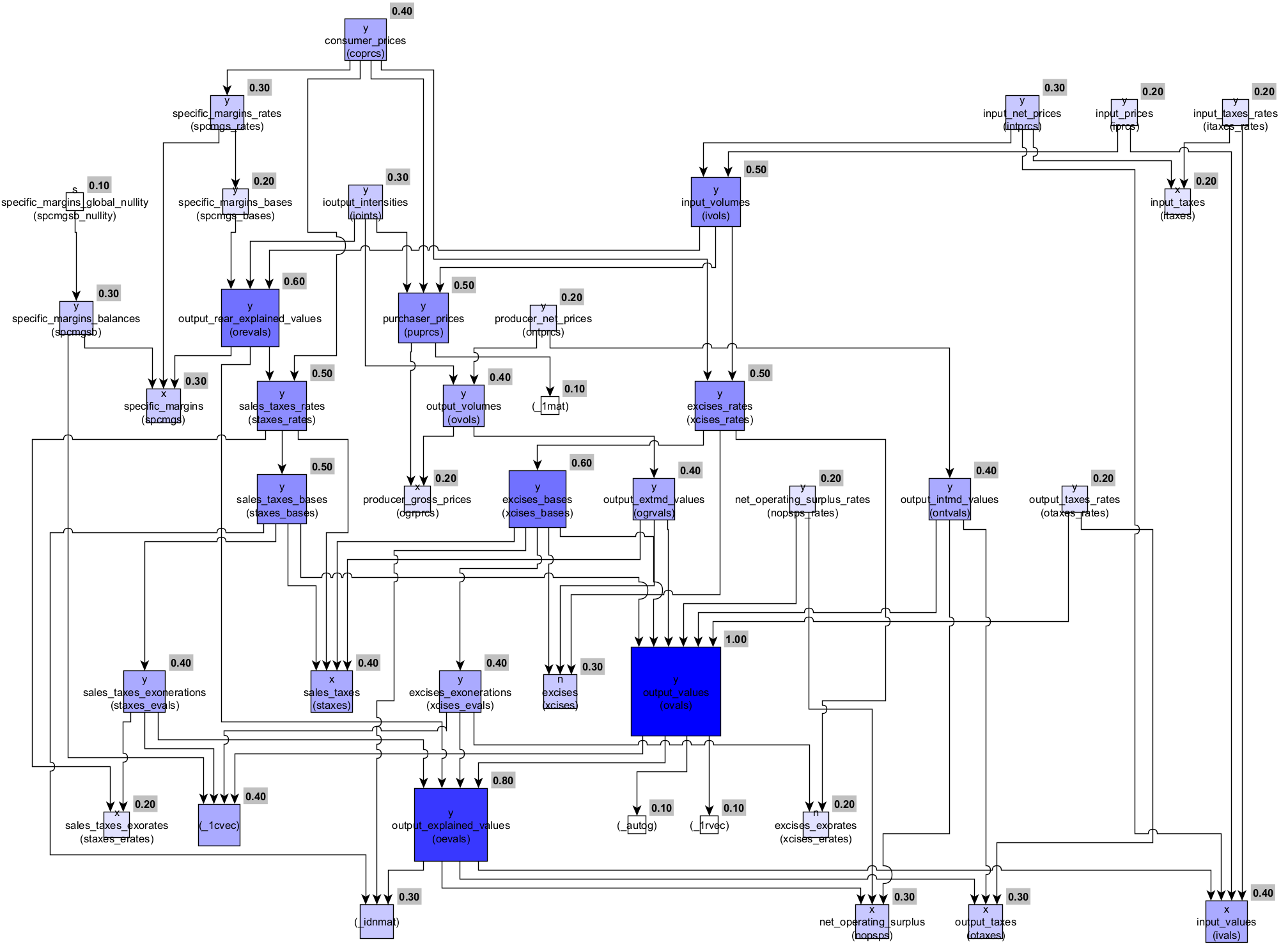
A calibration DAG. See also
-
property
_dag_items(self)¶ DAG-destined itemized version of
_arrays_mdata.
-
property
dag_resolved_callables(self)¶ Instance-cached
propertyversion of_dag_resolver().- Example
>>> idag = (s := MSystem()).dag_resolved_callables[0] >>> names = sorted( ... s._arrays_mdata[k]['n'] for k, _ in idag ... ) >>> for n in names: ... print(n) _0E1 ... _1E32 ... added_values ... deflators_sq_lfisher ... excises_premia ... zeros_vector_transpose
-
property
_œvars_names(self)¶ Optimization scaling variables’ private names.
Note
This attribute is not intended to be used publicly.
- Example
>>> s = MSystem( ... 'examples/ut(KLEM-BRICS-202006)@sol.xlsx', { ... 'mappings' : 'entities', ... 'input_volumes' : 'i-vols', ... 'input_values' : 'i-vals', ... 'contrib_taxes' : 'c-txs', ... 'producer_gross_prices' : 'av-p-prices', ... 'consumer_prices' : 'c-prices', ... 'output_volumes' : 'o-vols', ... 'excises_totals' : 'exs-tot', ... 'sales_taxes_totals' : 's-txs-tot', ... 'sales_taxes_exorates' : '¬%(s-txs)', ... 'specific_margins' : 'sp-mgs', ... 'unemployment_rates' : 'u-rates', ... 'unemployment_rates_shoptr': 'η(u-rates)', ... 'available_volumes_grates' : 'δ(caps)', ... 'available_volumes_drates' : 'θ(caps)', ... } ... ) >>> s._œvars_names ['_iocs_o', '_lsag_o', ...]
-
_hvars_getter(self, Ωs: (list|tuple)[Callable] = (), names_only: bool = False)¶ Dictionary of the arrays to be mobilized by
code_objects_getter.- Parameters
Note
This method is not intended to be used publicly.
-
property
_hvars_names(self)¶ List of the parameters’ names to be mobilized by
code_objects_getter.Note
This method is not intended to be used publicly.
- Example
>>> s = MSystem( ... 'examples/ut(KLEM-BRICS-202006)@sol.xlsx', { ... 'mappings' : 'entities', ... 'input_volumes' : 'i-vols', ... 'input_values' : 'i-vals', ... 'contrib_taxes' : 'c-txs', ... 'producer_gross_prices' : 'av-p-prices', ... 'consumer_prices' : 'c-prices', ... 'output_volumes' : 'o-vols', ... 'excises_totals' : 'exs-tot', ... 'sales_taxes_totals' : 's-txs-tot', ... 'sales_taxes_exorates' : '¬%(s-txs)', ... 'specific_margins' : 'sp-mgs', ... 'unemployment_rates' : 'u-rates', ... 'unemployment_rates_shoptr': 'η(u-rates)', ... 'available_volumes_grates' : 'δ(caps)', ... 'available_volumes_drates' : 'θ(caps)', ... } ... ) >>> s._hvars_names ['_ivals', '_spcmgs', ..., '_xa1']
See also
-
_type_duct_expander(self, ለ: Callable, _qn_: str = __qualname__)¶ Dynamically injects a new functional outflow into the class blueprint.
- Parameters
ለ (Callable) – The function to be bound as
staticmethod._qn_ (str) – Private argument assigned at the class level.
-
_compose_chain(self, sheet_key: str)¶ Recursively collapses a nested symbolic composition into its terminal form.
- Parameters
sheet_key (str) – Internal key of the composition to be processed.
-
property
_constraints_reachability_map(self)¶ Sparse boolean-like reachability maps between exogenous variables and constraints (
[c]) as well as between exogenous variables themselves ([x]).Note
Unknown and known exogenands are represented by
𝒳andαrespectively.- Example
>>> _ld, MSystem._lifted_dag = MSystem._lifted_dag, True >>> df = MSystem( ... 'examples/ut(KLEM-BRICS-202006).xlsx', dict( ... input_volumes = 'i-vols', ... input_values = 'i-vals', ... producer_gross_prices = 'av-p-prices', ... consumer_prices = 'c-prices', ... output_volumes = 'o-vols', ... ordinal_volumes = 'w-vols', ... contrib_taxes = 'c-txs', ... markets_rents = 'nos', ... sales_taxes_totals = 's-txs-tot', ... sales_taxes_exorates = '¬%(s-txs)', ... specific_margins = 'sp-mgs', ... available_volumes_grates = 'δ(caps)', ... available_volumes_drates = 'θ(caps)', ... income_private_circuit = 'inc-circuit', ... mappings = 'entities', ... ) ... )._constraints_reachability_map >>> df.loc[ ... pd.IndexSlice[:, :, ['ogrprcs_ˉ¹'], ['_ovols']], ... ['ogrprcs_'] ... ].T [c] _ovols¹ ogrprcs_ˉ¹ _ovols * * * n a z o e_kl e_kle o_kl o_kle ogrprcs_ * * * n a o α . . . . z e_kl . 𝒳 . . . e_kle . . 𝒳 . . o_kl . . . 𝒳 . o_kle . . . . 𝒳 >>> MSystem._lifted_dag = _ld
-
property
_ŕmaps(self)¶ Reachabilities between 1) constraints and their exogenous fibers and 2) between fibers themselves.
- Examples
>>> _ld, MSystem._lifted_dag = MSystem._lifted_dag, True >>> s = MSystem( ... 'examples/ut(KLEM-BRICS-202006).xlsx', dict( ... input_volumes = 'i-vols', ... input_values = 'i-vals', ... producer_gross_prices = 'av-p-prices', ... consumer_prices = 'c-prices', ... output_volumes = 'o-vols', ... ordinal_volumes = 'w-vols', ... contrib_taxes = 'c-txs', ... markets_rents = 'nos', ... sales_taxes_totals = 's-txs-tot', ... sales_taxes_exorates = '¬%(s-txs)', ... specific_margins = 'sp-mgs', ... available_volumes_grates = 'δ(caps)', ... available_volumes_drates = 'θ(caps)', ... income_private_circuit = 'inc-circuit', ... mappings = 'entities', ... ) ... ) >>> s._ŕmaps {'c': {('[c]', '_ovols¹', '_spcmgsˉ¹', '_ovols', (0, 2)): ...} >>> MSystem._lifted_dag = _ld
-
property
_mmaps(self)¶ Upstream reflection of the point-like positions of the data being subject to (static) constraints under multiple perspectives.
Note
This method is not intended to be used publicly.
See also
-
property
_xmaps(self)¶ Point-like data-space positions of optimizers.
Note
This method is not intended to be used publicly.
See also
_x́maps()and_x̀maps().
-
_x́maps(self) _mmaps-tempered version of_xmaps, i.e. symbolically solved unknowns.Note
This method is not intended to be used publicly.
See also
_xmaps()and_x̀maps().
-
_x̀maps(self) _mmaps-tempered complement of_x́maps, i.e. still numerically solved unknowns.Note
This method is not intended to be used publicly.
See also
_x́maps()and_xmaps().
-
_set_xlanes(self, _ppath: str = PACHEDIR)¶ Set the equation system’s working environment.
- Parameters
_ppath (str) – Private argument assigned at the class level.
See also
_set_xmains()’s note.
-
property
_symbolization_gain(self)¶ Indicate whether and how symbolic rearrangement is beneficial in terms of space complexity.
- Example
>>> MSystem()._symbolization_gain (None, 0.0)
>>> _ld, MSystem._lifted_dag = MSystem._lifted_dag, True >>> MSystem( ... 'examples/ut(KLEM-BRICS-202006).xlsx', dict( ... input_volumes = 'i-vols', ... input_values = 'i-vals', ... producer_gross_prices = 'av-p-prices', ... consumer_prices = 'c-prices', ... output_volumes = 'o-vols', ... ordinal_volumes = 'w-vols', ... contrib_taxes = 'c-txs', ... markets_rents = 'nos', ... sales_taxes_totals = 's-txs-tot', ... sales_taxes_exorates = '¬%(s-txs)', ... specific_margins = 'sp-mgs', ... available_volumes_grates = 'δ(caps)', ... available_volumes_drates = 'θ(caps)', ... income_private_circuit = 'inc-circuit', ... mappings = 'entities', ... ) ... )._symbolization_gain (True, 0.3076923076923077) >>> MSystem._lifted_dag = _ld
-
property
code_objects_getter(self)¶ Return a partial version of
_code_objects_getter()(private and undocumented) responsible for dynamically generating a JAX-friendly dependency-resolved instance-method specifically related to the model calibration and recursions, with a mean squared error or sum of squares scalar objective.Note
The state of this
propertyattribute directly depends on_dag_items’s. Anyway, this method is not intended to be used publicly.- Example
>>> s = MSystem( ... 'examples/ut(KLEM-BRICS-202006)@sol.xlsx', { ... 'mappings' : 'entities', ... 'input_volumes' : 'i-vols', ... 'input_values' : 'i-vals', ... 'contrib_taxes' : 'c-txs', ... 'producer_gross_prices' : 'av-p-prices', ... 'consumer_prices' : 'c-prices', ... 'output_volumes' : 'o-vols', ... 'excises_totals' : 'exs-tot', ... 'sales_taxes_totals' : 's-txs-tot', ... 'sales_taxes_exorates' : '¬%(s-txs)', ... 'specific_margins' : 'sp-mgs', ... 'unemployment_rates' : 'u-rates', ... 'unemployment_rates_shoptr': 'η(u-rates)', ... 'available_volumes_grates' : 'δ(caps)', ... 'available_volumes_drates' : 'θ(caps)', ... } ... ) >>> d = s.code_objects_getter() >>> d['script'] <code object <module> at ..., file "<string ''>", ...> >>> d['repr']() ...
-
_definjecter(self, script, /, fname: str)¶ Models definer.
- Parameters
script (types.CodeType) – Modeled system’s compiled script.
fname (str) – Modeled system’s underlying function’s name.
Note
This method is not intended to be used publicly.
-
property
_proc_cmds(self)¶ Processed commands, originally found in file via the
CUNK_0D_SYM,RUNK_0D_SYMandRUNK_1D_SYMsymbols.Note
This method filters out commands not being located onto
_localizations.- Example
>>> s0 = MSystem( ... 'examples/ut(KLEM-BRICS-202006).xlsx', dict( ... producer_gross_prices='av-p-prices' ... ) ... ) >>> s0._proc_cmds {'C': ({'ogrprcs_': {(2010,): (0, ...)}}, ...), 'R': ...}
Keeping the above note in mind, no recursion commands, i.e.
RUNK_0D_SYMandRUNK_1D_SYM, are shown. While the sheet'av-p-prices'contains some of them, it does so through the excel notes, not explicitly associated to any specific (time) localization. Let’s instantiate anotherMSystemwith a sheet that explicite an entire_localizations.>>> MSystem( ... 'examples/ut(KLEM-BRICS-202006).xlsx', { ... 'consumer_prices': 'c-prices', ... **s0._sheets_names, ... }, ... )._proc_cmds {'C': ({'ogrprcs_': {(2010,): (0, ...)}}, ...), 'R': ...}
-
property
wbook_specs(self)¶ _ilocalization-variant work book specificities such as the declared calibration’s unknowns, their number, etc.- Example
Let’s load a lot of tables for the sake of this example.
>>> s = MSystem( ... 'examples/ut(KLEM-BRICS-202006)@sol.xlsx', dict( ... input_values = 'i-vals', ... contrib_taxes = 'c-txs', ... producer_gross_prices = 'av-p-prices', ... sales_taxes_totals = 's-txs-tot', ... sales_taxes_exorates = '¬%(s-txs)', ... specific_margins = 'sp-mgs', ... ) ... ) >>> s._utils.otbprint(s.wbook_specs['public']) { "graph_options": { "detailed_excises": false, "detailed_sales_taxes": false, "detailed_trade_margins": true, "exogenous_market_rents": true, "reflected_rights": false, "relative_contrib_taxes": false, "relative_market_rents": false, "relative_other_costs": false, "relative_sales_taxes": false, "relative_trade_margins": false }, "resolution_options": { "aggregated_constraints": true, "autodiffed_hessian": false, "autodiffed_jacobian": false, "averaged_losses": false, "broadest_graph": true, "compiled_rcomps": false, "complex_underliers": true, "cscalingf_logbase": 2.0, "densified_arrays": true, "hoisted_indexers": true, "jitted_derivatives": true, "jitted_objective": true, "lifted_dag": false, "losses_exponent": 2.0, "losses_factor": 1.0, "nonlinear_decision": false, "regressed_iguess": true, "regressed_scaling": true, "scaled_decision": true, "serialized_results": false, "unclustered_udms": true, "vectorized_udcs": false, "without_inequality": false }, "resolution_stats": { "dimensionality": 0, "solved": false } }
Indeed, nowhere in
'examples/ut(KLEM-BRICS-202006)@sol.xlsx'a cell has?(t=0)for value, which is the symbol to be used (by default, cfCUNK_0D_SYM) to tell the calibration solver where its unknowns are located within the data space.Let’s have a look at (one of) the “private” items, keyed by
'unks'.>>> unks = s.wbook_specs['private']['unks'] >>> s._utils.otbprint(unks.pop('_žλ') and unks) { "__k": [], "__s": [], "_dim": 0, "_x̃s₀": [ [] ], "_x̃s₁": [ [] ], "_x̃s₂": [ [] ], "_z_": [], "_ẕ_": [] }
We are confronted to the “null” case for the just-mentioned reason.
-
__repr__(self)¶ Instance’s formal string representation.
- Example
>>> MSystem( ... 'examples/ut(KLEM-BRICS-202006)@sol.xlsx', ... dict(input_values='i-vals'), ... ) { "graph_options": { "detailed_excises": False, "detailed_sales_taxes": False, "detailed_trade_margins": True, "exogenous_market_rents": True, "reflected_rights": False, "relative_contrib_taxes": False, "relative_market_rents": False, "relative_other_costs": False, "relative_sales_taxes": False, "relative_trade_margins": False }, "resolution_options": { "aggregated_constraints": True, "autodiffed_hessian": False, "autodiffed_jacobian": False, "averaged_losses": False, "broadest_graph": True, "compiled_rcomps": False, "complex_underliers": True, "cscalingf_logbase": 2.0, "densified_arrays": True, "hoisted_indexers": True, "jitted_derivatives": True, "jitted_objective": True, "lifted_dag": False, "losses_exponent": 2.0, "losses_factor": 1.0, "nonlinear_decision": False, "regressed_iguess": True, "regressed_scaling": True, "scaled_decision": True, "serialized_results": False, "unclustered_udms": True, "vectorized_udcs": False, "without_inequality": False }, "resolution_stats": { "dimensionality": 0, "solved": False } }
-
classmethod
_lfancy_substracter(cls, lfancys: list[tuple[type], tuple[int, tuple[tuple[int]]]], nfancy: (tuple|list)[tuple[int]], ref_iloc: int = None)¶ Subtract a numpy-friendly fancy index from a per-localization (onto
_localizations) counterpart.- Parameters
lfancys (tuple) – Sequence of (localized) indexes to be processed.
nfancy (tuple or list) – Unique (non-localized) fully specified advanced index to be subtracted from
lfancys.ref_iloc (int) –
_ilocalizationto be used as reference for filtering. Set toNoneby default.
- :Example
>>> MSystem._lfancy_substracter( ... nfancy=[(0, 0, 1), (1, 1, 1), (1, 2, 3)], ... lfancys=[ ... (('a',), (0, (1, 1, 1, 2), (1, 2, 3, 3))), ... (('b',), (1, (1, 1, 1), (1, 2, 3))), ... ], ... ) [(('a',), (0, (1, 2), (3, 3))), (('b',), (1, (1, 1), (1, 2)))]
>>> MSystem._lfancy_substracter( ... ref_iloc=0, nfancy=[(0, 0, 1), (1, 1, 1), (1, 2, 3)], ... lfancys=[ ... (('a',), (0, (1, 1, 1, 2), (1, 2, 3, 3))), ... (('b',), (1, (1, 1, 1), (1, 2, 3))), ... ], ... ) [(('a',), (0, (1, 2), (3, 3))), (('b',), (1, (1,), (3,)))]
>>> MSystem._lfancy_substracter( ... ref_iloc=0, nfancy=[(0, 0, 0), (1, 1, 1), (1, 2, 3)], ... lfancys=[ ... (('a',), (0, (1, 1, 1, 2), (1, 2, 3, 3))), ... (('b',), (1, (1, 1, 1), (1, 2, 3))), ... ], ... ) [(('a',), (0, (2,), (3,))), (('b',), (1, (), ()))]
-
classmethod
_lfancy_merger(cls, lfancys: list[tuple[type], tuple[int, tuple[tuple[int]]]], _otyper: Callable = lambda s: sorted(set(s)))¶ Merge localized numpy-friendly fancy indexes on a per-localization basis (onto
_localizations).- Parameters
lfancys (tuple) – Sequence of (localized) indexes to be processed.
_otyper (Callable) – Private argument assigned at the class level. To
lambda s: sorted(set(s)).
- Example
>>> a, b = MSystem._lfancy_merger( ... lfancys=[ ... (('a',), (0, (1, 1, 1), (1, 2, 3))), ... (('b',), (1, (1, 1, 1), (1, 2, 3))), ... (('a',), (0, (1, 1, 2), (1, 2, 3))), ... ] ... ) >>> a (('a',), (0, (1, 1, 1, 2), (1, 2, 3, 3))) >>> b (('b',), (1, (1, 1, 1), (1, 2, 3)))
-
property
uid(self)¶ Solver-specialized version of
uid.Note
This attribute is session-stable and cross-platform.
- Example
>>> MSystem().uid 'mpSFaYDQFe5j'
-
_iguess_specifier(self, xmaps: dict[str, list[tuple[int]]], _xuign: str = XUNK_IG_CNAME, **_kws: 'np.ndarray|bool')¶ Specify the initial position of the system in the decision-space.
- Parameters
xmaps (dict) – Point-like data-space positions of optimizers, (such as
_xmaps)._xuign (str) – Private argument assigned at the class level. Set to
XUNK_IG_CNAME.**_kws (numpy.ndarray or bool) – Private keyword arguments, if any.
Note
This method is not intended to be used publicly.
-
_optim_specifier(self, iguess: np.ndarray = None, _xuign: str = XUNK_IG_CNAME, _xusfn: str = XUNK_SF_CNAME)¶ Define a set of (callable) specifiers related to a given optimization process, such as initial guesses, scaling factors, variables’ bounds, etc.
- Parameters
iguess (numpy.ndarray) – Initial guess the solver should be forced to start from. Set to
Noneby default, i.e. inferred/taken from the numerical context._xuign (str) – Private argument assigned at the class level. Set to
XUNK_IG_CNAME._xusfn (str) – Idem. Set to
XUNK_SF_CNAME.
Note
This method is not intended to be used publicly.
-
_jacobian_c_renormer(self, ῼs: (tuple|list)[Callable], **_kws: float)¶ Compute the scaling factors associated to the decision components of the system of interest.
-
_scale_inferrer(self, **_kws: float)¶ Scale a vector decision variable using the Ruiz equilibration algorithm.
- Parameters
**_kws (float) – Private keyword arguments, if any.
-
_scale_explorer(self, sheet_id: str, _ia: int = 0)¶ Explore attributes’ companions for an exploitable base scale.
- Parameters
Note
This method is not intended to be used publicly.
- Example
>>> sheet_name = 'sp-mgs' >>> s = MSystem( ... 'examples/ut(KLEM-BRICS-202006)@sol.xlsx', dict( ... input_values='i-vals', ... contrib_taxes='c-txs', ... specific_margins=sheet_name, ... ) ... ) >>> s._scale_explorer(sheet_name).item() 115326071.17840433
-
classmethod
_distributor_blueprint(cls, x, /, z: np.ndarray, ẕ: np.ndarray, k: np.ndarray, s: np.ndarray, μ: np.ndarray, arrays: dict[str, np.ndarray], χ: int, dγ: float, dγs: np.ndarray, Ѡs: tuple[Callable], žλ: Callable, ᴧs: tuple[tuple[str, type]], λs: dict[str, Callable], ʈs: dict[str, tuple], keỳs: tuple[str], yćḿs: tuple[tuple[str, str, tuple[str, tuple[int]]]], śłćs: tuple[tuple[str, tupe[str, tuple[int]]]], slcs: tuple[str, tuple[str, tuple[int]]], full_output: bool, *, Ω: Callable, **_kῶs: np.ndarray)¶ Wrapper responsible for distributing the solver’s unknowns among the (modeled) system’s exogenous arrays.
- Parameters
x (numpy.ndarray) – Array of real elements everted during minimization.
z (numpy.ndarray) –
x’s first scaling parameter.ẕ (numpy.ndarray) –
x’s second scaling parameter.k (numpy.ndarray) –
x’s jacobian columns scaling parameter.s (numpy.ndarray) –
x’s group level multiplier on the target column-norm level used to solve fork.µ (numpy.ndarray) – Levenberg-Marquardt damping parameter.
arrays (dict) – Dictionary of arrays constitutive of the modeled system.
dγs (np.ndarray) – Archetype of
_dγs.Ѡs (tuple) – Sequence of symbolically defined
Ω’s simplifiers.žλ (Callable) –
x’s scaler.ᴧs (tuple) – Archetype of
_ᴧs(undocumented).λs (dict) – Archetype of
_λs(undocumented).ʈs (dict) – Archetype of
_ʈs(undocumented).keỳs (tuple) – Sequence of arrays’ names to be mobilized by
Ѡs’s elements.yćḿs (tuple) – Bunch of key materials processed for knowns injection.
śłćs (tuple) – Bunch of key-slice materials processed for knowns extraction.
slcs (tuple) – Bunch of key-slice materials processed for unknowns injection.
full_output (bool) – Whether all intermediary objects are to be returned as well as the primary quantity of interest, that is the
grand_saturationof the system atχ.Ω (Callable) – System of interest.
**_kῶs (numpy.ndarray) –
Ω-specific keyword arguments.
-
classmethod
_jx_jit(cls, j: bool, copts: dict[str, type] = None, _v_: tuple[str] = (*jx.__version__.split('.'), ))¶ Either return
jax.jitor an identity function.
-
_distributor(self, Ω, /)¶ Factory method responsible for JAX-JITing the operationalized version of
_distributor_blueprint().- Parameters
Ω (Callable) – System of interest.
Important
This method returns an unjitted callable for
JITTED_OBJECTIVEset toFalse.Note
The arguments of the returned callable are
x,z,ẕ,µ,arrays,χ,dγ,dγs,žλ,ᴧs,λs,ʈs,slcsandfull_output. For details, see_distributor_blueprint().- Example
>>> s = MSystem() >>> s._distributor(s._xmains_0).__name__ '_cmains_0'
-
_distributors_fuzzer(self, Ωs, /, fuzzkey: str = '_x̃s₂', **_kws: type)¶ Evaluate the systems of interest’s (combined) system-specific objective at multiple locations in the decision space.
- Parameters
- Example
>>> s = MSystem() >>> s._distributors_fuzzer( ... s._xmain_eqs + s._xmain_ins ... ) [Array([0.], dtype=float64), Array([[0.]], dtype=float64)]
-
_distributor_jacobian(self, Ω, /)¶ JAX-JIT-compiled jacobian computer of
_distributor.- Parameters
Ω (Callable) – System of interest.
Important
This method returns an unjitted callable for
JITTED_DERIVATIVESset toFalse.See also
- Example
>>> s = MSystem() >>> s._distributor_jacobian(s._xmains_0).__name__ '_cmains_0_jac'
-
_soberly_computed(self, ncond: bool|int = False)¶ Control-flow performatively stating whether downstream callable derivatives’ definition do not imply full (and costly) computations.
- Parameters
ncond (bool or int) – Boolean specifying whether the value of the attribute
_aggregated_constraintsis to be considered as a (necessary) condition favoring full computation. Set toFalseby default.
See also
Note
This method’s tradeoff is based on the decision’s dimensionality and (undocumented private) class’s attributes such as
_batch_sizeand_forced_lnrzd.- Example
>>> m = MSystem( ... 'examples/ut(KLEM-BRICS-202006).xlsx', sheets_names={ ... 'producer_gross_prices': 'av-p-prices', ... 'input_values' : 'i-vals', ... } ... ) >>> m.wbook_specs['public']['resolution_stats']['dimensionality'] 9 >>> m._batch_size 100000 >>> m._forced_lnrzd False >>> m._aggregated_constraints True
>>> m._soberly_computed() False >>> m._soberly_computed(ncond=True) False
>>> MSystem._batch_size = 8 >>> m._soberly_computed() {'d': 9, 's': 8} >>> m._soberly_computed(ncond=True) False
>>> MSystem._batch_size = 100
-
_distributor_jacobianl(self, Ω, /)¶ JAX-JIT-compiled jacobian computer of
_distributorbased on jvp, i.e. the linearization of the \(0\)th order derivative.- Parameters
Ω (Callable) – System of interest.
Important
This method returns an unjitted callable for
JITTED_DERIVATIVESset toFalse.See also
- Example
>>> s = MSystem() >>> s._distributor_jacobianl(s._xmains_0).__name__ '_cmains_0_jac'
>>> MSystem._forced_lnrzd = True >>> s._distributor_jacobianl( ... s._xmains_0 ... ).__name__ Traceback (most recent call last): ... RuntimeError: ... not allowed.
>>> MSystem._forced_lnrzd = False
-
_distributor_jacobianls_structurer(self, Ωs, /)¶ Determine the combined jacobians sparsity pattern of the systems of interest.
-
_distributor_jacobianls_fuzzer(self, Ωs, /, fuzzkey: str = '_x̃s₂', sparse: bool = False, **_kws: type)¶ Evaluate the systems of interest’s (combined) system-specific jacobian at multiple locations in the decision space.
- Parameters
fuzzkey (str) – Key associated to the sequence of positions in the decision space over which the fuzzing process must be performed. Undocumented for now, options are
'_x̃s₀','_x̃s₁','_x̃s₂'or'_x̃s₃'. Set to'_x̃s₂'by default.sparse (bool) – Whether the evaluation should resort to sparse methods and objects. To
Falseby default.**_kws (type) – Private keyword arguments, if any.
Note
In the
sparse=Falsecase, this method raises an error if aNaNis detected in any of the computed jacobians.- Example
>>> s = MSystem() >>> s._distributor_jacobianls_fuzzer( ... s._xmain_eqs + s._xmain_ins ... ) [Array([], shape=(1, 0), dtype=float64), ...]
-
_distributor_sp_jacobianl(self, Ω, /)¶ JAX-JIT-compiled sparse jacobian computer of
_distributor.Note
This method can only differentiate functions whose output is exactly 1-dimensional.
- Parameters
Ω (Callable) – System of interest.
Important
This method returns an unjitted callable for
JITTED_DERIVATIVESset toFalse.See also
- Example
>>> s = MSystem() >>> s._distributor_sp_jacobianl(s._xmains_0).__name__ '_cmains_0_jacl_sp'
-
_distributor_hessian(self, Ω, /)¶ JAX-JIT-compiled hessian computer of
_distributor.- Parameters
Ω (Callable) – System of interest.
Important
This method returns an unjitted callable for
JITTED_DERIVATIVESset toFalse.See also
- Example
>>> s = MSystem() >>> s._distributor_hessian(s._xmains_0).__name__ '_cmains_0_hess'
-
_distributor_hessianl(self, Ω, /)¶ JAX-JIT-compiled hessian computer of
_distributorbased on hvp, i.e. the linearization of the localized Jacobian.- Parameters
Ω (Callable) – System of interest.
Important
This method returns an unjitted callable for
JITTED_DERIVATIVESset toFalse.See also
- Example
>>> s = MSystem() >>> s._distributor_hessianl(s._xmains_0).__name__ '_cmains_0_hess'
>>> MSystem._forced_lnrzd = True >>> s._distributor_hessianl( ... s._xmains_0 ... ).__name__ Traceback (most recent call last): ... RuntimeError: ... not allowed.
>>> MSystem._forced_lnrzd = False
-
_distributor_hessianl_lws(self, Ω, /)¶ JAX-JIT-compiled hessian Lagrangian weighted sum computer of
_distributor.- Parameters
Ω (Callable) – System of interest.
Important
This method returns an unjitted callable for
JITTED_DERIVATIVESset toFalse.See also
Attention
This method is about to be removed since implying very inefficient objects formulation.
- Example
>>> s = MSystem() >>> s._distributor_hessianl_lws(s._xmains_0).__name__ '_cmains_0_hessl_lws'
-
_distributor_hessianls_structurer(self, Ωs, /, **_kws: type)¶ Determine the combined hessians sparsity pattern of the systems of interest.
- Parameters
- Example
>>> s = MSystem( ... 'examples/ut(KLEM-BRICS-202006).xlsx', dict( ... input_volumes = 'i-vols', ... input_values = 'i-vals', ... producer_gross_prices = 'av-p-prices', ... consumer_prices = 'c-prices', ... output_volumes = 'o-vols', ... ordinal_volumes = 'w-vols', ... contrib_taxes = 'c-txs', ... markets_rents = 'nos', ... sales_taxes_totals = 's-txs-tot', ... sales_taxes_exorates = '¬%(s-txs)', ... specific_margins = 'sp-mgs', ... available_volumes_grates = 'δ(caps)', ... available_volumes_drates = 'θ(caps)', ... income_private_circuit = 'inc-circuit', ... mappings = 'entities', ... ) ... ) >>> s._distributor_hessianls_structurer( ... s._xmain_obs[:1] + s._xmain_eqs + s._xmain_ins ... ) BCOO(uint8[13, 13], nse=81)
-
_distributor_sp_hessianl(self, Ω, /)¶ JAX-JIT-compiled sparse hessian computer of
_distributor.Note
This method can only differentiate functions whose output is exactly 1-dimensional.
- Parameters
Ω (Callable) – System of interest.
Important
This method returns an unjitted callable for
JITTED_DERIVATIVESset toFalse.- Example
>>> s = MSystem() >>> s._distributor_sp_hessianl( ... s._xmains_0 ... ).__name__ '_cmains_0_hessl_sp'
-
_distributor_derivatives(self, Ω, /)¶ Tuple-gather the callables returned by
_distributor(),_distributor_jacobian(),_distributor_jacobianl(),_distributor_hessian(),_distributor_hessianl(), and_distributor_hessianl_lws()in this very order, when evaluated atΩ.- Parameters
Ω (Callable) – System of interest.
See also
-
_distributor_decomposer(self, Ω: Callable, order: int = 0, relative: bool = False, fuzzed: bool = True, fuzzkey: str = None, aggregator: Callable = ft.partial(np.mean, axis=0), as_frame: bool = True, set_œscalers: str = 'restored', full_output: bool = False, _usym: str = UNIV_SYM, **_kws: type)¶ Compute the components’ zeroth or first order contributions to the total system-specific function of interest.
- Parameters
Ω (Callable) – System of interest.
order (int) – Differentiation order, ranging from
0to1. Set to0by default.relative (bool) – Whether the contributions should be returned as summing-to-one shares. Set to
Falseby default.fuzzed (bool) – Whether the contributions must be evaluated at multiple locations in the decision space. Set to
Trueby default.fuzzkey (str) – Key associated to the sequence of positions in the decision space over which the fuzzing process must be performed. Undocumented for now, options are
'_x̃s₀','_x̃s₁','_x̃s₂'or'_x̃s₃'. Set toNoneby default, which actually boils down to'_x̃s₁'whenfuzzedand'_x̃s₀'otherwise.aggregator (Callable) – Aggregating function to be used over the contributions being fuzzed. Set to 0th-axis-partialized
numpy.meanby default, which is neutral forfuzzed=False.as_frame (bool) – Whether the result is to be returned as
pandas.DataFrame. Set toTrueby default.set_œscalers (str) – Option specifying whether, once the contributions are computed, scalers can either be
'restored','reset'or'left_as_is'as is. Indeed, this method set all optimization scalers to 1 prior to performing its calculations. Set to'restored'by default.full_output (bool) – Whether the intermediary total
Ω-derived jacobian should be returned as well, incidentally aimlessly calculated asrelative=False. Set toFalseby default._usym (str) – Unaccessible argument defined at the class level. Set to
UNIV_SYM.**_kws (type) – Private keyword arguments, if any.
-
_set_œscalers(self, value: float = 1.0, withheld: (tuple|list)[str] = None, discarded: (tuple|list)[str] = None)¶ Gather and identically update all optimization scalers.
- Parameters
value (float) – Value the arrays must be updated to. Set to
1.by default.withheld (list or tuple) – Sequence of scalers to be updated. Set to
Noneby default, i.e. no scaler is put aside.discarded (list or tuple) – Sequence of scalers not to be updated. Set to
Noneby default, i.e. no scaler is put aside.
Note
This method returns
selffor the sake of chaining.
-
_compute_opscalers(self, ῼs: (tuple|list)[Callable], method: str|tuple[str, dict[str, type]], **_kws: type)¶ Compute the scaling factors associated to the optimization components (such as the objective and constraints) of the system of interest.
- Parameters
Note
ATM, the method
'jacobian-based'can only be used over (ῼs-contained) systems that have the exact same components and whose derived function are scalar valued, otherwise, an error is raised.This method returns
selffor the sake of chaining.This method is not intended to be used publicly.
-
_systems_interpreter(self, Ὦs: (tuple|list)[Callable], order: int = 0, with_ƨnames: bool = False, unjitted: bool = True)¶ Conceive and return the systems-specific partialized functions of interest.
- Parameters
order (int) – Differentiation order, ranging from
0to2, with the latter two being untested. Set to0by default.with_ƨnames (bool) – Whether the returned callables should be “zipped” with their corresponding system’s
~._ƨnamesattribute. Set toFalseby default.unjitted (bool) – Whether the returned functions have to be unjitted. To
Trueby default.
Note
This method (whose underliers are unjitted) is not intended to be used publicly.
-
_zsystems_evaluator(self, ῼs: (tuple|list)[Callable], order: int = 0, fuzzed: bool = True)¶ Evaluate the \(n\)th order derivative of the Z-systems-specific functions of interest.
- Parameters
order (int) – Derivation order passed to
_systems_interpreter(). Set to0by default.fuzzed (bool) – Whether the contributions must be evaluated at multiple locations in the decision space. Set to
Trueby default.
Note
This method (whose underliers are unjitted) is not intended to be used publicly.
-
_compute_residuals_grand_mask(self, ῼ, /, _0λ: Callable = __0λ, _hvλ: Callable = __hvλ)¶ Compute the mask of the callable’s output prior to aggregation, if any.
- Parameters
ῼ (Callable) – Z-system of interest.
_0λ (Callable) – Private argument assigned at the class level. Set to
lambda _: _._hvλ (Callable) – Idem. Set to
lambda o, _λ=opr.itemgetter('h', 'v'): (*map(int, _λ(o)),)
Note
This method is not intended to be used publicly.
-
_compute_residuals_grand_masks(self, ῼs: (list|tuple)[Callable])¶ Vectorized version of
_compute_residuals_grand_mask().Note
This method is not intended to be used publicly.
-
property
_minimization_coargumenter(self)¶ Return a callable that provides static parameters required by the objective function during optimization.
This method constructs and returns a callable object that, when invoked, supplies the necessary ancillary arguments to the modeling function. These additional parameters might include hyperparameters, configuration settings, or any other data that influences the behavior of the objective function but is not part of the standard argument set.
Note
This method is not intended to be used publicly.
-
_minimization_jacobian_computer(self, Ω: Callable, as_frame: bool = True)¶ Compute the gradient of the system-specific function of interest, evaluated at the best possible position within the decision space, depending on whether it is called before or after the minimization has occurred.
- Parameters
Ω (Callable) – System of interest.
as_frame (bool) – Whether the result is to be returned as
pandas.DataFrame. Set toTrueby default.
See also
-
property
minimization_jacobian(self)¶ Attribute storing the gradient of the objective function evaluated at the best possible position within the solution space, depending on whether it is called before or after the minimization has occurred.
When invoked after the minimization, this attribute represents the gradient vector of the objective function at the point where the function attains its minimum value, indicating the rate and direction of change of the function at that point. This can be used to verify optimality conditions or analyze the sensitivity of the solution.
Note
This attribute’s name contains the word “jacobian” instead of “gradient” as a first step toward generalization.
See also
- Example
>>> sheets_names = { ... 'mappings' : 'entities', ... 'income_private_circuit' : 'inc-circuit', ... # Cross-sections ... 'input_values' : 'i-vals', ... 'unemployment_rates' : 'u-rates', ... 'unemployment_rates_shoptr' : 'η(u-rates)', ... 'producer_gross_prices' : 'av-p-prices', ... 'output_volumes' : 'o-vols', ... 'ordinal_volumes' : 'w-vols', ... 'markets_rents' : 'nos', ... 'contrib_taxes' : 'c-txs', ... 'sales_taxes_totals' : 's-txs-tot', ... 'sales_taxes_exorates' : '¬%(s-txs)', ... 'excises_totals' : 'exs-tot', ... 'specific_margins' : 'sp-mgs', ... 'consumer_prices' : 'c-prices', ... # Time series ... 'input_volumes' : 'i-vols', ... # δ ... 'markets_rents_rates_grates' : 'δ(nos-rates)', ... 'contrib_taxes_rates_grates' : 'δ(c-txs-rates)', ... 'sales_taxes_totals_rates_grates' : 'δ(s-txs-tot-rates)', ... 'specific_margins_rates_grates' : 'δ(sp-mgs-rates)', ... 'consumer_prices_grates' : 'δ(c-prices)', ... 'unemployment_rates_grates' : 'δ(u-rates)', ... 'available_volumes_grates' : 'δ(caps)', ... 'skizo_budgets_shares_grates' : 'δ(skb-shares)', ... 'input_volumes_grates' : 'δ(i-vols)', ... 'ioq_intensities_order3_grates' : 'δ(io-ints-o3)', ... # θ ... 'available_volumes_drates' : 'θ(caps)', ... 'ioq_shares_drates' : 'θ(io-shas-o1)', ... } >>> s = MSystem( ... 'examples/ut(KLEM-BRICS-202006).xlsx', sheets_names ... ) >>> s.minimization_jacobian.iloc[:, [3, 4, 5]] * E₀ 𝒳 sgn 𝕵 |𝕵| producer_gross_prices * * * n a e 1000.0 - 8.42e-03 d e 1000.0 + 1.28e-33 k 1000.0 + 7.90e-04 m e 1000.0 - 4.00e-03 z e_kl 1000.0 - 4.84e-04 e_kle 1000.0 - 4.40e-04 o_kl 1000.0 - 3.68e-04 o_kle 1000.0 - 3.19e-04 w x e 1000.0 - 0.00e+00 specific_margins n a e n d c 0.0 - 2.06e-05 x e 0.0 - 1.32e-04 z e_kle 0.0 - 2.74e-06 o_kle 0.0 - 2.99e-06
-
property
_minimization_residuals(self, _usym: str = UNIV_SYM)¶ Private counterpart of
minimization_residuals.
-
property
minimization_residuals(self, _usym: str = UNIV_SYM)¶ Attribute storing the residuals of the (disaggregated) objective function evaluated at the best possible position within the solution space, depending on whether it is called before or after the minimization has occurred.
- Example
>>> sheets_names = { ... 'mappings' : 'entities', ... 'income_private_circuit' : 'inc-circuit', ... # Cross-sections ... 'input_values' : 'i-vals', ... 'unemployment_rates' : 'u-rates', ... 'unemployment_rates_shoptr' : 'η(u-rates)', ... 'producer_gross_prices' : 'av-p-prices', ... 'output_volumes' : 'o-vols', ... 'ordinal_volumes' : 'w-vols', ... 'markets_rents' : 'nos', ... 'contrib_taxes' : 'c-txs', ... 'sales_taxes_totals' : 's-txs-tot', ... 'sales_taxes_exorates' : '¬%(s-txs)', ... 'excises_totals' : 'exs-tot', ... 'specific_margins' : 'sp-mgs', ... 'consumer_prices' : 'c-prices', ... # Time series ... 'input_volumes' : 'i-vols', ... # δ ... 'markets_rents_rates_grates' : 'δ(nos-rates)', ... 'contrib_taxes_rates_grates' : 'δ(c-txs-rates)', ... 'sales_taxes_totals_rates_grates' : 'δ(s-txs-tot-rates)', ... 'specific_margins_rates_grates' : 'δ(sp-mgs-rates)', ... 'consumer_prices_grates' : 'δ(c-prices)', ... 'unemployment_rates_grates' : 'δ(u-rates)', ... 'available_volumes_grates' : 'δ(caps)', ... 'skizo_budgets_shares_grates' : 'δ(skb-shares)', ... 'input_volumes_grates' : 'δ(i-vols)', ... 'ioq_intensities_order3_grates' : 'δ(io-ints-o3)', ... # θ ... 'available_volumes_drates' : 'θ(caps)', ... 'ioq_shares_drates' : 'θ(io-shas-o1)', ... } >>> r = MSystem( ... 'examples/ut(KLEM-BRICS-202006).xlsx', sheets_names ... ).minimization_residuals
The model’s residuals are classified into five categories:
E-System: Market-clearing and resource-balance equations.A-System: User-imposed static constraints on endogenous variables.U-System: User-defined functions whose outputs must vanish.UA-System: Differences between endogenous variables and their user-defined target values.ℝ⁺: Residuals associated with non-negativity constraints.
Let’s check the (first five) residuals associated with the equilibrium equations:
>>> r.xs('E-System').head() * * * * * * * ê ô o demand_side_integrity * * * n a e 0.00e+00 8.93e+06 8.93e+06 o 0.00e+00 1.26e+08 1.26e+08 d e 0.00e+00 7.60e+06 7.60e+06 o 8.33e-33 1.15e+08 1.15e+08 m e 0.00e+00 1.30e+06 1.30e+06
Next, inspect some residuals associated with user-imposed static constraints:
>>> r.xs('A-System').head() * * * * * * * ê ô o _output_volumes * * * n a o 0.00 124377.95 124377.95 z e_kl 0.88 150.00 2450.40 e_kle 0.89 300.00 5403.72 o_kl 0.91 1500.00 32365.38 o_kle 0.92 1500.00 37453.48
Now, examine some residuals returned by user-defined functions and required to vanish:
>>> r.xs('U-System').head() * * * * * * * ê ô o aggregated_input_volumes n a e * * * 1.27e-31 3.57e-16 0.0 d e * * * 0.00e+00 0.00e+00 0.0 m e * * * 0.00e+00 0.00e+00 0.0 z e_kl * * * 1.27e-31 3.57e-16 0.0 o_kl * * * 1.70e-31 4.12e-16 0.0
We can also inspect residuals measuring deviations from user-defined target values:
>>> r.xs('UA-System').head() * * * * * * * ê ô o available_volumes * * * n d k 7.98e-01 15231.16 149440.83 contrib_taxes_rates * * * n d e 0.00e+00 0.09 0.09 o 0.00e+00 0.04 0.04 input_volumes n a o n d e 1.21e-32 1460.49 1460.49 o 2.00e-32 72799.04 72799.04
Finally, check the only residual associated with non-negativity constraints:
>>> r.xs('ℝ⁺') * * * * * * * ê ô o consumer_prices_rparts * * * * * * 0.0 0.0 0.0
-
property
_constraints_jacobian(self)¶ Attribute combining the jacobian of the constraints evaluated at the best possible position within the solution space, depending on whether it is called before or after the minimization has occurred.
- Example
>>> sheets_names = { ... 'mappings' : 'entities', ... 'income_private_circuit' : 'inc-circuit', ... # Cross-sections ... 'input_values' : 'i-vals', ... 'unemployment_rates' : 'u-rates', ... 'unemployment_rates_shoptr' : 'η(u-rates)', ... 'producer_gross_prices' : 'av-p-prices', ... 'output_volumes' : 'o-vols', ... 'ordinal_volumes' : 'w-vols', ... 'markets_rents' : 'nos', ... 'contrib_taxes' : 'c-txs', ... 'sales_taxes_totals' : 's-txs-tot', ... 'sales_taxes_exorates' : '¬%(s-txs)', ... 'excises_totals' : 'exs-tot', ... 'specific_margins' : 'sp-mgs', ... 'consumer_prices' : 'c-prices', ... # Time series ... 'input_volumes' : 'i-vols', ... # δ ... 'markets_rents_rates_grates' : 'δ(nos-rates)', ... 'contrib_taxes_rates_grates' : 'δ(c-txs-rates)', ... 'sales_taxes_totals_rates_grates' : 'δ(s-txs-tot-rates)', ... 'specific_margins_rates_grates' : 'δ(sp-mgs-rates)', ... 'consumer_prices_grates' : 'δ(c-prices)', ... 'unemployment_rates_grates' : 'δ(u-rates)', ... 'available_volumes_grates' : 'δ(caps)', ... 'skizo_budgets_shares_grates' : 'δ(skb-shares)', ... 'input_volumes_grates' : 'δ(i-vols)', ... 'ioq_intensities_order3_grates' : 'δ(io-ints-o3)', ... # θ ... 'available_volumes_drates' : 'θ(caps)', ... 'ioq_shares_drates' : 'θ(io-shas-o1)', ... } >>> MSystem._aggregated_constraints = False >>> s = MSystem( ... 'examples/ut(KLEM-BRICS-202006).xlsx', sheets_names ... ) >>> s._constraints_jacobian.loc[ ... :, pd.IndexSlice[ ... 'producer_gross_prices', :, :, :, :, :, 'e' ... ] ... ].map("{:.0e}".format).replace('0e+00', '.') producer_gross_prices * * * n w a d m x e e e e eq_0 * * * n a e . . . . b b -2e-03 . . . d k . . . . l1 -4e-03 . . . o -1e-03 . . . m * -2e-03 . . . z e_kl . . . . e_kle . . . . o_kl . . . . o_kle . . . . n b b n m * . . -4e-03 . d cg n m e . . . . e * * * . . . . ineq_0 * * * * * * . . . . >>> MSystem._aggregated_constraints = True
-
minimize(self, disp: int = 0, oalgo: str|list[str] = 'sl', salgo: str|tuple[str, dict[str, type]] = 'none', ctypes: tuple[str] = (), rschedule: tuple[float] = (), **soptions: type)¶ System minimizer.
- Parameters
disp (int) – Control the verbosity of the minimization. Between
0(nothing is displayed) and13(maximal information). Note that values above4are inoperative asoalgois either not'ip.<>'or not'sp.<>'. To0by default.oalgo (str or list) – (Sequence of) optimization(s) method(s). Choices are
'nm'(Nelder Mead),'cg'(CG),'jx'(JAX’s BFGS),'bf'(BFGS),'lb'(L-BFGS-B),'tr'(trust-constr),'nc'( Newton-CG),'pw'(Powell),'sl'(SLSQP), NLOPT’s methods (e.g.'nl.mma') and IPOPT’s linear solvers (e.g.'ip.mumps'), as well as the sparse couterparts of the latter (e.g.'sp.mumps'). To'sl'by default.salgo (str or tuple) – Scaling method to be employed so as to calculate the appropriate objective gradient scale. By default to
'none'. For details, see the documentation regarding_compute_opscalers()’smethodargument.ctypes (tuple) – Types of constraints to be considered by the optimizer, among
'eq'and'ineq'. Set to()by default.rschedule (tuple or list) – Monotone schedule of target dominance ratios φ between the SSR gradient and the regularizer gradient – with a regularization term à la Levenberg-Marquardt so as to improve numerical conditioning –, used for annealing the regularization strength
µacross successive runs. The dominance ratio is \(\phi = \frac{\left\lVert \nabla \mathrm{SSR}(x) \right\rVert_{\infty}}{\left\lVert \nabla R(x) \right\rVert_{\infty}}, \ R(x) = \mu \left \lVert x - x_0 \right\rVert_2^2\). Use[np.inf](or equivalently()) to disable regularization. Set to()by default.**soptions (type) – Algorithm-dependent options.
See also
Pretty-format a bunch of solvers’ statistics.
- Parameters
Note
This method is not intended to be used publicly.
- Example
>>> # ...
Pretty-format a given solvers’ statistic.
Note
This method is not intended to be used publicly.
-
calibrate(self, validating: bool = True, **options: type)¶ Preset
propertyversion ofminimize().- Parameters
validating (bool) – Whether the instance in hand must transition to the recursion state once the calibration is successful. Set to
Trueby default.**options (type) – Options to be passed to
minimize(), if any.
Note
This method returns
selffor the sake of chaining.- Example
>>> s = MSystem( ... 'examples/ut(KLEM-BRICS-202006).xlsx', dict( ... input_volumes = 'i-vols', ... input_values = 'i-vals', ... producer_gross_prices = 'av-p-prices', ... consumer_prices = 'c-prices', ... output_volumes = 'o-vols', ... ordinal_volumes = 'w-vols', ... contrib_taxes = 'c-txs', ... markets_rents = 'nos', ... sales_taxes_totals = 's-txs-tot', ... sales_taxes_exorates = '¬%(s-txs)', ... specific_margins = 'sp-mgs', ... available_volumes_grates = 'δ(caps)', ... available_volumes_drates = 'θ(caps)', ... income_private_circuit = 'inc-circuit', ... mappings = 'entities', ... ) ... ) >>> s.calibrate(salgo='jacobian-based') ⌛ δƒ/δ𝒳 𝒳* producer_gross_prices * * * n a e (-3E-12) 1631.53 d e (4E-13) 1543.37 k (-3E-11) 101.92 m e (-1E-13) 2447.99 z e_kl (3E-13) 16335.99 e_kle (-3E-13) 18012.41 o_kl (1E-29) 21576.92 o_kle (4E-30) 24968.98 w x e (2E-13) 2447.99 specific_margins n a e n d c (-6E-16) -202822.61 x e (-3E-13) 107750.71 z e_kle (-6E-16) -731385.37 o_kle (-6E-16) 826457.27 message: Optimization terminated successfully success: True status: 0 fun: 8.495559148507668e-25 x: [ 4.079e+02 3.858e+02 ... -2.285e+04 2.583e+04] nit: 79 nfev: 120 njev: 79 fun*: 8.816741112727387e-31 { "graph_options": { "detailed_excises": False, "detailed_sales_taxes": False, "detailed_trade_margins": True, "exogenous_market_rents": True, "reflected_rights": False, "relative_contrib_taxes": False, "relative_market_rents": False, "relative_other_costs": False, "relative_sales_taxes": False, "relative_trade_margins": False }, "resolution_options": { "aggregated_constraints": True, "autodiffed_hessian": False, "autodiffed_jacobian": False, "averaged_losses": False, "broadest_graph": True, "compiled_rcomps": False, "complex_underliers": True, "cscalingf_logbase": 2.0, "densified_arrays": True, "hoisted_indexers": True, "jitted_derivatives": True, "jitted_objective": True, "lifted_dag": False, "losses_exponent": 2.0, "losses_factor": 1.0, "nonlinear_decision": False, "regressed_iguess": True, "regressed_scaling": True, "scaled_decision": True, "serialized_results": False, "unclustered_udms": True, "vectorized_udcs": False, "without_inequality": False }, "resolution_stats": { "coarsen_space": [ "av-p-prices", "sp-mgs" ], "dimensionality": 13, "solved": True } }
-
evolve(self, optimize: bool = False, **options: type)¶ Move the
MSysteminstance in hand by one step within the evolution space, 1D currently, i.e. along the time line.- Parameters
optimize (bool) – Whether the minimization has to be performed once the current step’s states are propagated to the next one. Set to
Falseby default.**options (type) – Options to be passed to
minimize(), if any.
Note
This method returns
selffor the sake of chaining.- Example
>>> sheets_names = { ... 'mappings' : 'entities', ... 'income_private_circuit' : 'inc-circuit', ... # Cross-sections ... 'input_values' : 'i-vals', ... 'unemployment_rates' : 'u-rates', ... 'unemployment_rates_shoptr' : 'η(u-rates)', ... 'producer_gross_prices' : 'av-p-prices', ... 'output_volumes' : 'o-vols', ... 'ordinal_volumes' : 'w-vols', ... 'markets_rents' : 'nos', ... 'contrib_taxes' : 'c-txs', ... 'sales_taxes_totals' : 's-txs-tot', ... 'sales_taxes_exorates' : '¬%(s-txs)', ... 'excises_totals' : 'exs-tot', ... 'specific_margins' : 'sp-mgs', ... 'consumer_prices' : 'c-prices', ... # Time series ... 'input_volumes' : 'i-vols', ... # δ ... 'markets_rents_rates_grates' : 'δ(nos-rates)', ... 'contrib_taxes_rates_grates' : 'δ(c-txs-rates)', ... 'sales_taxes_totals_rates_grates' : 'δ(s-txs-tot-rates)', ... 'specific_margins_rates_grates' : 'δ(sp-mgs-rates)', ... 'consumer_prices_grates' : 'δ(c-prices)', ... 'unemployment_rates_grates' : 'δ(u-rates)', ... 'available_volumes_grates' : 'δ(caps)', ... 'skizo_budgets_shares_grates' : 'δ(skb-shares)', ... 'input_volumes_grates' : 'δ(i-vols)', ... 'ioq_intensities_order3_grates' : 'δ(io-ints-o3)', ... # θ ... 'available_volumes_drates' : 'θ(caps)', ... 'ioq_shares_drates' : 'θ(io-shas-o1)', ... } >>> s = MSystem( ... 'examples/ut(KLEM-BRICS-202006)@sol.xlsx', sheets_names ... ) >>> s._localization MultiIndex([(2010,)], names=['year']) >>> s.evolve( ... optimize=True, maxiter=500, ... ftol=1e-23, salgo='jacobian-based', ... ) ⌛ δƒ/δ𝒳 𝒳* contrib_taxes * * * n d e (1E-13) 943788.68 l1 (-2E-14) 729053.08 l2 (-3E-14) 70567.97 o (2E-13) 6138693.84 input_values n a e n d c (-2E-13) 939974.28 ... ... ... specific_margins n a e n d c (-5E-13) -221337.35 x e (-1E-13) 84503.42 z e_kle (-2E-13) -915581.75 o_kle (-1E-12) 1036898.29 unemployment_rates * * * n d l (-6E-14) 0.04 [51 rows x 2 columns] message: Optimization terminated successfully success: True status: 0 fun: 2.73255591767315e-25 x: [ 1.137e+00 9.910e-01 ... 1.337e+00 9.796e-01] nit: 87 nfev: 164 njev: 87 fun*: 1.0381848668746877e-26 { "graph_options": { "detailed_excises": False, "detailed_sales_taxes": False, "detailed_trade_margins": True, "exogenous_market_rents": True, "reflected_rights": False, "relative_contrib_taxes": False, "relative_market_rents": False, "relative_other_costs": False, "relative_sales_taxes": False, "relative_trade_margins": False }, "resolution_options": { "aggregated_constraints": True, "autodiffed_hessian": False, "autodiffed_jacobian": False, "averaged_losses": False, "broadest_graph": True, "compiled_rcomps": False, "complex_underliers": True, "cscalingf_logbase": 2.0, "densified_arrays": True, "hoisted_indexers": True, "jitted_derivatives": True, "jitted_objective": True, "lifted_dag": False, "losses_exponent": 2.0, "losses_factor": 1.0, "nonlinear_decision": False, "regressed_iguess": True, "regressed_scaling": True, "scaled_decision": True, "serialized_results": False, "unclustered_udms": True, "vectorized_udcs": False, "without_inequality": False }, "resolution_stats": { "coarsen_space": [ "av-p-prices", "c-txs", "i-vals", "nos", "s-txs-tot", "sp-mgs", "u-rates", "w-vols" ], "dimensionality": 51, "solved": True } } >>> s._localization MultiIndex([(2015,)], names=['year'])
-
property